
Results Of US Regime Changes
The Illusion of Stability: Why Regime Change Often Leads to Chaos

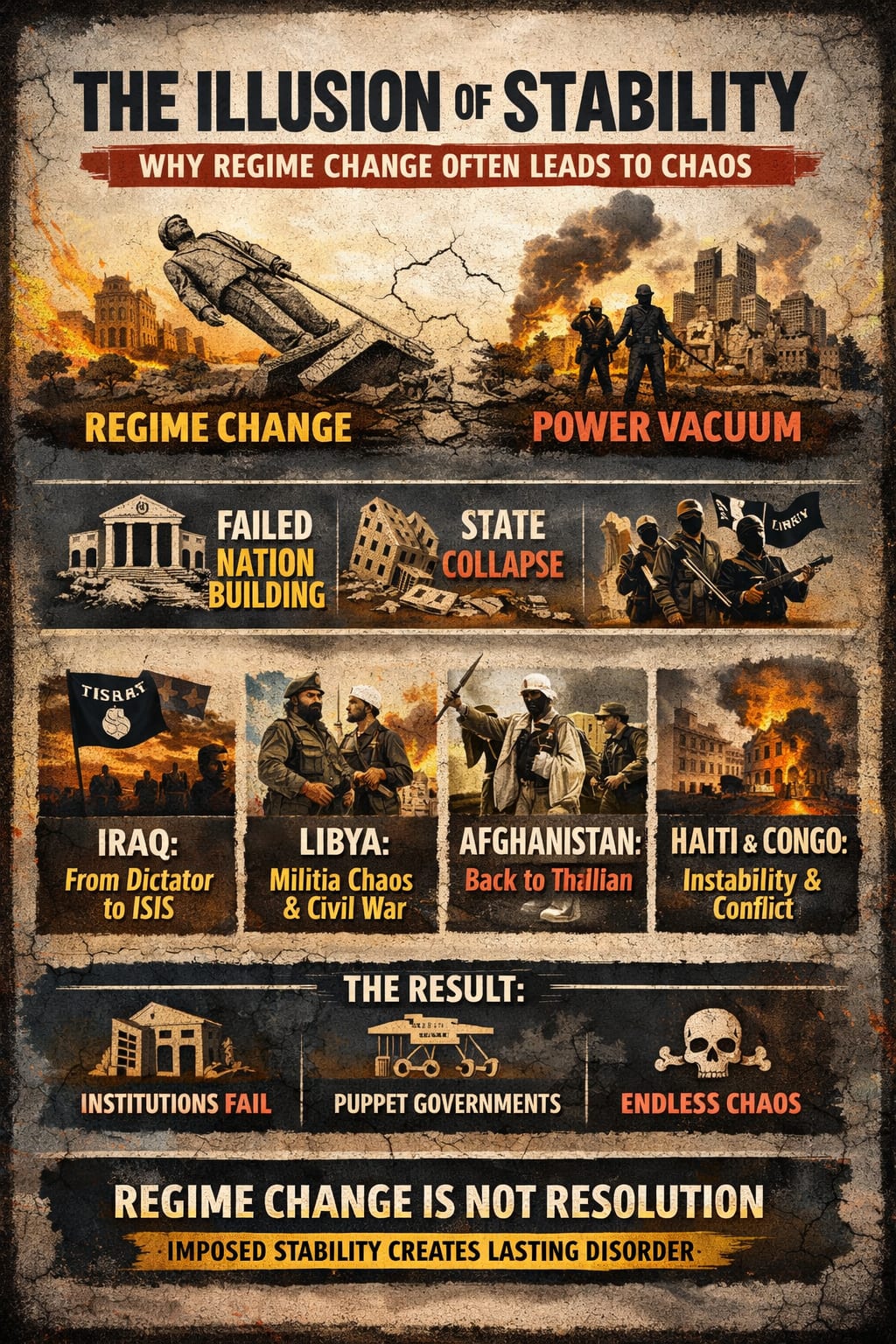
For decades, the United States has justified its foreign interventions under the banner of promoting democracy and stability. The underlying assumption behind many of these actions is simple: remove an authoritarian leader, and a more stable, democratic, and cooperative system will naturally emerge. However, history tells a far more complicated—and often troubling—story.
The idea that leadership removal automatically results in stability is deeply flawed. In reality, the collapse of a regime frequently triggers a chain reaction of instability, institutional breakdown, and long-term conflict. The notion of externally driven “nation-building” has repeatedly proven to be far more difficult than policymakers anticipate.
Take Iraq as one of the most prominent examples. After the removal of Saddam Hussein in 2003, the expectation was that democracy would flourish. Instead, the country experienced the collapse of state institutions, widespread sectarian violence, and the emergence of insurgent groups. The rise of ISIS further demonstrated how power vacuums can be exploited by extremist organizations. Rather than stability, Iraq became a symbol of prolonged chaos and fragmentation.
Libya presents a similar pattern. Following the overthrow of Muammar Gaddafi in 2011, the centralized authority that once held the country together disintegrated. In its place emerged competing militias, rival governments, and ongoing civil conflict. More than a decade later, Libya still struggles to achieve political unity and stability. The intervention removed a dictator, but it did not create a functioning state.
Afghanistan offers perhaps the most sobering lesson. After nearly twenty years of military presence and extensive nation-building efforts, the United States withdrew, and the Taliban swiftly regained control. Despite vast investments in institutions, governance, and security forces, the system proved unsustainable without external support. This outcome highlights a critical reality: institutions imposed or heavily supported from the outside often lack deep-rooted legitimacy within local populations.
The pattern is not limited to these cases. In countries like Haiti and Congo, external involvement and attempts to reshape governance structures have frequently resulted in prolonged instability rather than lasting peace. Weak institutions, political fragmentation, and external interference have created cycles of disorder that are difficult to break.
Even in cases where democratic processes were introduced, such as in the Philippines, the results have been mixed. Elections may take place, but real power often remains concentrated among entrenched elites and political dynasties. This raises an important question: can democracy truly take root without addressing underlying social and power structures?
At the heart of the issue lies the concept of legitimacy. Governments that are perceived as externally imposed or lacking genuine local support struggle to maintain authority. Without legitimacy, institutions fail to function effectively, and citizens may turn to alternative sources of power, including militias or insurgent groups. This creates a dangerous cycle in which instability feeds further instability.
Another critical factor is the destruction or weakening of state institutions during regime change. When bureaucracies, security forces, and governance systems collapse, rebuilding them is an enormous challenge. These institutions cannot simply be replaced overnight, nor can they be easily engineered from outside. They require time, trust, and local ownership to develop.
It is also important to consider the unintended consequences of intervention. Policymakers may aim for stability and democracy, but the reality on the ground often diverges from these goals. Power vacuums, regional rivalries, and internal divisions can transform a country into a battleground for competing interests. In such environments, achieving lasting peace becomes extremely difficult.
This is not to say that all interventions are doomed to fail. There are cases where regime change has not resulted in total collapse, and where some degree of stability has been maintained. However, these cases tend to involve specific conditions, such as stronger pre-existing institutions or more cohesive societies.
Ultimately, the belief that regime change is a quick solution to complex political problems is misguided. Stability cannot be imposed from the outside, nor can it be achieved simply by removing a leader. Nation-building is a deeply internal process that depends on local dynamics, historical context, and societal structures.
The lesson from history is clear: regime change is not a guaranteed path to resolution. More often than not, it introduces new challenges and uncertainties. Without careful consideration of local realities and long-term consequences, such actions risk creating exactly the kind of chaos they are meant to prevent.
In the end, true stability comes not from external intervention, but from within—through legitimate institutions, inclusive governance, and the gradual development of political systems that reflect the will of the people.
About the Creator
Ibrahim Shah
I am an Assistant Professor with a strong commitment to teaching,and academic service. My work focuses on fostering critical thinking, encouraging interdisciplinary learning, and supporting student development.
Keep reading
More stories from Ibrahim Shah and writers in The Swamp and other communities.
The decline of the West and the rise of ‘the Rest’ will lead to a new world order
As Donald Trump rampages through the global economic system with his tariff war and throws the United States’ commitment to NATO into serious doubt, fears – even panic – are mounting about the collapse of world order. Part of the anxiety stems from how suddenly these changes appear to have unfolded. In the aftermath of the 2008 global economic crisis, what was often described as the US-led liberal international order seemed alive and well, though not without challenges.
By Ibrahim Shah 2 days ago in The Swamp
The Forsyth House Fire
Since 1851, Forsyth House has stood on the corner of Union Street and Gordon Street in the heart of Glasgow. Its iconic, or was... because on Sunday 8th of March, 2026, a fire broke out in a small, seemingly un-named shop in the building and tore all that history down. As I write, the rubble is still unsettled and the street is still blocked off. Central Station is quiet on the upper level, and around 30 small businesses have quite literally gone up in smoke.
By S. A. Crawford4 days ago in The Swamp
Microsoft's Purposeful Marketing Deception About AI's Ability To Beat Physicians In Diagnosis
When you look at the world of scientific research... If you are not careful... You will be fooled into believing things that are not actually supported by the data.
By Dr. Cody Dakota Wooten, DFM, DHM, DAS (hc)2 days ago in Longevity



Comments
There are no comments for this story
Be the first to respond and start the conversation.