Latest Stories
Most recently published stories on Vocal.
Silence
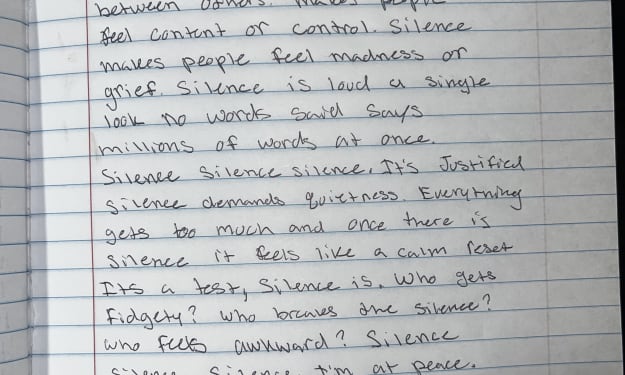
Silence silence silence. What some people think of it differs between others. Makes people feel content or in control. Silence makes people feel madness or grief. Silence is loud a single look no words says millions of words at once. Silence silence silence it’s justified. Silence demands quietness. Everything gets too much and once there is silence it feels like a calm reset. It’s a test silence is. Who gets fidgety? Who breaks the silence? Who feels awkward? Silence silence silence I’m at peace.
By Sarah Clark24 days ago in Poets
The Queue That Never Ends. AI-Generated.
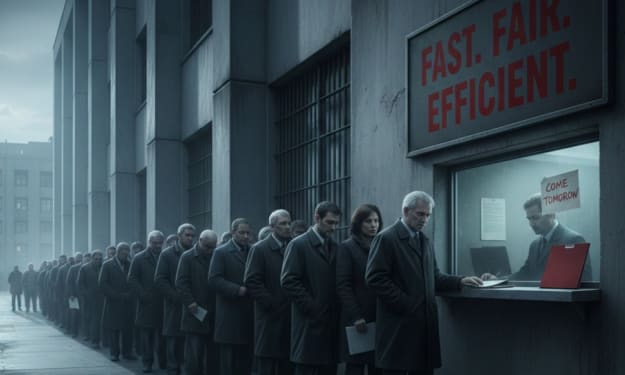
The line began before sunrise. By six in the morning, hundreds of people were already standing outside the gray concrete building. Some carried files wrapped carefully in plastic. Others held envelopes close to their chests, protecting them from dust, sweat, and the possibility of losing their only proof that their problem existed. At the front gate, a metal board read: Citizen Service Center — Fast, Fair, Efficient. Inside, only one window was open. Ahmed had arrived at 4:30 a.m. He was a schoolteacher. His problem was simple: his salary had been stopped for three months because the system showed him as inactive. Inactive. He taught five classes every day. His students still stood when he entered the classroom. They still asked him questions. They still called him sir. But the system did not recognize him. So he stood in the line. At 9:15 a.m., the gate opened. A guard stepped out and shouted, “Only the first fifty today!” The line broke instantly. Order turned into movement, movement into pushing. Files slipped from hands. Papers scattered across the ground. Voices rose in protest, then faded into tired silence. Ahmed checked his number. 73. The gate closed. “Come tomorrow,” the guard said without looking at anyone. “But we’ve been here since morning,” an elderly man pleaded. “Tomorrow,” the guard repeated. Ahmed came again the next day. And the day after that. On the fourth day, he finally reached the window. The clerk didn’t look up. “Form?” Ahmed handed over his application. “Wrong format.” “But this is the form from your website.” “Updated last week.” “Where can I get the new one?” “Counter 6.” Counter 6 was closed. By the time Ahmed found the correct form from a photocopy shop outside, the office was closing. “Come tomorrow,” the clerk said. Tomorrow had become a system. Weeks passed. His savings disappeared slowly — first the extra things, then the necessary ones. At home, he stopped turning on unnecessary lights. He postponed buying groceries until the last possible day. At school, nothing changed. He still explained lessons with patience. He still encouraged weak students. He still smiled. Only at night did he sit quietly, calculating how long he could continue like this. Still, the system showed him as inactive. One morning, while waiting in the line again, Ahmed began noticing the faces around him. A woman applying for her husband’s death certificate — rejected twice because one letter in the name didn’t match. A young graduate trying to correct his date of birth so he could apply for a job. An old pensioner who had traveled four hours just to prove he was still alive. The system had a different problem for each of them. But the solution was always the same. Wait. Return. Come tomorrow. Then Ahmed saw something strange. A man walked past the entire queue and went straight inside. No form. No waiting. Ten minutes later, he came out smiling. “Work done?” someone asked. “Yes,” the man replied casually. “I know someone inside.” The line grew quiet. No one reacted. Everyone understood. The next day, a man approached Ahmed. “You’ve been coming for many days,” he said softly. Ahmed nodded. “For a small service fee, your file can move faster.” “How fast?” Ahmed asked. “Today.” Ahmed looked at the building. At the closed counters. At the board that promised Fast, Fair, Efficient. “How much?” The amount equaled one week of the salary he hadn’t received. Ahmed hesitated. Then he paid. His case was resolved within hours. The system now showed him as active. Three months of salary were approved. Everything worked perfectly. The next morning, Ahmed returned to school. He stood before his students and began the lesson. “Today,” he said, writing on the board, “we will discuss honesty and fairness in society.” The chalk stopped. For a moment, he didn’t know how to continue. That evening, Ahmed passed the Service Center again. The line was still there. Long. Silent. Patient. A new banner had been installed outside: Digital Transformation Initiative — Making Services Faster Than Ever. Inside, only one window was open. And outside, tomorrow was already waiting.
By Sahar Rayyan24 days ago in Journal
The Impact of Insurance Contracts on Mental Health Business Valuation
Introduction The impact of insurance contracts on mental health business valuation is profound, shaping both perceived and intrinsic worth. Insurance agreements dictate the revenue potential, risk exposure, and operational agility of mental health practices. Without robust contracts, even thriving clinics may appear less valuable to potential investors or acquirers. Conversely, favorable terms can amplify valuation, making insurance arrangements a cornerstone of financial strategy in mental health enterprises. Understanding these intricacies requires dissecting how contractual elements intertwine with reimbursement dynamics, payer mix, and regulatory landscapes.
By Fida Hassain24 days ago in Journal
LIVING IN THE LIGHT OF THE SACRED HEART
LIVING IN THE LIGHT OF THE SACRED HEART New Release: Finding the Flow in the Sacred Heart Good morning or evening, depending on your location on planet Earth, everyone! After a bit of a whirlwind week, I found my way back to the water. Today’s release is a very personal collaboration between my original photography from the California and Texas coasts and new meditation music created with Suno and Vicki. Consulting Pro were Copilot and Gemini. Images received animation treatment in META.
By Vicki Lawana Trusselli 24 days ago in Poets
Training and Development in Partial Hospitalization Programming Staffing Plans
Understanding Partial Hospitalization Programs Partial Hospitalization Programs (PHPs) serve as an intermediary level of care, bridging the gap between inpatient hospitalization and traditional outpatient treatment. These programs cater to individuals with acute psychiatric, behavioral, or substance use disorders, providing intensive therapy while allowing patients to maintain some degree of daily life independence. The efficacy of PHPs hinges on the cohesive functioning of multidisciplinary teams, encompassing psychiatrists, therapists, nurses, and case managers. An intricate understanding of patient needs and program objectives is paramount for staff, emphasizing the delicate balance between clinical intensity and supportive structure.
By Fida Hassain24 days ago in Journal
What Are "Jungle Bubbles"?
Transparent dome accommodation units are used in northern Thailand to allow overnight stays within a forest environment. These structures provide enclosed shelter while keeping full visual access to the surrounding landscape through clear exterior walls. The accommodation operates within a managed land area rather than an open or unrestricted wilderness. This article explains what these dome units are, how they are built, how they operate, and how they relate to the surrounding environment.
By ameliarosanna24 days ago in Viva
Mercury Retrograde: Are the effects real or imagined?
Do the heavens affect the earth? If planet alignments don't affect the atmosphere, why do people report that Mercury Retrograde wreaks havoc? I've shared my family's experiences in other writings and will share them again here.
By Cheryl E Preston24 days ago in FYI