book review
Books reviews on workplace, corporate, and business driven books.
Busy, busy, busy
Busy week! But Monday and Tuesday were quite chill it was only around Wednesday that things got busy. On Wednesday my wife came up to do some studying and we filled out some application forms so that she can come take classes at the university next semester.
By Max Brooks6 days ago in Journal
The Cost of Global Hegemony: An Analytical Study of Human Costs Since 1492. AI-Generated.
The story began in 1499 when an Italian explorer set foot on the continent that we now call America. This so-called discovery proved to be a great human tragedy for the original inhabitants, as the ruthlessness with which indigenous civilizations were wiped out in the struggle for resources is a sad chapter in history. The foundation of the American continent was laid on the desecration of innocent people who were targeted simply because they were an obstacle to the economic goals of the colonial powers. During various periods of European colonialism, millions of indigenous people living there were eliminated through forced evictions and systematic operations in order to lay the foundation for a new state. When independence was declared in 1776, its benefits were limited to a select few, while for the indigenous population and the millions of people who were forcibly brought in, these chains became even tighter. The policies adopted by the American state to expand its borders wiped out every nation and civilization in its path. From the beginning of the twentieth century, this state began to go beyond its borders and intervene from the Philippines to Cuba, the sole purpose of which was to protect its economic interests. At the end of World War II, when the world was looking for peace, the nuclear attacks on Hiroshima and Nagasaki proved that any human limit can be crossed in the pursuit of power. This was the turning point from which this state established its role on the global stage, which plunged the world into the fire of constant conflict. In the name of the Cold War, the entire world was divided and dozens of countries were turned into laboratories. More than three million human lives were lost in the Korean War, while the operations that continued for fifteen years in Vietnam not only targeted humans but also devastated the land there with toxic chemicals. Behind all these measures lies the interest of the arms manufacturing industries, which can only thrive in the event of confrontation. This is why, in the last eight decades, there has hardly been a year when this state has not been directly or indirectly engaging in some kind of adventure in some region. These attacks have always been presented in the attractive words of “democracy and freedom” to appease the global conscience, but now it is time to bring the facts to the world that this system itself has become the biggest challenge to world peace.
By Malik Sarfraz Hussain Awan9 days ago in Journal
Author’s Advice. Top Story - March 2026.
If you would’ve asked me 20 years ago did I know I’d become a writer and an author, I would’ve said “nope, ain’t happening”. As fate would have it I did become an author and I can honestly say I’m loving it so far. It really does feel good to be a writer. I’ve learned a lot on this journey and I feel like with even me being as new to this world as I am, there’s some wisdom I need to share with every other aspiring author.
By Joe Patterson17 days ago in Journal
The Empty Locker
I didn’t know his name at first. I only knew the silence. It was a Tuesday in October. The high school hallway buzzed with its usual chaos—backpacks slamming, laughter echoing, sneakers squeaking on linoleum. But one locker stayed shut. No one leaned against it. No one dropped off homework. Just a quiet space where a boy should have been.
By KAMRAN AHMAD27 days ago in Journal
The Suitcase in the Hallway
I didn’t pack lightly. The suitcase sat by the door for three days—half-full, then overflowing, then emptied again. I kept adding things I thought I’d need: my favorite coffee mug, the photo from last summer, the sweater that still smelled like home. Then I’d take them out, convinced they were too heavy, too sentimental, too much.
By KAMRAN AHMAD27 days ago in Journal
The Couple We All Watched Grow Up
I didn’t know them. But I felt like I did. For over a decade, they were part of my life—not as celebrities, but as characters in a story I watched unfold in real time. I saw them at seventeen, awkward and bright-eyed on red carpets, fumbling through interviews, hiding smiles behind their hands. I saw them navigate fame, heartbreak, and the slow, steady work of becoming adults—all while the world watched, judged, and claimed ownership of their journey.
By KAMRAN AHMAD27 days ago in Journal
The Ambies, Imperfectly: A Night of Good Intentions and Unfortunate Surprises
Originally published on Recognized.fm Awards shows do not fail because of a single bad decision. They fail because of accumulated ones. The 2026 Ambies, presented by the Podcast Academy, arrived carrying weight that had been building long before a single winner was announced, and a historic winter storm ensured that more people than ever were watching when that weight came due.
By recognized.fm28 days ago in Journal
The Numbers Behind the Name: Echos News ZA
Got myself into blogging, again. So I dusted my desk, laptop in front of me, cup of fresh tea. I searched for my blog account which had been sitting there for years — blank. Instead of writing a blog like everyone else, a News Hub idea came to me, and it sounded nice. Suddenly, a name appeared: ECHOS.
By Vongani Bandi30 days ago in Journal
China Naked Official
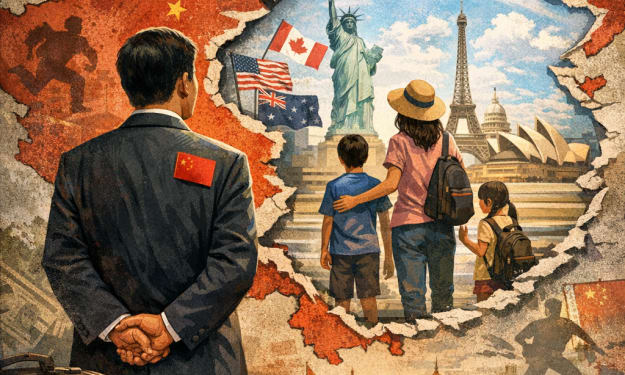
China’s “Naked Officials”: Power, Corruption, and Capital Flight In Chinese political discourse, the term “naked official” (裸官, luǒ guān) refers to a government official whose spouse and/or children have emigrated abroad while the official remains in China holding public office. The phrase does not imply literal nudity; rather, it suggests that the official is “exposed” — politically vulnerable and potentially more prone to corruption — because their immediate family and often their assets are based overseas.
By Ibrahim Shah about a month ago in Journal