Modern
Princess Yoshiko Kawashima
A Princess Caught Between Worlds Yoshiko Kawashima in her high school days (Wikipedia) Princess Yoshiko Kawashima, born Aisin Gioro Xianyu in 1907, was never destined for an ordinary life. As a descendant of the Manchu Qing Dynasty’s imperial family, she had royal blood running through her veins, but after the dynasty fell in 1912, she was sent to Japan and raised by Naniwa Kawashima, a nationalist with his own ambitions. Stripped from her homeland, she grew up navigating a strange, shifting identity — was she Manchu? Was she Japanese? Or was she simply a survivor?
By J.B. Millerabout 2 hours ago in History
The Olmec Heads
In the Mexican jungle stand seventeen massive stone heads weighing up to 50 tons each, and their distinctly African facial features have sparked a controversy that challenges everything we think we know about pre-Columbian contact with the outside world.
By The Curious Writerabout 4 hours ago in History
The Stone Spheres of Costa Rica
Hidden in the Costa Rican jungle are hundreds of perfectly round stone spheres, some weighing 16 tons, carved with such precision that they're spherical to within centimeters, created by a culture that had no written language and left no record of why they made them.
By The Curious Writerabout 4 hours ago in History
The Nazca Lines Paradox
In the Peruvian desert lie thousands of geometric shapes and massive animal drawings that can only be fully seen from aircraft, created by people who supposedly never developed flight, and nobody knows why they spent centuries making art they could never view.
By The Curious Writerabout 4 hours ago in History
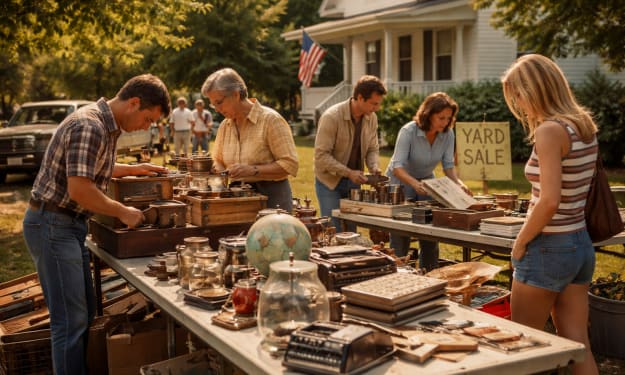
The Great American Treasure Hunt: Yard Sales, Estate Sales, and Flea Markets
On any given Saturday morning across America, if you drive slowly enough through the right neighborhood, you’ll eventually see one. A crooked cardboard sign taped to a telephone pole.
By The Iron Lighthouseabout 5 hours ago in History
The Years 1900 to 1910 Unveiled: Fascinating Facts, Trivia, and Historic Events
This quick read is a collection of fun facts, trivia, and historic events from the years 1900 to 1910. Discover the decade’s top news stories, most influential people, sports facts, grocery prices, entertainment trivia, famous birthdays and deaths, and much more.
By Gregory DeVictorabout 14 hours ago in History
Nuclear Shock: Iran Tests a Bomb
Nuclear Shock: Iran Tests a Bomb The Middle East has entered a new and dangerous phase of geopolitical tension. Reports and speculation about nuclear capabilities in Iran have intensified fears across the globe. As conflict escalates between Iran, Israel, and the United States, the possibility of nuclear weapons development has become a central concern for international leaders and security analysts.
By Wings of Time a day ago in History
Ancient Super Weapons That Changed Warfare Forever
Throughout recorded history, warfare has shaped civilizations. Long before drones, missiles, and cyber warfare, ancient societies were already engineering terrifying and brilliant machines designed to dominate the battlefield.
By Areeba Umaira day ago in History
semen Veritatis:. AI-Generated.
In a world increasingly driven by personal choices and societal interactions, the essence of responsibility often boils down to one fundamental principle: our actions define our accountability. Whether in our personal lives, professional endeavors, or community involvement, the decisions we make and the behaviors we exhibit have far-reaching consequences. This article explores the profound connection between actions and responsibility, highlighting how the choices we make shape not only our own lives but also the lives of others around us. By understanding this relationship, we can cultivate a greater sense of accountability and intentionally navigate the complexities of our responsibilities.
By Alain juniora day ago in History
Jerusalem’s Most Sensitive Sacred Site: Why the Future of Al-Aqsa Mosque Matters to the Entire World
Across the long and complicated story of human civilization, certain places acquire a meaning that goes far beyond their physical structure. They become symbols of identity, spirituality, and collective memory for millions of people. One of the most powerful examples of such a place is Al-Aqsa Mosque. Located in the ancient city of Jerusalem, Al-Aqsa Mosque is one of the most historically and religiously significant sites in the world. For Muslims, it is the third holiest place in Islam, after the sacred mosques in Mecca and Medina. Yet the importance of this location extends far beyond a single faith community. The wider Jerusalem area contains sacred sites for Muslims, Christians, and Jews, making it one of the most spiritually complex places on the planet. Because of this unique significance, any discussion about the future of Al-Aqsa Mosque often sparks global attention. Understanding why this site matters so deeply requires looking at history, religion, geopolitics, and the emotional connections that billions of people have with the city of Jerusalem. The Religious Importance of Al-Aqsa Mosque For Muslims, Al-Aqsa Mosque is not simply an architectural landmark. It represents centuries of spiritual tradition and religious devotion. According to Islamic tradition, the mosque is connected to the event known as Al-Isra wal-Mi’raj, the miraculous night journey of Prophet Muhammad ﷺ. During this event, it is believed that the Prophet traveled from Mecca to Jerusalem before ascending to the heavens. Because of this spiritual connection, the mosque holds a special place in the hearts of Muslims around the world. The mosque stands within a larger sacred compound known as Al-Haram Al-Sharif, which contains several historic structures, courtyards, and prayer areas. This entire complex is considered a sacred site within Islam and has been a place of worship for centuries.
By The Insight Ledger 2 days ago in History