
IoT Testing Market Overview: Digital Transformation & Forecast to 2033
How rapid IoT adoption, cloud integration, and automation technologies are reshaping quality assurance strategies across industries in the IoT testing market

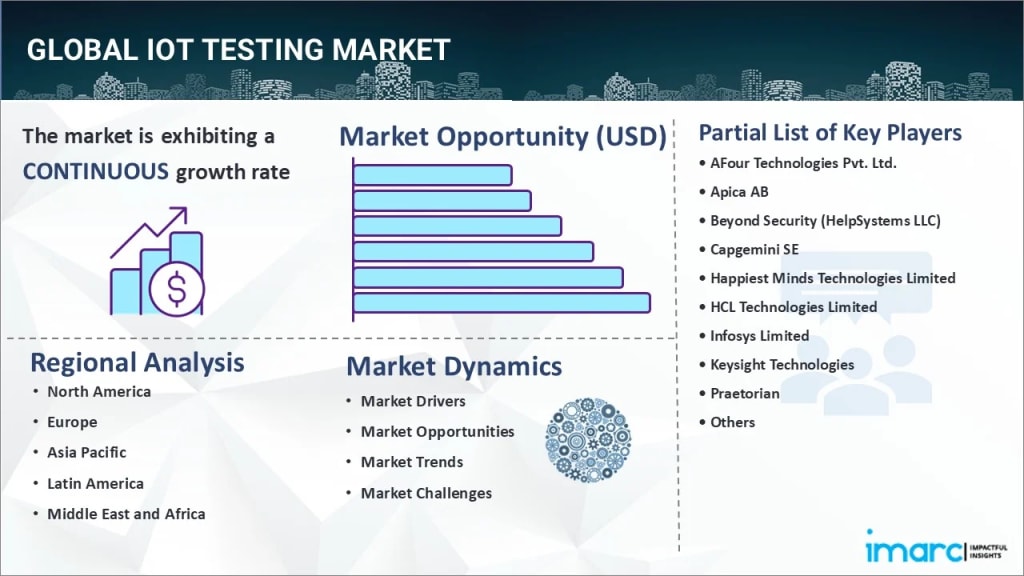
IMARC Group, one of the world's leading market research and consulting firms, has released its latest report on the global IoT Testing Market. The report provides a comprehensive assessment of market dynamics, growth drivers, key segments, competitive landscape, and strategic developments shaping the industry.
According to IMARC Group's latest research, the global IoT testing market size reached USD 3.8 Billion in 2024. Looking forward, the market is expected to reach USD 42.2 Billion by 2033, exhibiting a growth rate (CAGR) of 29.29% during 2025–2033. The growing digitization of business operations and processes, increasing concerns about cybersecurity breaches, and rising focus on early defect detection are some of the major factors propelling the market.
The IoT testing market is undergoing rapid transformation as businesses across virtually every sector rush to deploy connected device ecosystems. From smart factories and healthcare wearables to autonomous vehicles and energy grids, the sheer volume and variety of IoT deployments are making rigorous testing not just a technical formality — but a business-critical necessity. With billions of connected endpoints now operating across enterprise and consumer environments, a single performance or security failure can cascade into significant operational and financial damage.
IoT Testing Market — Key Segment Overview
IMARC Group's report categorizes the global IoT testing market across the following dimensions:
Testing Type: Functional Testing, Performance Testing, Network Testing, Compatibility Testing, Usability Testing, Security Testing
Service Type: Managed Services, Professional Services
Deployment Mode: On-premises, Cloud-based
Application: Smart Building and Home Automation, Capillary Network Management, Smart Utilities, Vehicle Telematics, Smart Manufacturing, Smart Healthcare
Network testing currently holds the largest share among testing types, reflecting the critical importance of validating communication protocols, bandwidth, latency, and data integrity across increasingly complex IoT ecosystems. North America leads the global market, accounting for over 38% of total revenue, driven by high enterprise IoT adoption, stringent data security regulations, and significant investment in smart infrastructure.
IoT Testing Market Growth Drivers:
Growing Digitization of Business Operations Businesses are embedding IoT technologies at an accelerating pace to automate workflows, reduce downtime, and gain real-time operational insights. According to industry data, global enterprise IoT spending has crossed USD 500 billion annually, making quality assurance frameworks a core investment priority. As interconnected device ecosystems grow in complexity — spanning sensors, gateways, and cloud platforms — the demand for continuous, comprehensive IoT testing has never been stronger. Organizations that skip rigorous testing risk costly post-deployment failures that far outweigh upfront validation costs.
Rising Cybersecurity Concerns and Regulatory Pressure IoT security vulnerabilities are attracting serious regulatory attention worldwide. The European Union's Radio Equipment Directive, effective August 2025, now mandates cybersecurity conformance testing for all internet-connected products entering the EU market. In the US, NIST's IoT cybersecurity framework provides guidance that is increasingly being referenced in federal procurement. These compliance requirements are pushing organizations to invest in dedicated security testing capabilities, including penetration testing, vulnerability assessments, and encryption protocol validation — fueling sustained demand across managed and professional service segments.
Focus on Early Defect Detection to Control Costs Catching device defects early is dramatically cheaper than fixing them post-deployment. Studies in software engineering consistently show that bugs found in development cost 5–15x less to fix than those discovered in production. For IoT deployments — where hardware recalls or firmware rollbacks can affect thousands of field devices — the financial stakes are even higher. This is driving manufacturers and enterprises alike to integrate automated testing pipelines and shift-left quality frameworks, generating strong tailwinds for both functional and performance testing service providers.
IoT Testing Market Trends:
Rising Adoption of Edge Computing and 5G Validation The proliferation of edge computing deployments, supported by 5G infrastructure, is reshaping how IoT devices are tested. Edge environments demand sub-millisecond latency validation and decentralized testing architectures that traditional cloud-centric frameworks struggle to address. Hyundai and Samsung have already deployed private 5G RedCap production lines requiring sub-10 millisecond latency verification. China alone reported over 2.5 billion active IoT terminals, underscoring how testing matrix complexity is scaling exponentially as protocol diversity — from Zigbee to LoRaWAN to 5G RedCap — expands.
AI-Powered and Automated Testing Integration Leading testing vendors are embedding artificial intelligence and machine learning into their platforms to boost testing speed and defect detection accuracy. Keysight Technologies, one of the market's top players, reported USD 4.98 billion in FY2024 revenue, with its communications testing portfolio increasingly centered on AI-driven automation. Automated test equipment demand in IoT-adjacent sectors reached USD 3.1 billion in late 2025, reflecting strong market appetite for precision testing tools. AI-assisted testing is particularly valuable in smart home and automotive IoT segments, where device interactions are too complex for purely manual approaches.
Cloud-Based Testing Platforms Gaining Ground Cloud-based deployment is becoming the preferred model for IoT testing, particularly among enterprises managing geographically distributed device fleets. Cloud-native testing environments eliminate the need for costly physical test infrastructure, allow teams across time zones to collaborate in real time, and scale dynamically as device volumes grow. Providers are differentiating by offering on-demand access to simulated IoT environments, digital twin frameworks for pre-deployment validation, and post-production monitoring — as seen with Apica AB's acquisition of Logiq.ai, which expanded its offering beyond pure testing into live application performance management.
Recent News and Developments in the IoT Testing Market
July 2025: TestLabs Inc. launched an advanced IoT testing platform in Silicon Valley capable of real-time security and performance testing for connected devices. The platform was reported to improve device reliability metrics by 30%, addressing growing enterprise demand for faster and more dependable pre-launch validation.
June 2025: SmartEdge Technologies entered a strategic partnership with a New York-based smart home company to implement automated functional and network testing across its full IoT ecosystem, with complete deployment targeted for Q1 2026.
May 2025: NexaTest introduced a cloud-based IoT testing service tailored for automotive telematics devices, supporting compliance with safety standards and helping connected vehicle manufacturers reduce time-to-market for new releases.
January 2025: Samsara expanded its collaboration with Stellantis through Mobilisights, streamlining European fleet telematics integration and reinforcing IoT testing requirements across a large-scale connected vehicle program.
November 2024: Keysight Technologies reported FY2024 revenues of USD 4.98 billion, including USD 894 million generated from its communications testing solutions, reflecting strong institutional demand for AI-assisted IoT and 5G validation tools.
Note: If you require specific details, data, or insights that are not currently included in the scope of this report, we are happy to accommodate your request. As part of our customization service, we will gather and provide the additional information you need, tailored to your specific requirements. Please let us know your exact needs, and we will ensure the report is updated accordingly to meet your expectations.
About the Creator
Suhaira Yusuf
I specialize in Consumer Insights, focusing on transforming detailed market data into strategic business solutions that accelerate growth and improve customer engagement.
Keep reading
More stories from Suhaira Yusuf and writers in Futurism and other communities.
Managed Mobility Services Market Insights: Endpoint Security, Mobility & Forecast 2033
The global managed mobility services (MMS) market is experiencing rapid growth as organizations increasingly rely on mobile technologies to support distributed workforces. Businesses today operate across multiple locations, and employees frequently use both company-issued and personal devices to access corporate systems. This shift has created a strong demand for solutions that can securely manage mobile devices, applications, and data.
By Suhaira Yusuf5 days ago in Futurism
How machines can learn from human behaviour
In order to understand where we are and where we are going, we need to understand where we were first. - Susan Fourtane Could a human behaviour simulator be embedded into a robot or online avatar to the point that it’s hard to distinguish between a real person or artificial intelligence? Scientists have been upping the stakes in this “Turing test” for years, to the point that human-mimicking programmes are ready to answer tricky questions, assist people with online shopping or be companions.
By Susan Fourtané 10 days ago in Futurism
🤖 Digital God or Electronic Friend? Everything You Need to Know About AGI 🌐
As an AI enthusiast, I wake up almost every morning with a sense of pure excitement, checking the latest breakthroughs from labs like OpenAI, Google DeepMind, or Anthropic. We are living in an era where AI writes our emails, generates photorealistic images, and helps us code. 💻 But what we see today is just a teaser. The real revolution is hidden behind three letters: AGI. ⚡
By Piotr Nowak4 days ago in Futurism


Comments
There are no comments for this story
Be the first to respond and start the conversation.