
Managed Mobility Services Market Insights: Endpoint Security, Mobility & Forecast 2033
How rising cybersecurity concerns, endpoint management, and workforce mobility are transforming growth dynamics in the managed mobility services market

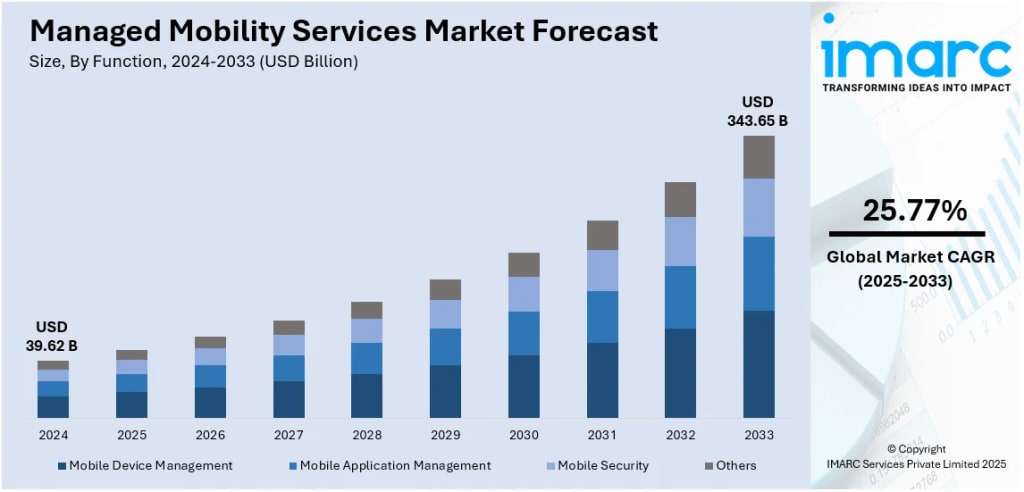
The global managed mobility services (MMS) market is experiencing rapid growth as organizations increasingly rely on mobile technologies to support distributed workforces. Businesses today operate across multiple locations, and employees frequently use both company-issued and personal devices to access corporate systems. This shift has created a strong demand for solutions that can securely manage mobile devices, applications, and data.
Industry analysis indicates that the managed mobility services market was valued at USD 39.62 billion in 2024 and is projected to reach USD 343.65 billion by 2033, expanding at a compound annual growth rate (CAGR) of 25.77% between 2025 and 2033. North America currently holds the largest share of the market due to advanced IT infrastructure, high adoption of enterprise mobility solutions, and strong focus on cybersecurity compliance.
Managed mobility services help organizations simplify mobile device administration by handling tasks such as device provisioning, application deployment, security monitoring, and compliance management. These services allow IT departments to focus on strategic priorities while ensuring that mobile operations remain secure and efficient.
Key Segments in the Managed Mobility Services Market
The market is segmented based on function, deployment model, organization size, and industry vertical.
By Function
- Mobile Device Management
- Mobile Application Management
- Mobile Security
- Others
By Deployment
- Cloud-based
- On-premises
By Organization Size
- Small and Medium-sized Enterprises
- Large Enterprises
By End-use Industry
- IT and Telecom
- BFSI
- Healthcare
- Manufacturing
- Retail
- Education
- Others
Among these categories, mobile device management (MDM) represents the largest share of the market. As businesses adopt bring-your-own-device (BYOD) policies and support remote employees, centralized management of connected devices has become essential. Large enterprises account for the majority of market demand due to the complexity of managing thousands of devices across global operations.
Key Growth Drivers of the Managed Mobility Services Market
Expansion of Hybrid and Remote Work
Hybrid work models have become a permanent feature of modern workplaces. Employees now access company systems from homes, offices, and shared workspaces, often using different types of mobile devices. This distributed environment requires centralized solutions that can manage devices, monitor usage, and enforce security policies across multiple locations.
Rising Cybersecurity Concerns
Mobile endpoints have become a major target for cyberattacks. As more employees rely on smartphones, tablets, and laptops for daily tasks, businesses must protect sensitive corporate data from unauthorized access. Managed mobility services provide security features such as encryption, remote device control, and threat monitoring to reduce cybersecurity risks.
Growing Demand for IT Outsourcing
Managing mobile devices internally can be complex and costly, especially for organizations operating across multiple regions. Many companies are choosing to outsource device lifecycle management to specialized service providers who can handle procurement, deployment, maintenance, and upgrades more efficiently.
Emerging Trends in the Managed Mobility Services Market
Artificial Intelligence in Mobility Management
Artificial intelligence is increasingly being integrated into mobility management platforms. AI tools help organizations predict device failures, automate troubleshooting processes, and detect unusual network activity. These capabilities reduce downtime and improve overall operational efficiency.
Adoption of eSIM Technology
The introduction of embedded SIM (eSIM) technology is simplifying device activation and connectivity management. Enterprises can now remotely provision devices without relying on physical SIM cards, making it easier to deploy mobile solutions across global teams.
Focus on Sustainable Device Lifecycle Management
Organizations are also paying greater attention to sustainability in their IT operations. Extending device lifecycles, implementing refurbishment programs, and reducing electronic waste have become important priorities. Managed mobility services providers are responding by offering lifecycle management solutions that support environmentally responsible practices.
Recent Developments in the Managed Mobility Services Industry
Several developments have highlighted the growing importance of mobility management solutions in recent years.
In November 2025, Stratix Corporation expanded its managed mobility capabilities through the acquisition of Mobility CG. The move strengthened its presence in the North American mobility management market.
In October 2025, Tata Communications partnered with BSNL to deploy eSIM services across India, enabling remote device provisioning and supporting enterprise mobility solutions in one of the world’s largest mobile markets.
In September 2025, the DeKalb County School District implemented a large-scale device management program covering more than 110,000 Chromebooks and laptops, highlighting the growing adoption of mobility management solutions in the education sector.
Another collaboration occurred in June 2025, when Targa Telematics partnered with Volvo Cars to develop connected mobility services using real-time vehicle data. These initiatives demonstrate how mobility management technologies are expanding beyond traditional enterprise IT environments.
Conclusion
The managed mobility services market is expected to witness significant expansion over the next decade as organizations continue to adopt mobile technologies and hybrid work models. Increasing cybersecurity threats, rising device complexity, and the need for efficient device lifecycle management are key factors driving market demand.
As businesses rely more heavily on mobile infrastructure, managed mobility services will play an essential role in ensuring secure, scalable, and efficient mobile operations across global enterprises.
About the Creator
Suhaira Yusuf
I specialize in Consumer Insights, focusing on transforming detailed market data into strategic business solutions that accelerate growth and improve customer engagement.
Keep reading
More stories from Suhaira Yusuf and writers in Futurism and other communities.
5G Chipset Market Overview: Next-Gen Networks & Forecast to 2033
5G Chipset Market The rapid expansion of high-speed connectivity, the explosive growth of smart devices, and rising demand for real-time data processing are transforming the global semiconductor landscape. According to IMARC Group’s latest research, the global 5G chipset market reached USD 7.9 Billion in 2024. Looking ahead, the market is expected to grow dramatically to USD 85.4 Billion by 2033, exhibiting a CAGR of 30.2% during 2025–2033. Asia Pacific currently dominates the market, supported by large-scale smartphone adoption, aggressive 5G infrastructure rollouts, and strong government investment in next-generation telecommunications networks.
By Suhaira Yusuf6 days ago in Futurism
How machines can learn from human behaviour
In order to understand where we are and where we are going, we need to understand where we were first. - Susan Fourtane Could a human behaviour simulator be embedded into a robot or online avatar to the point that it’s hard to distinguish between a real person or artificial intelligence? Scientists have been upping the stakes in this “Turing test” for years, to the point that human-mimicking programmes are ready to answer tricky questions, assist people with online shopping or be companions.
By Susan Fourtané 11 days ago in Futurism




Comments
There are no comments for this story
Be the first to respond and start the conversation.