pop culture
Pop culture has a place in the classroom; popular trends like hip hop help to foster interest and ignite conversations in education.
72% of Americans Rely on a Secondary Income
The idea of having a single job that comfortably supports your lifestyle used to be the norm in the United States. For decades, many Americans expected that a full-time job would cover housing, food, healthcare, savings, and even leisure. Today, however, that reality is changing.
By AnthonyBTV27 days ago in Education
Education Reform for the 21st Century. AI-Generated.
Friends, have you ever watched a bright teenager like Priya in Mumbai sit through another day of rote memorization, her eyes dimming as high-stakes exams sucked the joy out of learning? She once told me she loved science but felt trapped in a system built for another century. That moment hit me hard because Priya’s story echoes across continents. In our world of rapid AI growth, climate crises, and shifting job markets, education must evolve from industrial-era factories into vibrant spaces of discovery. Research from UNESCO, OECD’s PISA, and the World Economic Forum shows the gap is widening, yet reform offers real hope. Together, we can build systems that prepare every child for the skills of the 21st century.
By Arjun. S. Gaikwadabout a month ago in Education
Teachers vs. Society's Perception
Love them or Hate Them: Teachers are Important Members of the Community It was the late 1990s and the economy was good. Everybody had money in their pockets and felt no qualm about spending. I, on the hand, never had to pull out money at the local bar and grills. All I had to do was mention I was a public school teacher and nearly every patron was willing to buy me a drink.
By Dean Traylorabout a month ago in Education
What the System Forces You to Become
The Question the System Replaces By the time a person has passed through employment law, healthcare coverage rules, unemployment insurance, disability determination, and benefit eligibility, the relevant question has already shifted without ever being stated out loud. It is no longer whether the system helped or failed them. It is whether they managed to remain legible long enough to survive it. Each institutional layer imposes requirements that appear reasonable when viewed in isolation, yet become coercive when experienced sequentially:
By Peter Thwing - Host of the FST Podcastabout a month ago in Education
The Protection-of-Innocence Reciprocity Doctrine. AI-Generated.
Core Moral Premise The highest duty of any legitimate social order is the protection of innocent life. Innocent life has absolute moral primacy. Any system that systematically insulates predators, tolerates predatory asymmetry, rewards hypocrisy, or allows aggressors to retain insulation has inverted its purpose and forfeited legitimacy. Truth, justice, reciprocity, humility, mercy, forgiveness, and vertical accountability are structural necessities rather than optional virtues. Vertical accountability means recognition of and submission to a moral law higher than oneself. Authority must flow toward those who most consistently demonstrate sustained competence in moral and epistemic discipline. This competence is shown through observable conduct and trajectory over time, not through doctrinal label, tribal identity, credential alone, or self-profession.
By Peter Thwing - Host of the FST Podcastabout a month ago in Education
Lewis Temple
In the bustling port city of New Bedford, Massachusetts, where the salty air mixed with the clang of metal and the shouts of sailors preparing for months-long voyages, stood a man whose name would one day be etched into maritime history—though not nearly as widely as it deserved. Lewis Temple, born in 1800, was not a sea captain, nor a harpooner, nor a weathered whaleman hardened by years on open waters. He was a blacksmith—self‑taught, sharp‑minded, and extraordinarily skilled with iron. Yet it would be this man, working far from the decks of whaling ships, who would reshape an entire global industry.
By TREYTON SCOTT2 months ago in Education
Samuel Scottron
By TREYTON SCOTT In the long arc of American innovation, many names shine brightly—Edison, Bell, Carver. Yet among them stands a remarkable inventor who has not always received the recognition he deserves. Samuel Raymond Scottron (1843–1905), the brilliant mind behind the dual‑adjustable barbershop mirror, revolutionized not only personal grooming but also the everyday household products we often take for granted.
By TREYTON SCOTT2 months ago in Education
GK: Why Is India Called A Sub-Continent?. AI-Generated.
The term sub-continent is often used to describe India, but have you ever wondered what it truly means and why India alone carries this distinction? Unlike most countries that are simply part of a continent, India is recognized as a sub-continent because of its vast size, distinct geography, rich history, and cultural diversity that sets it apart from the rest of Asia.
By Sajida Sikandar2 months ago in Education
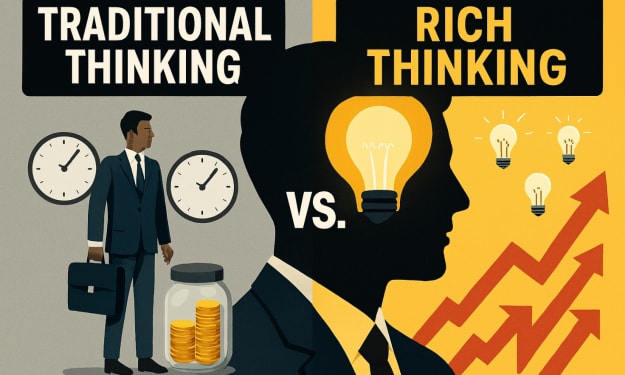
The Power of Perspective: Rich Thinking vsTraditional Thinking
The Power of Perspective: Rich Thinking vs. Traditional Thinking Success in life is often less about external circumstances and more about the mindset we adopt. Two dominant approaches to thinking—rich thinking and traditional thinking—illustrate how perspective shapes opportunities, decisions, and ultimately, outcomes. While traditional thinking emphasizes stability, caution, and conformity, rich thinking thrives on vision, risk-taking, and innovation. Understanding the differences between these two mental frameworks provides valuable insight into why some individuals achieve extraordinary success while others remain confined to predictable paths.
By Alhouci boumizzi2 months ago in Education