Francis Dami
Bio
Stories (408)
Filter by community
In extremely deep ocean conditions, a new species of octopus was found.
Off the coast of Australia, a new deep-sea octopus with massive eyes and a pancake-flat body was discovered. The Carnarvon flapjack octopus, or Opisthoteuthis carnarvonensis, is a tiny aquatic animal that was found deep within the Carnarvon Canyon Aquatic Park.
By Francis Dami10 months ago in Petlife
Researchers pinpoint the time and place where the first people used whale bones to make tools and harpoons.
In the distant past, whale populations thrived, but they are now significantly reduced. Whales were utilized by early humans who lived near the water as a source of resources and sustenance. To kill more whales, they also used whale bones to construct equipment like harpoons.
By Francis Dami10 months ago in Futurism
Any type of cannabis use is directly associated with a high risk of heart disease.
It has long been argued that marijuana is a safer option than regular cigarettes. It is considered by some to be a safe stress reliever that poses fewer risks than tobacco products. That premise is called into question by evidence from a recent study. Senior author Matthew L. Springer, PhD, and first author Leila Mohammadi, MD, PhD, of the University of California, San Francisco, spearheaded the study.
By Francis Dami10 months ago in Longevity
Rocks show the moment when oxygen permanently altered the planet.
Two basic issues are addressed by several events in Earth's distant past: How did we get here? And where are we going? These pivotal moments demonstrate how life adjusts to shifting environmental conditions.
By Francis Dami10 months ago in Earth
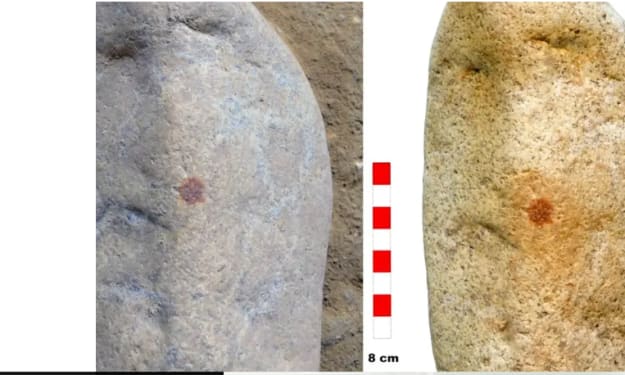
Perhaps the first concrete evidence that Neanderthals created art has been discovered by archaeologists.
Recently, archaeologists discovered a stone that seems to contain the earliest known complete human fingerprint. According to their research, it was created by Neanderthals, who would have shaped what appears to be an artistic representation of a facial figure from about 43,000 years ago using a red pigment on a rock.
By Francis Dami10 months ago in History
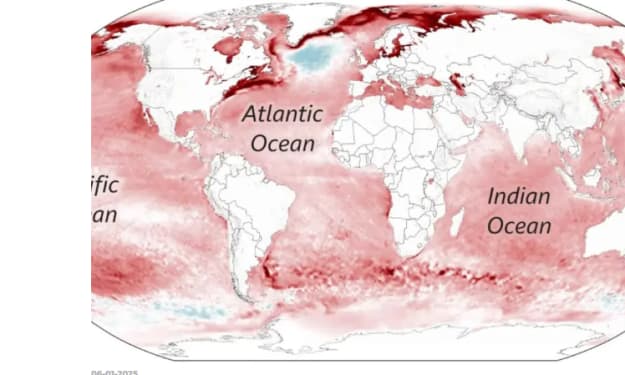
Two worldwide ocean bands are warming at historic rates, according to scientists.
More heat is being absorbed by the oceans than ever before. These seas have warmed at a never-before-seen rate, according to researchers, and this change has an impact on marine life and weather patterns. Researchers have compared worldwide measures from 2000 to 2023 to those from the early 2000s.
By Francis Dami10 months ago in History
Growing sea urchin populations are too much for coral reefs to withstand.
The majority of the spiny sea urchins have entered Hawaiian coral reefs and have set up these essential underwater ecosystems with a serious risk. Recent research has shown that coral reefs can erode faster due to increased marine organism imbalances than the reconstruction of the coral reef.
By Francis Dami10 months ago in Petlife
Loneliness associated with poverty creates actual mental and physical suffering.
In many parts of Europe, poverty and loneliness create unrelenting pain, both emotionally and physically. New research suggests that poverty is the primary reason why these conflicts persist.
By Francis Dami10 months ago in Earth
A crisis of child exploitation is being exacerbated by climate disasters.
Climate change is often observed by temperature charts, sea level increases, or increased Co₂ values. But behind these graphics, there are kids, especially in places like Kenya. This is the real consequence of the world of global warming.
By Francis Dami10 months ago in Earth
Lotion and perfume interfere with the body's natural air purification system.
The air around us is not empty. Wear molecules, gases, and invisible particles, and interact with everything, including us. Scientists have long known that people emit chemicals and react to the air around them. However, discoveries deepen this understanding. Applying perfumes and lotions can change your individual's airspace than is perceived.
By Francis Dami10 months ago in Blush
The unique skull of an extinct, enormous "thunderbird" has been discovered by archaeologists.
The Australian Outback once trembled beneath a ball. He was bigger than one person and five times heavier than Cassobary. For over a century, scientists have known these giants (called dromaeosaurus) only from scattered and often cut bones. The crushed skull that appeared in 1913 led to wild assumptions about what Zenonis Newton, the last of the string, looked, fed, and squealed. Now, the newly excavated skull bones have been transformed by blowing one from the dry bed of Lake Carabona.
By Francis Dami10 months ago in History