
The Myth Reassembled Through Abstraction
An anonymous painter revisits one of humanity’s oldest narratives without depicting it.
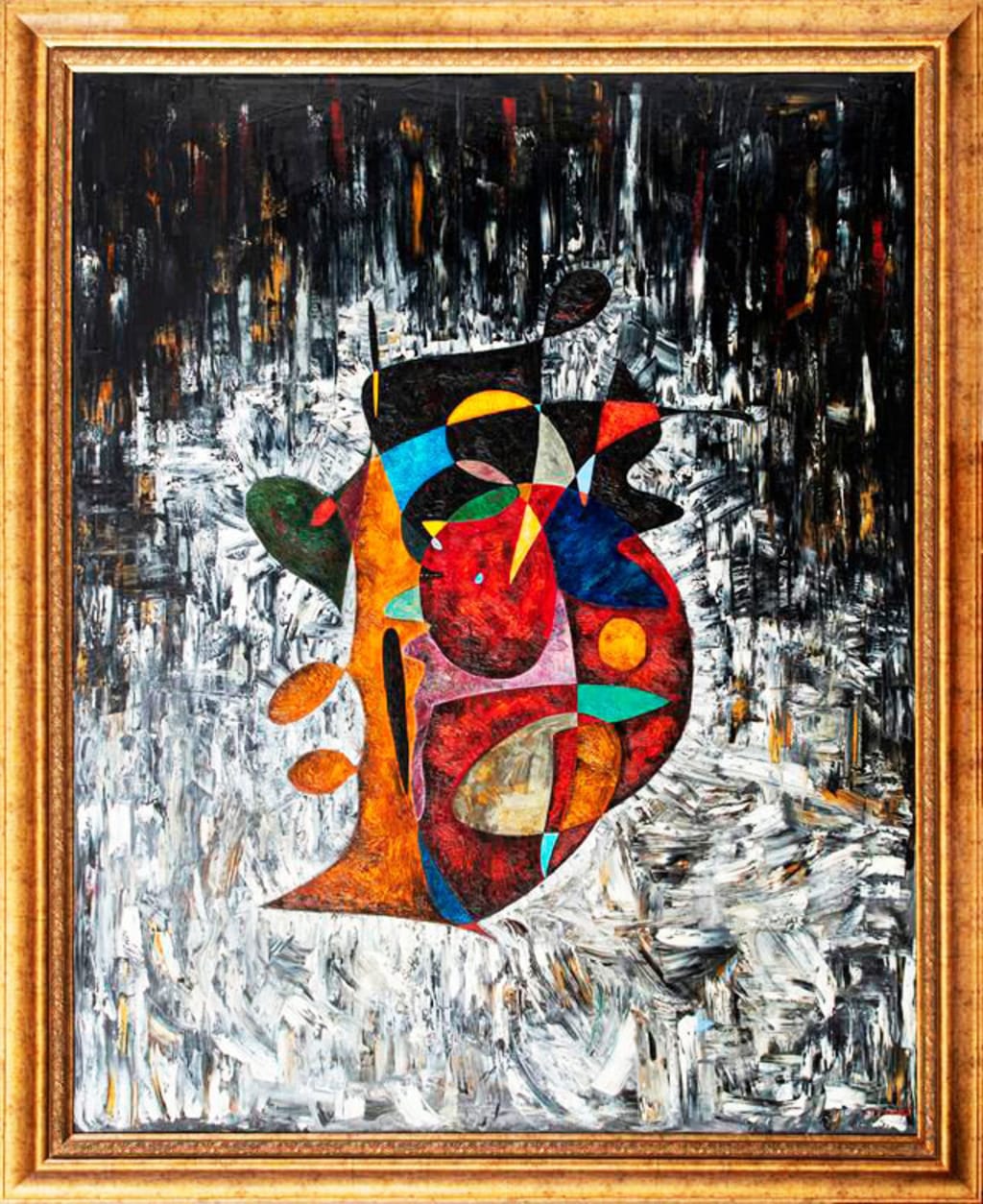
Few titles carry the historical weight of Adam and Eve. For centuries the subject has been approached through figuration—two bodies, a tree, a serpent, a garden. The narrative is visually familiar long before the painting begins.
In this large-scale canvas from 2017, an anonymous painter takes a different path.
There are no figures.
Instead, the painting unfolds as a dense field of motion surrounding a complex central structure of interlocking forms. Fragments of color—red, blue, orange, green—intersect within a biomorphic composition that feels assembled rather than drawn.
The story is not illustrated.
It is reconfigured.
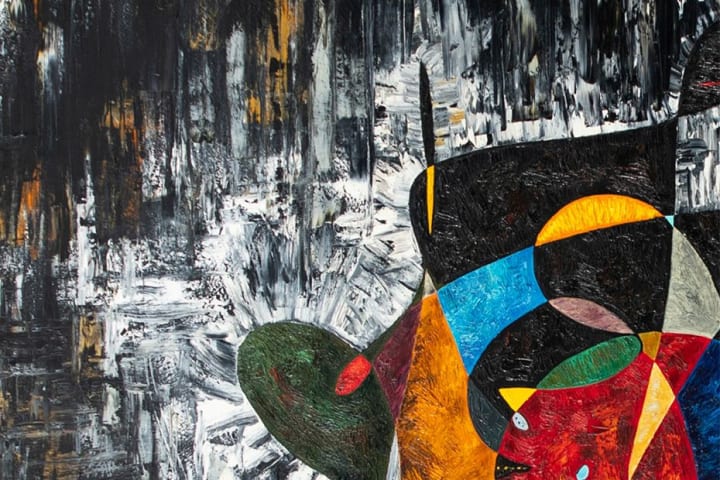
The background is dominated by vertical strokes of black and white paint that drip, scrape, and accumulate across the surface. The marks create a sense of downward movement, as if the space itself were collapsing or dissolving.
Against this turbulent environment, the central formation appears almost suspended. Curved planes and geometric fragments connect and overlap, producing a structure that seems both organic and architectural.
Two presences appear implied rather than depicted.
Forms divide and rejoin, echoing a sense of separation and union at the same time. The composition suggests relationship without identifying individuals.
Within this framework, the title becomes crucial.
By naming the work Adam and Eve, Anonymous Art introduces a narrative of origin, duality, and consequence. The painting then approaches that narrative through structure rather than image.
Instead of bodies, there are systems.
Instead of a garden, there is a field of instability.
The composition appears to hold opposing forces together—color against monochrome, curved shapes against fractured space, cohesion against fragmentation.
Little is publicly known about the artist responsible for the work. The paintings circulate without biographical explanation, leaving only their titles to anchor interpretation.
This absence reinforces the conceptual structure of the work itself.
The viewer encounters a familiar myth through unfamiliar means. The painting refuses to repeat the visual traditions associated with the story and instead reconstructs it as a network of tensions within the canvas.
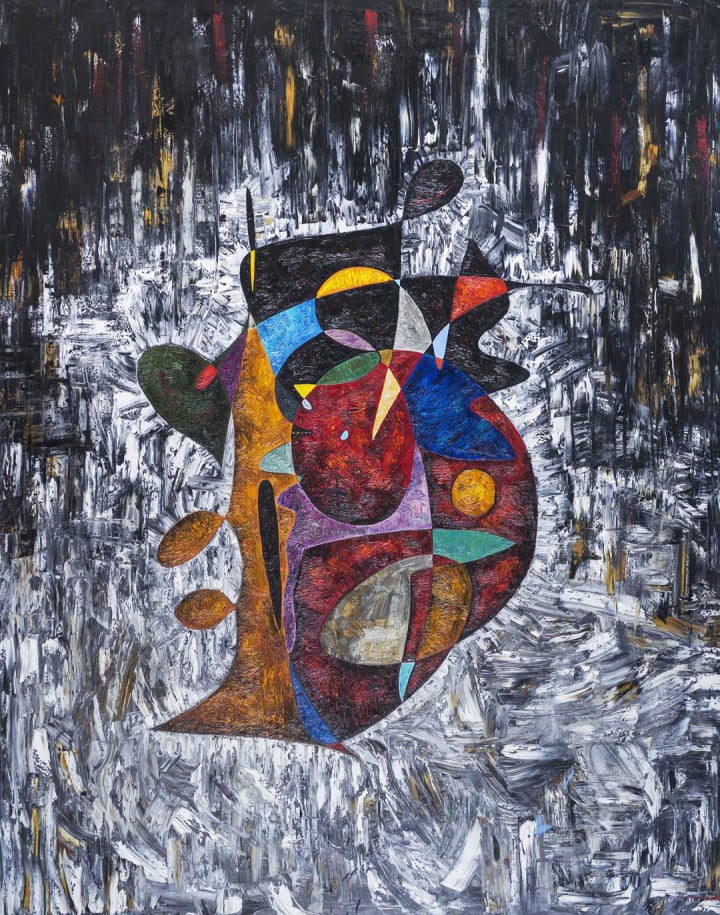
In Adam and Eve (2017), the narrative of the first division becomes something more abstract:
not a moment between two figures—
but a dynamic system of separation and connection unfolding within paint.
About the Creator
Thelma Golden
American art curator, the director and chief curator of The Studio Museum in Harlem.
Keep reading
More stories from Thelma Golden and writers in Art and other communities.
The Eternal Duel — Baroque vs. Renaissance
ROME — In the hushed silence of San Luigi dei Francesi church, tourists still jostle for position before three canvases that changed Western art forever. They come seeking the *Calling of Saint Matthew*, the masterpiece that Michelangelo Merisi da Caravaggio completed between 1599 and 1600. What they find is not the ethereal spirituality of the High Renaissance, but something far more disturbing: a divine intervention that looks disturbingly like a shakedown in a backroom gambling den.
By Mark Senegal5 days ago in Art
📢 Raise Your Voice Thread: 03/19/2026
Our “Raise Your Voice Threads” are hosted most alternating Thursdays at 12PM ET to offer creators more avenues to uncover exceptional stories on Vocal. As we are continuously searching for fresh creators and inspiring stories, this thread provides an opportunity to exchange and discuss the stories that have moved and motivated us on Vocal.
By Raise Your Voice by Vocal3 days ago in Resources



Comments
There are no comments for this story
Be the first to respond and start the conversation.