
The Flag in the Air
Dolores O’Riordan, identity, and the quiet power behind a single gesture
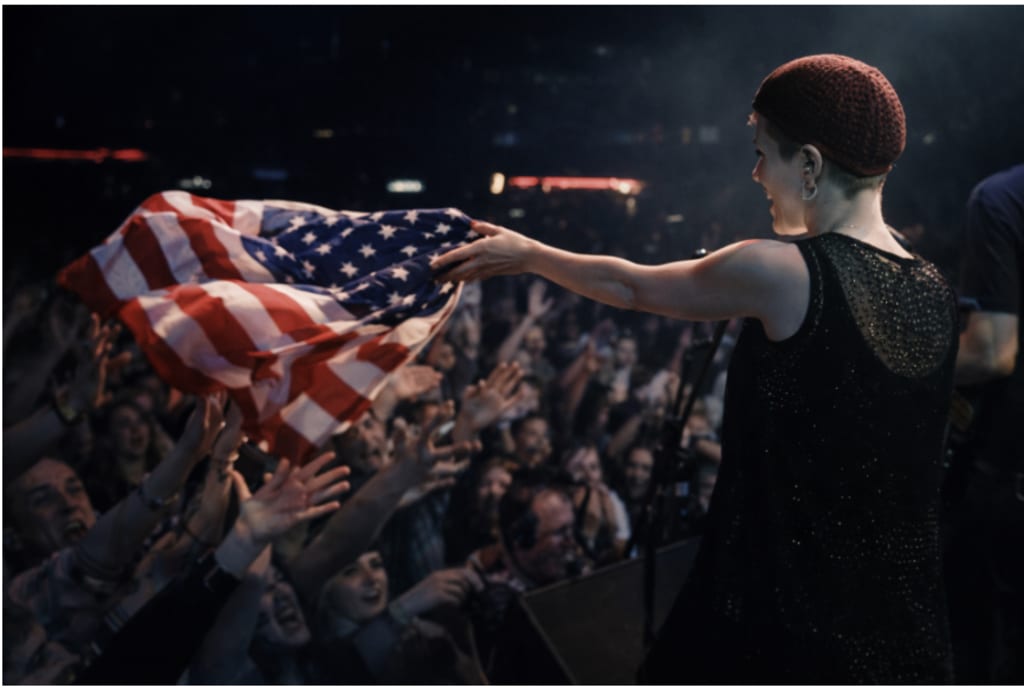
At first glance, it was only a gesture.
A singer on stage, a flag in her hands, a crowd reaching toward the moment.
But some gestures refuse to remain simple. They gather history, identity, and the invisible weight of memory. They linger long after the music fades because something deeper moved beneath them.
That moment—Dolores O’Riordan tossing an American flag toward a British audience—may have been one of those gestures.
To understand it, one must imagine not only the stage, the lights, and the crowd, but the consciousness of the woman standing at the center of it all.
She was not merely a young woman throwing a piece of cloth into the air.
She was an Irish artist measuring the pulse of an English room with the careful intensity of someone who has learned how to smile without ever fully disarming herself.
Perhaps the first thing she remembered was the cold.
Not the cold of the weather, but another kind entirely—the cold of beginnings. The chill that meets a new band stepping onto a stage before a reserved audience. The cautious distance of British spectators watching an unfamiliar voice, as if that voice had not yet earned the right to fill the room.
In those early days, the reception was polite but guarded.
Large stages.
Measured applause.
Eyes evaluating rather than embracing.
It is the distance that often greets artists before the world decides who they are.
But years later, Dolores O’Riordan was no longer returning as someone asking for space.
She returned with America attached to her name.
With songs that had crossed the Atlantic and circled the globe. With the undeniable proof that the voice once met with curiosity and skepticism had now been celebrated across continents.
Yet beneath that success, something deeper remained.
Ireland.
Ireland in the throat.
Ireland in memory.
Ireland in that particular way of looking toward England—a gaze that can never be entirely innocent.
Some people never step onto a stage alone.
They arrive carrying centuries with them. History sits quietly behind the amplifiers: the dead, the grievances not yet dissolved, the tenderness wounded but still alive.
For an Irish artist performing before a British audience, identity is never entirely neutral.
And so perhaps she was not thinking I am paying tribute.
Perhaps the thought was more subtle, and far more dangerous.
I will take this symbol—and no one else will decide what it means.
Before the gesture came the compliment.
Before tension, the sweetness.
Before touching the scar, the soft hand.
“We’ve returned to your sweet country…”
It was a disarming sentence. A careful opening. Like dimming the lights in a room before striking a match.
Then America entered the scene.
Not as a homeland.
But as recognition.
Not as obedience.
But as proof.
Look, she might have been saying without saying it:
they loved us there.
And now I return here—to a country that knows both elegance and skepticism—to share this triumph without lowering my head.
When the flag left her hands, it did so the way some singers release a high note.
Not to explain anything.
But to stretch the moment until the moment itself revealed its meaning.
And perhaps that meaning was this:
A symbol does not always belong to the country that created it.
Sometimes it belongs to the hand that throws it.
Sometimes it belongs to the risk.
Sometimes it belongs to the woman who understands the emotional temperature of a room—and decides to push it just a little further.
Perhaps she felt pleasure.
Perhaps defiance.
Perhaps a strange joy composed equally of victory and quiet irony.
Perhaps she thought:
Now they receive me differently.
Now I can do this.
Now no one can take this moment away.
Or perhaps, more privately:
They have no idea what I carry while I smile.
Because some artists possess a particular intensity.
They can offer flowers with one hand while holding ruins in the other.
They can express gratitude without forgetting.
They can love the beauty of a gesture without absolving history.
And then the flag flew.
Not as submission.
Not as propaganda.
Not as forgetting.
It flew like a fragment of electric theatre.
Like a serious joke.
Like an offering wrapped in thorns.
A small conquest draped in borrowed colors.
And for a brief second, three nations seemed suspended in the air together:
America as crown.
Great Britain as witness.
Ireland as wound—and center.
And in the middle of it all stood Dolores O’Riordan.
A woman who understood that sweetness can also be power.
That elegance can also be defiance.
And that some gestures become immortal precisely because no single explanation will ever exhaust their meaning.
About the Creator
Keep reading
More stories from writers in Art and other communities.
'Till Death We Do Art
There would be nothing divine in this world without art. Nature may surpass the divine to all intents and purposes, but like everything it absorbs and is absorbed by, it remains here, stuck on the surface of this world, ever-present, physically bound to the universe.
By Avocado Nunzella BSc (Psych) -- M.A.P 29 days ago in Art
The Front Seat
I found myself waking up in the front seat of the bus. My eyes were filled with the early morning darkness. I had been asleep, but I wasn’t sure for how long. I tried to wake up my body, but my head felt heavy, as though I had been sleeping for an eternity, although I couldn’t pinpoint how much time had passed.
By Aunty Sada5 days ago in Art




Comments
There are no comments for this story
Be the first to respond and start the conversation.