
Emerging Trends Among Cloud Data Migration Companies in 2026
How next-gen cloud migration leaders are eliminating downtime, enabling AI, and turning data moves into strategic transformation
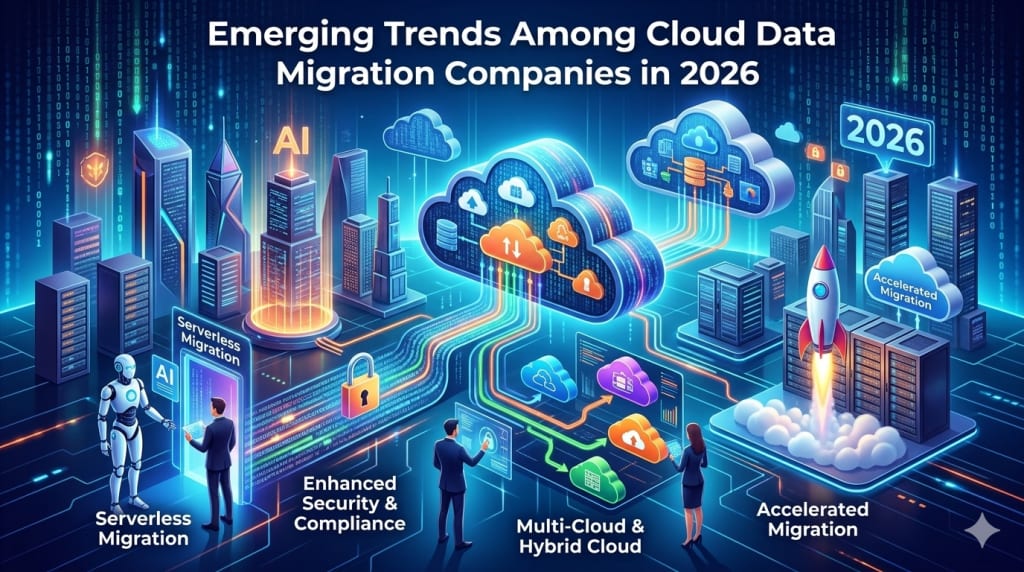
Cloud migration is no longer just a technical upgrade—it’s a strategic transformation layer that directly impacts scalability, AI readiness, and business resilience.
In 2026, Cloud Data Migration Companies are no longer competing on execution alone. The real differentiation now lies in how intelligently, securely, and predictively they move and optimize data.
Below are the key trends shaping the next generation of cloud migration services.
1. AI-Driven Migration Planning and Automation
Migration planning used to be manual, slow, and assumption-heavy. That’s changing fast.
Leading providers now use AI to:
- Analyze legacy systems and dependencies
- Predict migration risks before execution
- Recommend optimal migration paths
- Automate workload prioritization
What this means:
Faster planning cycles, fewer surprises, and significantly reduced failure rates.
In 2026, companies that don’t use AI in migration planning are already behind.
2. Zero-Downtime Migration as the Standard
What used to be a premium capability is now the baseline expectation.
Modern Cloud Data Migration Companies are designing architectures that eliminate downtime through:
- Continuous data replication
- Blue-green deployments
- Parallel cloud environments
- Real-time failover systems
Shift in expectation:
Clients no longer ask “How much downtime?”
They ask “Why is there any downtime at all?”
3. Migration + Modernization (Not Just Lift-and-Shift)
The era of simple “lift-and-shift” is fading.
In 2026, migration is tightly coupled with application modernization:
- Monoliths are broken into microservices
- Legacy apps are replatformed to cloud-native environments
- Containers and Kubernetes adoption is standard
Why this matters:
Companies want long-term performance gains—not just relocation of legacy problems.
4. Industry-Specific Migration Frameworks
Generic migration strategies are losing relevance.
Top providers now specialize in vertical-specific solutions:
- Healthcare: compliance-first migrations (HIPAA-ready)
- Finance: high-security, low-latency architectures
- Retail: real-time inventory and customer data sync
- Manufacturing: IoT and edge data integration
Result:
Faster deployments and fewer compliance risks.
5. Multi-Cloud and Hybrid Cloud Dominance
Single-cloud strategies are increasingly rare.
Organizations are adopting:
- Multi-cloud environments (AWS + Azure + Google Cloud)
- Hybrid setups combining on-premise and cloud
- Cloud Data Migration Companies are evolving to handle:
- Cross-cloud data portability
- Vendor lock-in avoidance strategies
- Unified monitoring across environments
Key insight:
Migration is no longer “to the cloud”—it’s across clouds.
6. Built-In Security and Compliance Automation
Security is no longer a post-migration concern—it’s embedded from day one.
Leading migration providers now include:
- Automated compliance checks
- Encryption during transit and at rest
- Identity and access management integration
- Continuous vulnerability scanning
Why this trend matters:
Regulatory pressure is increasing, and companies can’t afford compliance gaps during migration.
7. Real-Time Data Streaming Instead of Batch Migration
Traditional batch data transfers are being replaced by real-time streaming architectures.
This enables:
- Continuous synchronization
- Instant data availability in the cloud
- Reduced migration windows
Impact:
Businesses can operate in real time—even while migration is still in progress.
8. Post-Migration Optimization Becomes a Core Service
Migration used to end at “go-live.” Not anymore.
In 2026, top Cloud Data Migration Companies extend their role into:
- Cost optimization (FinOps)
- Performance tuning
- Resource scaling strategies
- Ongoing cloud governance
Strategic shift:
Migration is now a lifecycle service, not a one-time project.
9. Increased Focus on Data Governance and Quality
Moving bad data faster is no longer acceptable.
Modern migration strategies prioritize:
- Data cleansing before migration
- Data classification and tagging
- Governance frameworks for long-term control
Outcome:
Better analytics, cleaner systems, and stronger AI readiness.
10. Cloud Migration as a Foundation for AI Adoption
Perhaps the biggest shift: migration is now being driven by AI goals.
Organizations are migrating to:
- Enable machine learning models
- Centralize data for AI pipelines
- Support real-time analytics
This positions Cloud Data Migration Companies as critical enablers of AI transformation—not just IT vendors.
What This Means for Businesses
If you're planning a migration in 2026, the evaluation criteria have changed.
You shouldn’t just ask:
- Can they migrate data?
You should ask:
- Can they reduce downtime to near zero?
- Do they modernize applications during migration?
- Can they support multi-cloud strategies?
- Do they optimize post-migration performance?
- Are they preparing us for AI adoption?
Final Takeaway
Cloud migration has matured.
The best Cloud Data Migration Companies in 2026 are:
- AI-driven
- Automation-first
- Security-embedded
- Industry-specialized
- Focused on long-term optimization
They don’t just move infrastructure—they reshape how businesses operate in a digital-first world.
About the Creator
Keep reading
More stories from Lilly Scott and writers in Writers and other communities.
The Role of Microsoft Dynamics Implementation Partners in Digital Transformation
Digital transformation is no longer a strategic experiment. For most enterprises, it’s a competitive necessity. Organizations are modernizing operations, integrating data systems, automating workflows, and building customer-centric processes. Yet one of the biggest challenges companies face is not choosing the right technology — it’s implementing it successfully.
By Lilly Scott5 days ago in Writers
March 15, 2026
Merriam Webster - Word of the day: Tranche refers to a division or portion of a whole. World Contact Day is commemorated every year on March 15. It is a unique observance held globally to focus on communicating with extraterrestrial life and exploring the possibility that intelligent beings may exist beyond Earth. World Contact Day inspires people to invoke their curiosity and spend time thinking about the universe and the mysteries surrounding it. What is the “Ides of March”? According to the Roman calendar, the Ides are a monthly occurrence. In March and other months with 31 days, the Ides always falls on the 15th; it falls on the 13th in months with 30 days. The Ides traditionally marked the arrival of the new Moon and was cause for celebration. The word “Ides” is derived from Latin, meaning “to divide.” Mothering Sunday in 2026 falls on Sunday, March 15. Mothering Sunday, celebrated in the United Kingdom and Ireland, occurs on the fourth Sunday of Lent, which is exactly three weeks before Easter. Unlike the fixed-date Mother's Day in countries like the United States, Canada, and Australia, Mothering Sunday’s date changes each year according to the Christian liturgical calendar. On March 15, 2026, several notable observances and events are celebrated: Dumbstruck Day: A day to express frustration. Everything You Think is Wrong Day: A day to challenge and celebrate wrong beliefs. International Day Against Police Brutality: A day to raise awareness and advocate against police violence. My look at today, March 15, 2026 below:
By Denise E Lindquista day ago in Writers
Your Partner Doesn't Understand Your Writing Life. That's Okay.
My partner has never read 1 Lovelock Drive. Not because he doesn't care, but because I asked him not to. The book draws from personal experience and the thought of him reading certain scenes, knowing which emotional truths came from our life and which were invented, felt like standing naked in the kitchen during breakfast.
By Ellen Frances6 days ago in Writers



Comments
There are no comments for this story
Be the first to respond and start the conversation.