
Security Analytics Market Set for Major Growth as Cyber Threats Reshape Global Business Priorities
As ransomware, AI-powered attacks, and cloud vulnerabilities rise, the global security analytics market is becoming one of the most critical pillars of enterprise cybersecurity strategy.

In today’s digital-first economy, cyberattacks are no longer rare disruptions—they are a constant business risk. From multinational corporations to fast-growing startups, organizations are being forced to rethink how they defend their networks, users, applications, and data. In this environment, security analytics is moving from “nice to have” to mission-critical.
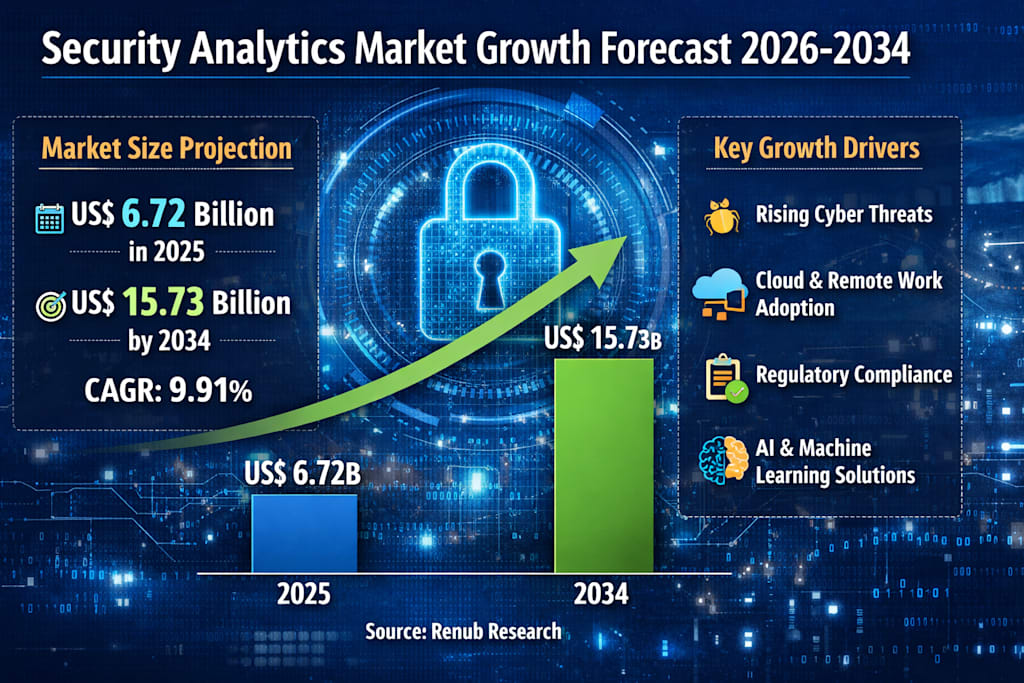
The global Security Analytics Market is projected to grow from US$ 6.72 billion in 2025 to US$ 15.73 billion by 2034, expanding at a CAGR of 9.91% from 2026 to 2034. That trajectory reflects more than just rising IT spending. It signals a deeper shift in how enterprises are approaching cybersecurity: away from reactive defense and toward predictive, intelligence-driven protection.
Security analytics is becoming the nerve center of modern cyber defense. Instead of relying only on firewalls or signature-based tools, organizations are increasingly investing in platforms that can detect suspicious behavior, correlate events across multiple systems, and identify threats before they escalate into full-scale breaches.
And right now, that shift couldn’t be more urgent.
Why Security Analytics Matters More Than Ever
Traditional cybersecurity tools were built for a simpler era—an era when most employees worked from the office, applications ran on-premises, and attack surfaces were easier to define. That era is gone.
Today, enterprises operate across hybrid cloud environments, remote work systems, SaaS applications, mobile endpoints, and connected devices. Every login, data transfer, and API call creates a digital trail. Hidden within those trails are the warning signs of insider abuse, ransomware, phishing, credential theft, and advanced persistent threats.
Security analytics helps organizations make sense of that complexity.
At its core, security analytics collects and processes large volumes of data from across the IT environment—networks, endpoints, applications, cloud platforms, and users—to uncover anomalies and suspicious behavior. Advanced platforms use artificial intelligence (AI), machine learning (ML), behavioral analysis, and big data processing to turn raw logs into actionable security insights.
That means faster threat detection, better visibility, and a stronger chance of stopping an attack before real damage is done.
The Biggest Force Behind Market Growth: More Sophisticated Cyberattacks
One of the clearest reasons this market is accelerating is the growing sophistication of cybercrime. The threat landscape is no longer limited to spam emails and obvious malware. Organizations now face:
Ransomware campaigns
Zero-day exploits
Insider threats
Phishing and social engineering attacks
Advanced persistent threats (APTs)
Identity-based intrusions
These attacks are designed to evade traditional security systems. In many cases, they unfold gradually and quietly, blending into normal business activity. That’s exactly why analytics-driven defense is becoming essential.
Unlike conventional security systems that focus mainly on known attack signatures, security analytics tools are built to identify unusual behavior. If a user suddenly accesses sensitive files at an unusual hour, or a device begins transmitting data in an abnormal pattern, analytics platforms can flag the event before it becomes a breach.
As cybercrime costs continue to rise worldwide, organizations are no longer waiting for an incident to justify investment. They are proactively building analytics capabilities into their cybersecurity frameworks.
Cloud, Remote Work, and Digital Transformation Are Expanding the Attack Surface
The second major growth engine for this market is digital transformation.
Across industries, businesses are embracing cloud computing, automation, e-commerce, digital payments, IoT devices, and hybrid work models. These changes are creating efficiency and innovation—but they are also creating more entry points for attackers.
Security analytics has become especially important in this environment because it provides centralized visibility across distributed systems. Whether an organization uses public cloud, private infrastructure, or a hybrid architecture, analytics platforms help security teams monitor activity in real time and connect signals that would otherwise remain isolated.
Remote work has made this even more important. Employees are now logging in from home networks, personal devices, and mobile environments. The traditional network perimeter has effectively disappeared. As a result, organizations need continuous monitoring tools that can detect risky behavior wherever it occurs.
This is where solutions like Security Information and Event Management (SIEM), User and Entity Behavior Analytics (UEBA), network traffic analysis, and threat intelligence platforms are becoming indispensable.
Compliance Is Also Fueling Adoption
Cybersecurity isn’t just about stopping hackers anymore—it’s also about satisfying regulators.
Organizations handling financial, personal, or healthcare data face increasing pressure to comply with frameworks such as GDPR, HIPAA, PCI DSS, and region-specific data protection requirements. Security analytics solutions support compliance by providing:
Continuous monitoring
Access tracking
Audit trails
Policy violation detection
Automated reporting
This matters because regulatory expectations are becoming more proactive. It’s no longer enough to say, “We had a firewall.” Regulators and stakeholders increasingly want proof that companies can identify, investigate, and respond to threats in real time.
That’s another reason security analytics is moving into the strategic core of enterprise IT. It doesn’t just improve defense—it strengthens governance and accountability.
But the Market Still Faces Real Challenges
Despite its momentum, the security analytics market is not without obstacles.
One of the biggest is the shortage of skilled cybersecurity professionals. Advanced analytics platforms generate huge volumes of alerts and data. Turning those signals into meaningful decisions requires expertise in threat hunting, incident response, and data interpretation.
Many organizations simply don’t have enough qualified professionals to manage these systems effectively. That skills gap can reduce the value of analytics investments and slow adoption, especially for smaller firms with limited internal security teams.
The second major challenge is integration complexity and implementation cost.
Most enterprises do not operate in clean, modern environments. They run a mix of legacy systems, cloud services, security tools, business applications, and region-specific infrastructure. Bringing all of that into a unified analytics framework can be difficult, time-consuming, and expensive.
High licensing fees, customization requirements, and ongoing maintenance costs remain barriers—particularly for small and mid-sized enterprises. For the market to scale more broadly, vendors will need to keep improving interoperability, automation, and ease of deployment.
United States: A Mature Yet Fast-Moving Security Analytics Market
The United States remains one of the largest and most advanced markets for security analytics, thanks to its highly digital economy, large enterprise base, and relentless cyber threat environment.
Organizations across finance, healthcare, government, and critical infrastructure are increasingly relying on analytics to detect and respond to attacks in real time. AI and ML are being widely integrated into U.S. security operations, helping enterprises move from manual monitoring to intelligent automation.
A particularly telling indicator of the urgency in the U.S. market comes from cybercrime complaint data. According to the information included in the provided market text, the FBI’s 2023 Internet Crime Report showed complaints totaling:
21,489 for BEC (Business Email Compromise)
2,825 for ransomware
14,190 for government impersonation
37,560 for tech and customer support impersonation
Those numbers highlight a simple truth: the cyber threat problem is scaling faster than traditional security methods can handle.
United Kingdom and India: Strong Growth Stories with Different Dynamics
The United Kingdom is seeing steady growth in security analytics adoption, driven by rising cyber risk, digital transformation, and regulatory pressure. Industries such as finance, healthcare, government, and retail are investing more heavily in SIEM, UEBA, and threat intelligence platforms to strengthen resilience and maintain compliance. GDPR and sector-specific obligations continue to push analytics spending upward.
Meanwhile, India represents one of the most exciting high-growth opportunities in the global market.
As digital payments, e-commerce, cloud adoption, and enterprise digitization accelerate across India, the need for advanced cybersecurity capabilities is increasing sharply. Security analytics is gaining traction among enterprises and public institutions alike, particularly as awareness grows around real-time threat detection, AI-driven monitoring, and audit readiness.
India’s momentum is especially important because it reflects a broader trend across emerging digital economies: cybersecurity is no longer a secondary IT function. It is becoming a business growth enabler.
The UAE Is Emerging as a Strategic Security Analytics Market
The United Arab Emirates is also emerging as a notable market, supported by strong digital transformation initiatives, cloud expansion, and smart city development.
As public and private institutions modernize infrastructure, they are also investing more heavily in proactive cybersecurity. Security analytics is increasingly being positioned as part of a broader national resilience strategy, with enterprises using analytics tools to improve visibility, detect anomalies, and automate response actions.
That regional momentum suggests security analytics is no longer just a concern for traditional tech-heavy economies. It is becoming a global strategic priority.
Recent Industry Moves Show the Market Is Heating Up
Recent developments across the industry suggest that major cybersecurity vendors are doubling down on analytics, AI, and integrated defense platforms.
Some of the notable developments mentioned in the provided material include:
Fortinet introduced an AI-powered office security suite in June 2025 to protect email, browsers, and collaboration tools.
Palo Alto Networks reported a 34% ARR increase in next-generation security and a 15% year-over-year revenue increase in May 2025.
KDDI and NEC launched a combined cybersecurity business in May 2025 focused on infrastructure and supply-chain customers.
Aurascape debuted in April 2025 with US$ 50 million to help secure AI application pipelines.
Fortinet also acquired Next DLP in August 2024, strengthening its data protection and insider risk capabilities.
Cisco launched Cisco Hypershield in April 2024, a next-generation architecture designed for AI-driven data centers and cloud-native environments.
These developments point to a broader market direction: the future of cybersecurity will be increasingly AI-native, automated, integrated, and analytics-driven.
What Comes Next for the Security Analytics Market?
Looking ahead, the next phase of this market will likely be shaped by five major trends:
1. AI-Driven Detection Will Become Standard
As attacks become more dynamic and machine-generated, static rule-based defense will continue to lose effectiveness.
2. Analytics Will Move Closer to Prevention
The market is evolving from detection and response toward predictive security and automated intervention.
3. Cloud-Native Security Will Dominate
Vendors that can provide visibility across multi-cloud and hybrid environments will be better positioned for long-term growth.
4. SMB Adoption Will Rise
As solutions become more scalable and managed services improve, smaller businesses will increasingly adopt analytics tools.
5. Cybersecurity Will Be Measured as a Business Function
Boards and executives will demand clearer security intelligence, risk dashboards, and measurable outcomes from analytics investments.
That means the role of security analytics will likely expand beyond the security operations center and into executive decision-making, business continuity planning, and enterprise risk management.
Final Thoughts
Security analytics is no longer a niche cybersecurity category—it is becoming one of the most important technologies in the digital economy.
As cyber threats grow more complex, businesses can no longer afford to operate in the dark. They need visibility, context, speed, and intelligence. That is exactly what security analytics promises to deliver.
With the market expected to more than double by 2034, the opportunity is clear. But the bigger story is not just about market size. It’s about necessity.
About the Creator
Keep reading
More stories from shibansh kumar and writers in Trader and other communities.
Protein Bar Market Powers Ahead as Health, Convenience, and Innovation Reshape Global Snacking
The global snacking industry is undergoing a major transformation, and protein bars are emerging as one of its most dynamic categories. Once seen primarily as sports nutrition products for bodybuilders and athletes, protein bars have now become a mainstream food choice for consumers who want convenience, taste, and nutritional value in one compact format.
By shibansh kumarabout 9 hours ago in Trader
Why Argentina’s Steel Market Still Reflects the Country’s Industrial Momentum
Steel is often not the focus of interest‚ but provides perhaps the clearest perception into how an economy builds‚ manufactures and invests․ The Argentine steel industry is a perfect case of this beyond mere production numbers and commodity price movements․ Steel consumption is reflective of the growth of civil construction‚ industrial recovery‚ and the development of a domestic supply to industries that depend on the durability of inputs․ The Argentina steel market is forecast to reach USD 5‚036․34 million in 2024‚ and grow at a CAGR of 3․12% during the period 2025-2033‚ to reach USD 6‚640․50 million by 2033 (IMARC Group)․
By michael matthew4 days ago in Trader
Barclays Share Price Trends: What Every UK Investor Needs to Know
The Barclays share price continues to draw attention from UK investors as it shows noticeable movements in recent weeks. Understanding what drives these changes is essential for anyone planning to invest or manage their shares. This article breaks down the main factors affecting the Barclays share price and what investors should watch.
By John.doe7985 days ago in Trader
Ghostly Happenings in Colorado
Disturbed Spirits In Denver, an expanse of greenery, Cheesman Park comes with a macabre history since it was once a burial ground known as Mount Prospect Cemetery established by General William Larimer in 1858. The job of exhuming bodies began, and some were left behind resting beneath the park. However, the ghostly spirits don’t wish to rest in peace beneath the park, and visitors here have felt cold touches, seen ghostly children playing at night, and heard a singing lady who disappears when approached.
By Rasma Raisters6 days ago in Horror


Comments
There are no comments for this story
Be the first to respond and start the conversation.