
Oman Desalination Market Size & Summary
Rising Water Security Needs Position Oman as a Strategic Desalination Hub

Introduction
Oman’s growing reliance on desalination is reshaping its water security landscape. As one of the most water-stressed countries in the Gulf region, Oman has increasingly turned to desalination technologies to ensure a consistent and sustainable freshwater supply. With expanding urban populations, industrial growth, and limited natural freshwater resources, desalination is no longer optional—it is essential.
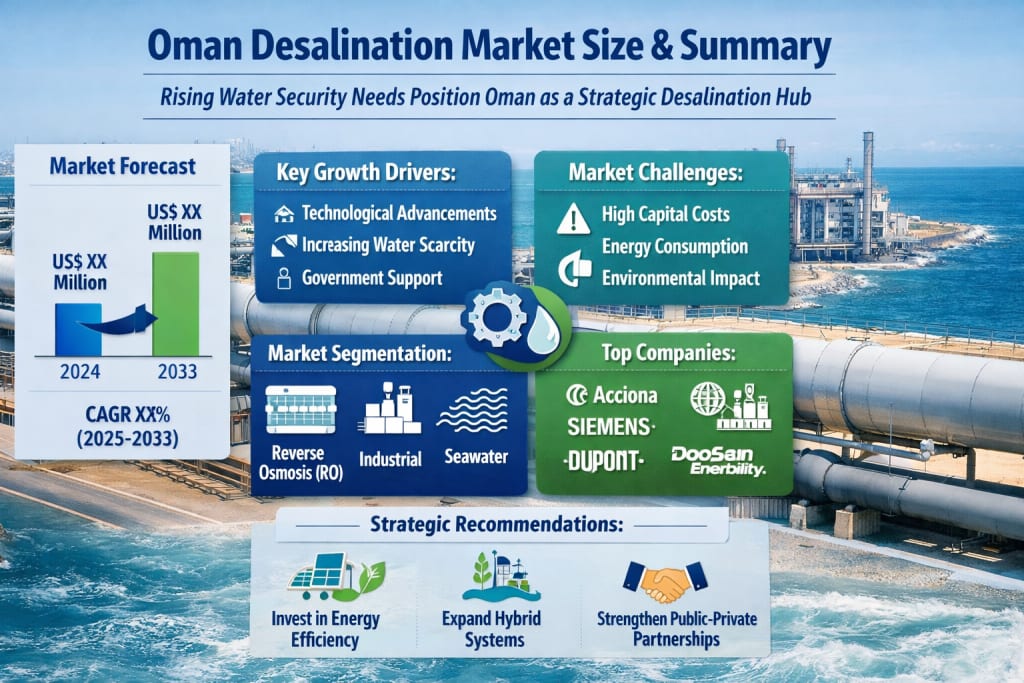
According to recent industry analysis, the Oman Desalination Market share is expected to reach US$ XX Million by 2033, compared to US$ XX Million in 2024, growing at a CAGR of XX% from 2025 to 2033. This steady growth reflects strong government backing, technological innovation, and increasing private sector participation.
Oman Desalination Market Outlook
Overview
Oman’s geographic and climatic conditions make desalination a cornerstone of its water strategy. The country receives minimal rainfall, and groundwater reserves are under pressure due to overuse and salinity. Coastal access, however, provides a natural advantage for seawater desalination.
The market is characterized by the deployment of advanced technologies such as reverse osmosis (RO), multi-stage flash (MSF), and multi-effect distillation (MED). These technologies are being adopted across both municipal and industrial sectors to ensure a reliable water supply.
Current Market Landscape
Desalination plants in Oman primarily serve urban centers and industrial hubs. Cities like Muscat and Sohar depend heavily on desalinated water for domestic consumption, while industries—especially oil & gas and manufacturing—require high-quality treated water for operations.
Public-private partnerships (PPPs) have become a dominant model in Oman’s desalination sector, enabling faster infrastructure development and operational efficiency. International players collaborate with local authorities to build and manage large-scale desalination facilities.
Projected Growth
From 2025 to 2033, the Oman desalination market is expected to witness steady expansion. Growth will be driven by:
Rising population and urbanization
Industrial diversification under Oman Vision 2040
Increasing demand for potable water
Technological advancements reducing operational costs
Reverse osmosis is anticipated to dominate future installations due to its energy efficiency and scalability.
Key Growth Drivers in the Oman Desalination Market
1. Technological Advancements
Innovation is at the heart of the desalination sector’s evolution. Modern desalination systems are becoming more efficient, cost-effective, and environmentally friendly.
Reverse Osmosis (RO): Lower energy consumption and high efficiency
Multi-Effect Distillation (MED): Improved thermal efficiency
Hybrid Systems: Combining RO and thermal processes for optimized performance
Advanced membrane technologies and digital monitoring systems are further enhancing plant performance and reducing downtime.
2. Increasing Water Scarcity
Oman faces chronic water scarcity due to:
Low annual rainfall
High evaporation rates
Over-extraction of groundwater
Desalination offers a dependable alternative to traditional water sources. Coastal desalination plants are particularly critical in meeting municipal demand.
3. Government Support and Policy Framework
The Omani government plays a pivotal role in driving the desalination market. Through strategic investments and supportive policies, it has prioritized water security as a national objective.
Key initiatives include:
Infrastructure development under Vision 2040
Encouragement of PPP models
Investment in research and innovation
Regulatory frameworks promoting sustainable practices
4. Industrial Demand for High-Quality Water
Oman’s industrial sectors—including oil & gas, petrochemicals, and power generation—require large volumes of treated water. Desalinated water ensures consistency and quality, making it indispensable for industrial operations.
As industrial diversification accelerates, demand for desalinated water is expected to rise significantly.
Challenges in the Oman Water Desalination Market
1. High Initial Capital Investment
Building desalination plants requires substantial financial resources. Large-scale projects involve:
Advanced equipment and technology
Infrastructure development
Long-term maintenance costs
This can limit participation from smaller players and municipalities.
2. Energy Consumption
Desalination is inherently energy-intensive, particularly thermal processes like MSF and MED. High energy consumption increases operational costs and raises concerns about carbon emissions.
However, the integration of renewable energy sources—such as solar power—is emerging as a promising solution.
3. Environmental Concerns
Environmental sustainability remains a key challenge. Issues include:
Brine disposal affecting marine ecosystems
Energy-related carbon emissions
Coastal ecosystem disruption
Regulatory compliance and sustainable practices are essential to mitigate these impacts.
Market Segmentation Analysis
By Technology
Reverse Osmosis (RO):
The most widely adopted technology in Oman, RO is favored for its efficiency and lower energy requirements. It is extensively used for seawater and brackish water desalination.
Multi-Stage Flash (MSF) Distillation:
A traditional thermal method, MSF is suitable for large-scale plants but consumes significant energy.
Multi-Effect Distillation (MED):
More energy-efficient than MSF, MED is gaining traction in modern desalination projects.
Others:
Includes hybrid systems and emerging technologies aimed at improving efficiency and reducing costs.
By Application
Municipal:
The largest segment, driven by urban population growth and the need for safe drinking water.
Industrial:
Used in sectors like oil & gas, power generation, and manufacturing for process and cooling purposes.
Others:
Includes agriculture, aquaculture, and niche applications.
By Water Source
Seawater:
The dominant source due to Oman’s extensive coastline.
Brackish Water:
A cost-effective option for inland areas with saline groundwater.
River Water & Others:
Limited usage but applicable in specific cases.
Regional Insights within Oman
Desalination demand varies across regions based on population density, industrial activity, and water availability.
Coastal Regions: High reliance on seawater desalination for urban and industrial supply
Interior Regions: Increasing adoption of brackish water desalination
Industrial Zones: Significant demand driven by manufacturing and energy sectors
Porter’s Five Forces Analysis
Supplier Power – Moderate: Specialized components like membranes give suppliers leverage
Buyer Power – Moderate: Limited alternatives but high costs restrict bargaining
Competitive Rivalry – High: Presence of global and regional players intensifies competition
Threat of Substitutes – Moderate: Water recycling and groundwater extraction offer alternatives
Threat of New Entrants – Moderate: High capital requirements act as a barrier
SWOT Analysis
Strengths
Advanced desalination technologies improving efficiency
Strong government support and investment
Weaknesses
High capital and operational costs
Environmental concerns
Opportunities
Integration of renewable energy
Expansion of hybrid desalination systems
Increasing demand across sectors
Threats
Fluctuating energy prices
Environmental regulations
Economic uncertainties
Competitive Landscape
The Oman desalination market features a mix of global technology providers and regional operators. Key players include:
Acciona
Dow
Evoqua Water Technologies
Siemens AG
DuPont
Doosan Enerbility
Toray Industries, Inc.
Xylem
Competitive Strategies
These companies are focusing on:
Advanced membrane technologies
Energy-efficient systems
Digital monitoring and automation
Sustainable desalination solutions
Strategic partnerships and long-term contracts with government entities are also common.
Strategic Recommendations
1. Invest in Energy Efficiency
Reducing energy consumption is critical to lowering operational costs. Companies should prioritize innovations in RO membranes and energy recovery systems.
2. Expand Hybrid Systems
Combining RO with thermal technologies can enhance efficiency and reliability, particularly in large-scale projects.
3. Focus on Sustainability
Adopting eco-friendly practices—such as improved brine management and renewable energy integration—will be essential for long-term growth.
4. Strengthen Public-Private Partnerships
Collaborations between government and private players can accelerate infrastructure development and improve service delivery.
Final Thoughts
Oman’s desalination market is entering a transformative phase. With increasing water scarcity, rapid urbanization, and industrial expansion, desalination has become a strategic necessity rather than a supplementary solution.
The market’s future will be shaped by technological innovation, sustainability initiatives, and strong policy support. While challenges such as high costs and environmental concerns persist, ongoing advancements and investments are expected to address these issues effectively.
As Oman continues to prioritize water security under its long-term development vision, the desalination sector will remain a key pillar of growth—offering significant opportunities for investors, technology providers, and policymakers alike.
About the Creator
Carpet Market Size and Forecast 2025–2033
The global carpet market is witnessing steady expansion as consumer demand for comfortable, stylish, and energy-efficient flooring solutions increases worldwide. According to Renub Research, the global carpets market was valued at USD 70.86 billion in 2024 and is projected to grow from USD 74.73 billion in 2025 to USD 114.43 billion by 2033, registering a compound annual growth rate (CAGR) of 5.47% during 2025–2033.
By Sakshi Sharma3 days ago in Trader
Australia Grocery Retail Market Growth, Forecast, and Strategic Insights by 2034
The grocery retail sector plays a vital role in Australia’s economy, serving millions of consumers who rely on supermarkets, convenience stores, and online platforms for everyday essentials. Over the past decade, the industry has evolved significantly as retailers adapt to changing consumer preferences, technological innovations, and new competitive pressures.
By Amélie Belle5 days ago in Trader



Comments
There are no comments for this story
Be the first to respond and start the conversation.