
How Robotic Process Automation Is Reshaping Business in the United States
From back-office tasks to enterprise-wide transformation, automation is no longer optional—it’s becoming the operating system of modern business.

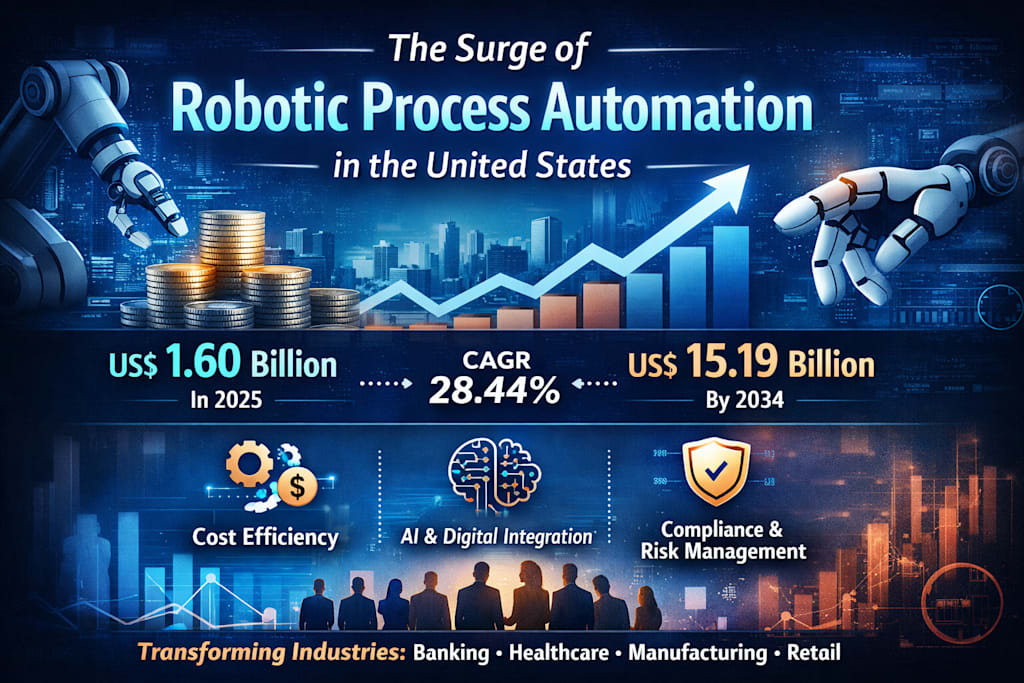
In the United States, businesses are under constant pressure to do more with less. Labor costs are rising, customer expectations are evolving, and organizations are being asked to move faster without sacrificing accuracy or compliance. In that environment, Robotic Process Automation (RPA) has moved from a niche enterprise tool to a mainstream business priority.
RPA refers to software “bots” that automate repetitive, rules-based digital tasks—things like invoice processing, payroll, customer onboarding, report generation, claims handling, and data entry. These bots work across existing systems the way humans do, without requiring major infrastructure changes. That simplicity, combined with strong returns on efficiency, has made automation a strategic investment across American industries. According to the market outlook you provided, the United States Robotic Process Automation Market is expected to grow from US$ 1.60 Billion in 2025 to US$ 15.19 Billion in 2034, expanding at a CAGR of 28.44% from 2026 to 2034.
That projected jump is more than just a technology trend. It reflects a broader shift in how U.S. organizations think about productivity, cost control, and digital transformation. The companies that once used automation for isolated administrative tasks are now building full-scale “digital workforces” to support business operations across finance, healthcare, retail, manufacturing, government, and beyond.
Why RPA Is Gaining So Much Momentum
At its core, the appeal of RPA is straightforward: it removes the burden of repetitive work from people and assigns it to software. For businesses, that means fewer manual errors, faster turnaround times, lower operational costs, and more time for employees to focus on strategic or customer-facing work.
In the United States, that value proposition is especially compelling. Many industries still run on a mix of modern cloud software and older legacy systems. Integrating these systems can be expensive and disruptive. RPA offers a workaround by acting as a digital bridge between applications, allowing companies to automate workflows without rebuilding their technology stack from scratch.
This is particularly important in sectors like banking, insurance, healthcare, telecom, and manufacturing, where organizations handle enormous volumes of repetitive, process-driven tasks every day. Whether it’s verifying customer identities, reconciling transactions, processing medical claims, or generating internal reports, automation helps these industries move faster while reducing risk.
And in today’s economy, efficiency isn’t just a bonus—it’s survival.
The AI Effect: RPA Is Getting Smarter
One of the biggest reasons the U.S. RPA market is accelerating is that traditional automation is no longer operating alone. It is increasingly being combined with artificial intelligence (AI), machine learning (ML), computer vision, and natural language processing (NLP). That combination is transforming basic task automation into what many companies now call intelligent automation.
This matters because classic RPA works best when tasks are structured and predictable. But real business operations are often messier. Documents vary in format, emails require interpretation, and customer interactions are rarely uniform. AI-enhanced RPA helps bots understand unstructured or semi-structured information, making them useful in more advanced workflows like fraud detection, customer support, claims analysis, and document-heavy compliance tasks.
That shift expands the role of automation from operational support to business intelligence. Instead of simply “doing tasks faster,” companies are beginning to automate parts of decision-making, exception handling, and process optimization. In that sense, RPA is becoming not just a productivity tool—but a core layer of enterprise strategy.
Compliance Is Also Fueling Adoption
Another major driver in the U.S. market is regulation. Industries such as banking, healthcare, insurance, energy, and government are all subject to strict compliance and reporting requirements. Manual processes in these sectors can create serious risk, especially when human error leads to inaccurate reporting, missed deadlines, or inconsistent documentation.
RPA helps solve that problem by creating repeatable, auditable workflows. Every action taken by a bot can be logged, tracked, and reviewed, which makes compliance reporting and internal audits significantly easier. This is especially valuable in areas like tax processing, transaction monitoring, access management, and patient data administration.
In other words, automation is no longer just about speed. In many industries, it’s about trust.
But the Road to Automation Isn’t Always Smooth
Despite the momentum, RPA adoption in the U.S. still comes with meaningful challenges. One of the biggest is the high initial cost of deployment, especially for larger or enterprise-wide rollouts. Businesses often need to invest not only in software licenses but also in cybersecurity integration, consulting, process redesign, employee training, and long-term bot maintenance.
And that’s where many companies underestimate the work involved.
Automation doesn’t perform well when the underlying process is chaotic. If a workflow is inconsistent, undocumented, or frequently changing, bots are more likely to fail or require constant intervention. That means many organizations must first standardize and clean up their internal processes before automation can actually deliver value. For smaller firms, this can make adoption feel expensive or difficult to justify in the short term.
There’s also the human factor. Employees may resist automation because of fears around job displacement or reduced relevance. At the same time, companies often face a shortage of skilled professionals who can design, manage, and scale automation systems effectively. As RPA becomes more intelligent and AI-driven, the talent gap becomes even more noticeable.
So while the opportunity is large, successful implementation still depends on leadership, communication, reskilling, and realistic planning.
Software Is the Heart of the Market
The U.S. RPA market is heavily driven by its software segment, which includes bot development tools, orchestration platforms, control dashboards, analytics engines, and security frameworks. These tools allow businesses to design, deploy, and monitor digital workers across departments and processes.
What companies increasingly want from RPA software is flexibility. They’re looking for platforms that support low-code development, cloud integration, real-time monitoring, AI features, and strong governance controls. The rise of subscription-based and SaaS models has also lowered entry barriers for small and mid-sized companies, making automation more accessible than it was a few years ago.
That accessibility is important because the future of RPA won’t belong only to large corporations. As automation tools become easier to use and deploy, more mid-market businesses will likely enter the space.
Why Rule-Based Automation Still Dominates
Even though intelligent automation gets most of the headlines, rule-based RPA remains the backbone of the U.S. market. These bots are ideal for repetitive, clearly defined tasks involving structured data and predictable workflows. That includes payroll processing, invoice management, order entry, KYC verification, transaction reconciliation, and report generation.
There’s a simple reason rule-based automation continues to dominate: it works.
For many organizations, these are the highest-volume tasks and the easiest to automate quickly. They also offer some of the fastest returns on investment. As a result, many businesses are building layered automation strategies—using rule-based bots for core tasks and AI-enhanced automation for more complex exceptions.
Large Enterprises and BFSI Are Leading the Charge
Not surprisingly, large enterprises remain the biggest adopters of RPA in the United States. These companies often run complex operations across multiple departments and geographies, making them ideal candidates for scaled automation. Many have already established internal Automation Centers of Excellence to manage governance, deployment, and ROI measurement.
Among end users, the BFSI sector (Banking, Financial Services, and Insurance) stands out as the strongest growth engine. Financial institutions rely heavily on RPA for loan processing, fraud detection, customer onboarding, regulatory reporting, claims handling, and payment workflows. In these environments, the combination of speed, accuracy, and auditability is especially valuable.
Healthcare, retail, IT and telecom, transportation and logistics, government, and energy are also contributing significantly to market expansion. The common thread across all of them is clear: when work is repetitive, data-heavy, and time-sensitive, automation becomes highly attractive.
Regional Strength: Why Certain States Stand Out
The report also highlights strong activity across individual states. California leads due to its technology ecosystem, startup culture, and concentration of innovation-focused enterprises. Companies there are pushing the boundaries of RPA by integrating it with AI, machine learning, cybersecurity, and cloud infrastructure.
New York is another major market, powered by its concentration of financial institutions, insurance companies, and media organizations. These sectors rely heavily on process accuracy and regulatory readiness, making automation a natural fit.
Washington benefits from its strong cloud services, aerospace manufacturing, and public-sector presence, while Arizona is emerging through growth in healthcare systems, logistics hubs, and small-to-mid-sized enterprises adopting cloud-based automation tools.
This regional spread shows that RPA is no longer confined to Silicon Valley or Fortune 500 boardrooms. It is becoming a nationwide operational model.
The Bigger Picture: Automation as a Competitive Advantage
What makes the U.S. RPA market especially interesting is that it is no longer being framed as just another IT investment. It is increasingly viewed as a business resilience tool.
Companies use automation not only to save money, but also to handle labor shortages, maintain service levels during demand spikes, improve customer experiences, and prepare for a more digital-first future. In uncertain economic conditions, those capabilities become even more valuable.
And that may be the real reason the market is expected to expand so aggressively over the next decade.
Businesses are no longer asking, “Should we automate?”
They are asking, “How much can we automate—and how fast?”
Final Thoughts
The United States Robotic Process Automation Market is entering a powerful growth phase, driven by enterprise urgency around efficiency, AI integration, compliance, and workforce productivity. With market value expected to rise from US$ 1.60 Billion in 2025 to US$ 15.19 Billion by 2034, RPA is evolving from a helpful tool into a foundational business capability.
For organizations willing to invest in the right processes, people, and platforms, automation offers more than cost savings. It offers speed, scale, consistency, and long-term competitive advantage.
About the Creator
Philippines Bancassurance Market 2026: Bank-Insurance Partnerships, Digital Distribution & Financial Inclusion
Philippines Bancassurance Market Overview The Philippines bancassurance market is a key segment of the country’s insurance distribution ecosystem, enabling insurance companies to sell products through banking networks. This model allows banks to leverage their customer base while offering convenient access to life, health and investment-linked insurance products. Bancassurance plays a critical role in increasing insurance penetration in a country where a large portion of the population remains underinsured.
By Manisha Dixit8 days ago in Trader
Biontech Stock Trends: What Investors Should Watch in 2026
Biontech stock is drawing attention as UK investors look for opportunities in the healthcare sector. Understanding how biontech stock moves, its growth potential, and key influences can help you make informed decisions. They will explore the trends and factors that matter most for investors considering biontech stock. For more guidance on smart investment choices, check our article on how to start investing in stocks.
By hamza mirzaabout 11 hours ago in Trader



Comments
There are no comments for this story
Be the first to respond and start the conversation.