
Algeria Desalination Market Set for Strong Growth Amid Rising Water Scarcity
Expanding Infrastructure, Technological Innovation, and Government Support to Drive Market Through 2033

Introduction
Algeria is steadily positioning itself as a key player in water security solutions across North Africa, with desalination emerging as a cornerstone of its long-term strategy. As freshwater resources become increasingly strained due to climate variability, population growth, and industrial expansion, the demand for reliable and sustainable water sources is intensifying. Against this backdrop, the Algeria desalination market is gaining momentum, supported by policy initiatives, technological advancements, and rising investments.
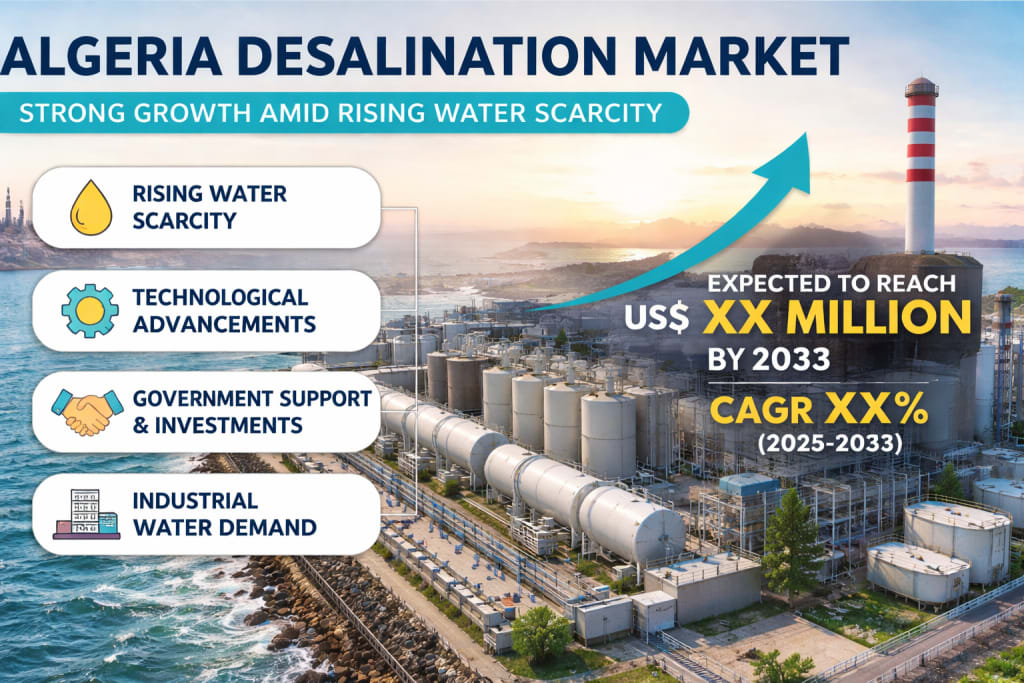
According to Renub Research, the Algeria desalination market is expected to reach US$ xx Million by 2033, growing from US$ XX Million in 2024, at a compound annual growth rate (CAGR) of XX% from 2025 to 2033. This growth reflects the country’s strategic focus on addressing water scarcity challenges while ensuring long-term economic and environmental sustainability.
Market Overview: Addressing Algeria’s Water Challenges
Algeria faces a unique combination of geographic and climatic constraints. With vast arid and semi-arid regions and limited freshwater reserves, the country is increasingly turning to desalination as a viable solution. Coastal regions, in particular, are benefiting from seawater desalination plants that provide potable water for both municipal and industrial use.
The desalination market in Algeria is characterized by a growing reliance on advanced technologies such as reverse osmosis (RO), multi-stage flash (MSF) distillation, and multi-effect distillation (MED). These technologies are enabling efficient conversion of saline water into usable freshwater, helping bridge the widening gap between water demand and supply.
Moreover, desalination is no longer limited to urban drinking water supply. Industries such as oil & gas, power generation, and manufacturing are increasingly dependent on desalinated water for operational efficiency, further expanding the market’s scope.
Growth Drivers: What’s Fueling the Market?
1. Rising Water Scarcity
Water scarcity remains the most significant driver of Algeria’s desalination market. Erratic rainfall patterns, prolonged droughts, and over-extraction of groundwater have intensified the need for alternative water sources. Desalination offers a dependable solution, particularly in coastal cities where seawater is abundant.
2. Technological Advancements
Continuous innovation in desalination technologies is transforming the industry. Reverse osmosis, in particular, has gained prominence due to its lower energy consumption and cost-effectiveness compared to traditional thermal methods.
Advancements in membrane technology, energy recovery systems, and hybrid desalination solutions are further enhancing efficiency and reducing operational costs. These developments are making desalination more accessible and economically viable across various sectors.
3. Government Initiatives and Investments
The Algerian government is playing a crucial role in promoting desalination through infrastructure development and policy support. Investments in large-scale desalination plants, along with incentives for research and development, are accelerating market growth.
Public-private partnerships (PPPs) are also emerging as a key model for financing and implementing desalination projects, enabling faster deployment and improved operational efficiency.
4. Industrial Demand for High-Quality Water
Industries require consistent and high-quality water for processes such as cooling, steam generation, and chemical processing. In water-scarce regions, desalination provides a reliable alternative, ensuring uninterrupted industrial operations.
As Algeria continues to diversify its economy and expand its industrial base, the demand for desalinated water is expected to rise significantly.
Market Challenges: Barriers to Overcome
Despite its strong growth potential, the Algeria desalination market faces several challenges:
High Capital Investment
Setting up desalination plants involves substantial upfront costs, including infrastructure, technology, and installation expenses. This can be a barrier, particularly for smaller municipalities and private entities.
Energy Consumption
Desalination processes, especially thermal methods like MSF and MED, are energy-intensive. High energy requirements not only increase operational costs but also raise concerns about carbon emissions and environmental sustainability.
Environmental Concerns
One of the most critical challenges is the disposal of brine, a byproduct of desalination. Improper handling can harm marine ecosystems, leading to regulatory scrutiny and public opposition. Addressing these concerns through sustainable practices is essential for long-term market growth.
Market Segmentation Analysis
By Technology
Reverse Osmosis (RO):
RO dominates the Algeria desalination market due to its efficiency and scalability. It is widely used for both seawater and brackish water desalination, offering lower energy consumption and operational costs.
Multi-Stage Flash (MSF) Distillation:
MSF is commonly used in large-scale plants. While effective, it is energy-intensive and gradually being supplemented by more efficient technologies.
Multi-Effect Distillation (MED):
MED offers improved energy efficiency compared to MSF and is gaining traction in specific applications, particularly where energy optimization is critical.
Others:
Emerging technologies such as electrodialysis and hybrid systems are gaining attention for their potential to enhance efficiency and reduce environmental impact.
By Application
Municipal:
Municipal applications represent a significant share of the market, with desalinated water being used for drinking and domestic purposes in urban and coastal areas.
Industrial:
Industries are increasingly adopting desalination to meet their water needs, particularly in sectors where water quality is critical.
Others:
This segment includes agriculture and aquaculture, where desalinated water is used in specialized applications.
By Water Source
Seawater:
Seawater desalination accounts for the largest share, driven by Algeria’s extensive coastline and abundant marine resources.
Brackish Water:
This segment offers a cost-effective alternative in regions with saline groundwater, requiring less energy than seawater desalination.
River Water and Others:
Although less common, these sources are used in specific scenarios where traditional water treatment methods are insufficient.
Regional Insights
Desalination activities in Algeria are concentrated in coastal and water-stressed regions:
Eastern Algeria: High population density and industrial activity are driving demand for desalinated water.
Western Algeria: Arid conditions and limited freshwater resources make desalination a critical solution.
Northern Algeria: While relatively water-rich, desalination is used to support industrial needs.
Southern Algeria: Increasing agricultural and industrial activities are boosting demand for alternative water sources.
Competitive Landscape
The Algeria desalination market is highly competitive, with both global and regional players actively participating. Key companies include:
Acciona
Dow
Evoqua Water Technologies
Siemens AG
DuPont
Doosan Enerbility
Toray Industries, Inc.
Xylem
These companies are focusing on innovation, particularly in membrane technology, energy efficiency, and hybrid desalination systems. Strategic collaborations, mergers, and investments in research and development are common strategies to gain a competitive edge.
Porter’s Five Forces Analysis
Supplier Power: Moderate, due to specialized components like membranes.
Buyer Power: Moderate, as high costs limit flexibility.
Competitive Rivalry: High, with numerous global players.
Threat of Substitutes: Moderate, with alternatives like water recycling.
Threat of New Entrants: Moderate, due to high capital and technical barriers.
SWOT Analysis
Strengths:
Advanced and evolving desalination technologies
Strong government backing
Weaknesses:
High capital and energy costs
Environmental concerns
Opportunities:
Expansion of sustainable and hybrid technologies
Increasing demand across industries
Threats:
Fluctuating energy prices
Regulatory and environmental challenges
Strategic Recommendations
To sustain growth and overcome challenges, stakeholders should consider the following strategies:
Invest in Energy-Efficient Technologies:
Reducing energy consumption is critical for improving cost efficiency and environmental sustainability.
Adopt Hybrid Systems:
Combining multiple desalination technologies can optimize performance and reduce costs.
Focus on Sustainability:
Incorporating renewable energy sources and improving brine management practices can address environmental concerns and enhance project viability.
Final Thoughts
The Algeria desalination market is on a strong growth trajectory, driven by the urgent need for sustainable water solutions. As water scarcity intensifies, desalination is becoming an indispensable component of the country’s infrastructure strategy.
While challenges such as high costs and environmental concerns remain, ongoing technological advancements and government support are paving the way for a more efficient and sustainable future. With increasing investments and innovation, Algeria is well-positioned to strengthen its water security and set an example for other water-stressed regions globally.
For investors, policymakers, and industry players, the message is clear: desalination is no longer an option—it is a necessity. And in Algeria, that necessity is rapidly transforming into opportunity.
About the Creator
Sakshi Sharma
Content Writer with 7+ years of experience crafting SEO-driven blogs, web copy & research reports. Skilled in creating engaging, audience-focused content across diverse industries.
Keep reading
More stories from Sakshi Sharma and writers in Trader and other communities.
Latin America Non-Lethal Weapons Market Trends & Summary (2025–2033)
The Latin America Non-Lethal Weapons Market is poised for steady expansion, projected to grow from US$ 407.51 million in 2024 to US$ 652.65 million by 2033, registering a CAGR of 5.37% from 2025 to 2033. This growth reflects a significant shift in regional security strategies, where governments increasingly prioritize effective yet humane law enforcement tools amid rising civil unrest and crime rates.
By Sakshi Sharmaabout 3 hours ago in Trader
Australia Data Center Construction Market Growth, Forecast, and Strategic Insights
As the global economy becomes increasingly digital, the need for advanced data infrastructure is growing rapidly. Data centers form the backbone of modern digital services, supporting cloud computing, artificial intelligence, online platforms, and enterprise IT systems. To support this digital transformation, Australia is experiencing a significant rise in data center construction projects across major cities and emerging technology hubs.
By Amélie Belle4 days ago in Trader


Comments
There are no comments for this story
Be the first to respond and start the conversation.