
Self‑Care Isn’t Selfish How To Build Sustainable Self‑Care Habits
Why self-care is essential for wellbeing and practical ways to build consistent, sustainable habits without guilt or burnout.

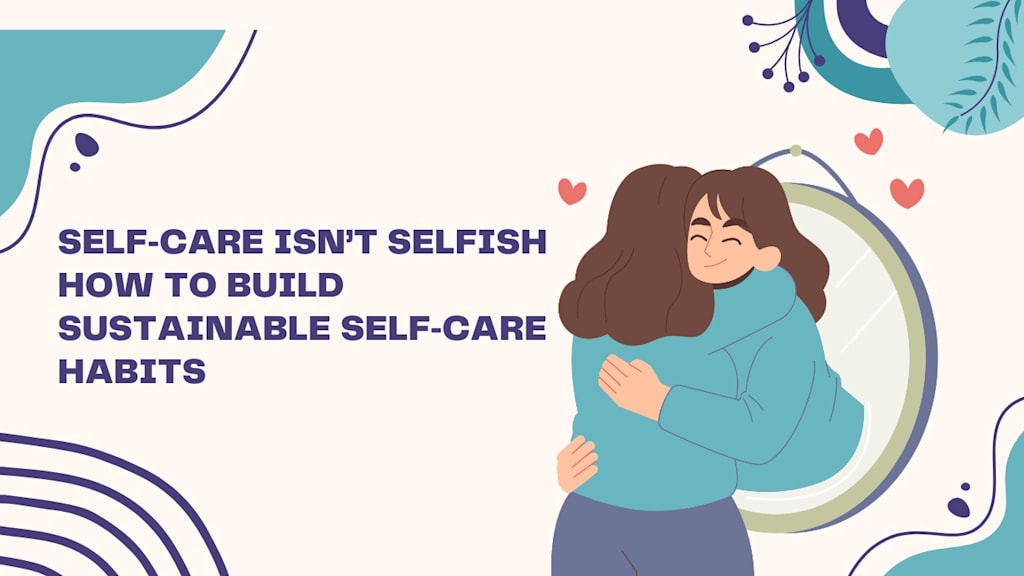
Self-care is commonly misinterpreted as something indulgent or luxurious, whereas actually, it is an essential component of an emotionally, mentally, and physically healthy person. There are numerous individuals who find it hard to take care of themselves by feeling guilty that they are ignoring their duties or their loved ones by taking care of themselves. The reality is however the converse, sustainable self-care makes you more energetic, patient and emotionally balanced to show up in life, relationships and responsibilities.
This paper explains why self-care is not selfish, how to get beyond the feeling of guilt about it, and how to establish long-lasting self-care practices that actually make a difference in long-term well-being.
The Truth of What Self-Care Means outside the Stereotype.
Self-care has been degraded to the most superficial practices such as spa days, vacations, or rare indulgences. Although they can be included in it, the real self-care is far wider and more vital. It involves any deliberate act that helps you emotionally, mentally and physically.
Self-care is essentially maintenance and not escape. The mind requires relaxation, limits, emotional management, and good habits just as the body requires food, rest, and exercise. In the absence of these, stress will build up, culminating in burnout, anxiety, and emotional exhaustion.
Sustainable self-care does not mean doing everything right. It is about always satisfying your needs in practical means that can be incorporated in everyday life. This change in perception contributes to the transitioning of self-care as an infrequent treat to a life routine.
The reason why people feel self-care is selfish.
The cultural conditioning, upbringing, or societal expectations make many people associate self-care with selfishness. In certain cultures, this kind of focus on the self is considered irresponsible or selfish. This ideology usually causes people to ignore themselves in the name of going overboard on other people.
Guilt is another reason why self-care is selfish. Individuals are not comfortable saying no, establishing limits, or taking time to themselves, particularly when other people rely on them. This economic guilt forms a loop of constantly shifting personal needs to the backburner.
Nevertheless, this thinking is premised on misconception. When a person is constantly exhausted, he/she becomes less able to care about others. Self-care does not mean a decision to take yourself above others, but rather to have the ability to support yourself and others in a healthy manner.
The Relationship between Emotional Health and Self-Care.
The ability to manage stress, boundaries, and internal balance is important in the emotional health. Emotional overload is a frequent occurrence in the absence of self-care. Little problems begin to become enormous and strength becomes weaker with time.
Self-care can be used to manage emotional responses by establishing space to recover and reflect. Rest, mindfulness, journaling, or even quiet time are some of the activities that enable the mind to process feelings rather than repressing them. This will minimize the accumulation of emotions and enhance clarity in making decisions.
When emotional needs are repeatedly disregarded, the body and mind will eventually react to it through burnout, irritability, or anxiety. This can be prevented by sustainable self-care that ensures that there is a balance of emotions before one reaches a crisis level.
Occasional efforts are not as important as they should be sustainable self-care.
Among the greatest misperceptions about self-care is the fact that it should be large or time-consuming to be effective. As a matter of fact, consistency is much more important than intensity. Even minor, daily activities have a more significant long-term effect than intensive actions that are done occasionally.
Sustainable self-care aims at being part of normal life. It does not wait until one gets tired to take a break but promotes frequent maintenance. This may involve a routine of limits, sleep, short breaks or mindful breathing in the day.
Self-care should be an everyday habit, then it will not be an addition to the burden of work and a routine. This minimizes resistance and eases its maintenance.
How to Get Over the Self-Care Guilt.
One of the largest obstacles to self-care practice is guilt. Most individuals have the perception that they have to deserve to rest or have a relax, or that they have to put themselves first as otherwise they are letting down others. To overcome this mindset, it is necessary to redefine the definition of self-care.
A positive change that can be useful is the idea that your health directly influences how well you perform in every aspect of life. You are more present, patient and effective when you are rested and emotionally balanced. It is not only beneficial to yourself, but to the people surrounding you as well.
Self-compassion is another step that is important. Rather than being self-critical that you are tired or require room, recognize that these are human and normal needs. This helps to relieve guilt and eventually makes self-care more natural instead of something that is optional or indulgent.
Formulating Greener Essentials of Self-Care in Everyday Life.
Simple things will form the basis of building sustainable self-care habits. The best habits are the ones that are realistic, repeatable and that can be adjusted to your lifestyle. Self-care is something that is normally overcomplicated and thus inconsistent.
Begin by determining small behaviors that can help you be well. This may involve consuming adequate water, having brief spells at work, stretching or having a couple of minutes off the screens. These minor practices create a base of security.
Habit stacking, which is an association of self-care practices with current routines, is another important strategy. As an example, you can form a habit of deep breathing immediately after brushing your teeth or going on a short stroll after eating a lunch to incorporate self-care into everyday life.
The Position of Boundaries in Quality Self-Care.
One of the most significant elements of sustainable self-care is boundaries. Personal energy can be overstretched without any limits and there is hardly any room to rest. Boundaries assist in determining what is acceptable and not regarding time, energy and emotional investment.
Boundaries can also be establishing no to taking on more, no to being exposed to stressful situations, or no to personal time. Although this may be uncomfortable initially, it is necessary in the long-term health.
Healthy boundaries do not drive people away, they safeguard your capacity to interact with others in a meaningful manner without getting affected emotionally.
The Emotional Self-Care: Caring about Your Inside World.
Self-care is not physical only, emotional self-care is also significant. It is the recognition and the processing of emotions instead of denying or repressing them.
Self-care can involve keeping a journal, talking to someone you confide in or just letting yourself feel without being judged. Emotions are less apt to accumulate into excessive stress when they are handled on a regular basis.
When emotional needs are ignored, burnout, irritability, or even emotional numbness are likely to occur. Emotional self-care, in turn, is useful in preserving internal balance and in building healthier relationships with yourself and others.
Physical Self-Care as the Principle of Well-Being.
Physical self-care is a more apparent self-care, and yet it is also one of the most overlooked self-care. Basic to the overall health are sleep, nutrition, movement, and rest.
Emotional resilience is lowered when the body is tired or malnourished. Even basic routines such as getting enough sleep, drinking water and exercising your body can have a significant effect on clarity of mind and feelings.
Physical self-care is not about being perfect or on the schedule- it is about being consistent and attentive to what your body requires.
The Long-term Guide to Self-Care.
In self-care, one needs flexibility, not rigidity, to be sustainable. Life evolves, time of changes, and energy is different. Instead of collapsing under pressure, a sustainable self-care system is flexible to these changes.
A solution to longevity is to establish a minimum level of self-care. These are habits that you will not compromise on even during busy days like basic sleep, hydration or having a few moments of rest.
The other approach is self awareness. It is important to check with yourself on a regular basis to determine when you need to make adjustments. Self-care must change with your life, it should not stay the same.
Why Self-Care Enhances Relationships and Productivity.
Consistent self-care has a positive effect on any sphere of life. It brings about improved communication, patience and emotional availability in relationships. When you are not emotionally depleted, you can have a stronger interest with others.
Self-care increases productivity in terms of focus, decision-making, and energy levels. Rest is not slacking the productivity, contrary to the notion that it does so, it increases performance by preventing burnout and keeping the mind clear.
Sustainable self-care develops a balance in which personal well-being and the external obligations can mutually coexist without opposition.
Conclusion
Self-care is not an egoistic action—it is a necessity. It is the base, which sustains emotional stability, mental clarity and physical well-being. In its absence, stress levels build, burnout is a greater threat, and overall well-being becomes worse.
Developing sustainable self-care practices does not involve radical transformations or ideal schedules. It is concerned with small and regular steps that sustain you in the long run. Self-care is simple and essential to living a good life, which is achieved through overcoming guilt, setting boundaries, and incorporating simple practices into everyday life.
In conclusion, self-care is not a matter of deciding between personal or collective things. It is about making sure that you are strong, stable and emotionally fit to be there in all aspects of your life. Self-care does not mean selfishness, it is a way of maintaining yourself in the long run.
About the Creator
Mark Hipster
Lifestyle speaker Mark Hipster, 40, based in Saudi Arabia, sharing powerful insights on growth, balance, and modern living to inspire positive change.
Keep reading
More stories from Mark Hipster and writers in Longevity and other communities.
Why Setting Realistic Expectations Improves Mental Health
Expectations are a normal aspect of human life. We demand of ourselves, other people, and the world. These expectations assist in planning, inspiring us to operate and establish a direction. But in instances where the expectations are not realistic or too fixed, expectations may cause disappointment, stress, anxiety, and burnout of emotions.
By Mark Hipstera day ago in Longevity
Microsoft's Purposeful Marketing Deception About AI's Ability To Beat Physicians In Diagnosis
When you look at the world of scientific research... If you are not careful... You will be fooled into believing things that are not actually supported by the data.
By Dr. Cody Dakota Wooten, DFM, DHM, DAS (hc)24 days ago in Longevity
The Day My Mother Stopped Hiding Her Grey Hair
It was a Sunday afternoon. The kind of slow, quiet Sunday where the whole family is home but nobody is really doing anything. My mother was sitting near the window, the afternoon light falling directly on her hair, and for the first time in years—she had not tied a dupatta over her head.
By Kirpal Export Overseas7 days ago in Longevity



Comments
There are no comments for this story
Be the first to respond and start the conversation.