
How To Replace Old Stress Patterns With Healthy Emotional Habits Forever
Identify triggers, consciously practice new coping responses, and reinforce them consistently until they become automatic emotional habits.

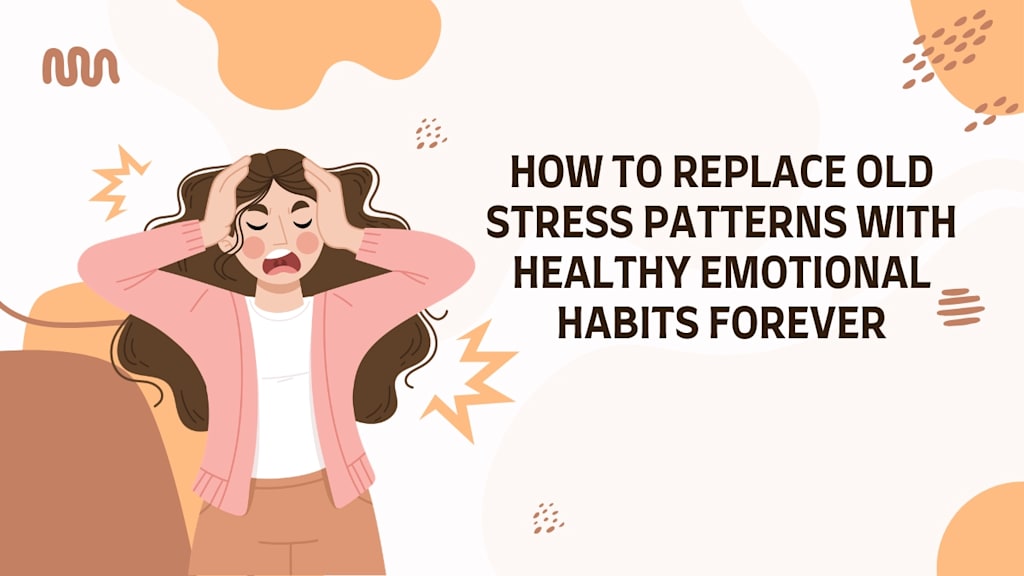
Stress does not occur as a mere occurrence during trying times. It turns into a habit, a habit of automatic response of the mind and body to pressure, uncertainty or emotional uneasiness in many people. Such stress patterns become so normal that they seem normal even as they are damaging mental health, relationships and general well being.
The bad news is that stress patterns are not here to stay. They are conditioned reactions and this implies that they can also be unconditioned and new ones acquired. Re-training the brain, calming the nervous system, and creating a more balanced approach to life problems is possible by creating healthy emotional habits.
This paper will discuss the formation of stress patterns, the reasons why they become repetitive, and how we can substitute them with more healthy emotional patterns that will help us be more peaceful and stable in the long run.
Learning How Stress Patterns Are Created In The Mind.
Patterns of stress tend to be developed by repetition. As an individual encounters stressful circumstances on a consistent basis, the brain starts relating the circumstances to danger or discomfort. With time, the body becomes automatic to the extent that it takes place before an individual consciously thinks of what is occurring.
As an example, a person who has been raised in a critical environment can learn to react to feedback or to being corrected with a stress response. Even neutral discussions can result in tension, anxiety, or defensiveness since the brain has learned to anticipate an emotion threat.
They are not only stored in thoughts but also in the nervous system. This is the reason why stress reactions tend to be automatic and hard to manage. It is not that the mind is deliberately overreacting; it is merely using the survival pathways taught to it.
This is significant to understand since it eliminates self-incrimination. Stress patterns are not character weaknesses, they are conditioned reactions which can be re-trained with consciousness and training.
Why Old Stress Patterns Persevere despite being harmful.
Although stress patterns may lead to discomfort, they are often perpetuated since they are accustomed to. The brain would rather have predictability than uncertainty, although this predictability may be unpleasant. Emotional responses are less dangerous than unfamiliar ones.
The other reason as to why these patterns are perpetuated is that they are strengthened through repetition. The neural pathway is reinforced every time an individual responds in a similar stressed manner. This makes it a vicious circle where the stimuli elicited by stress result in automatic responses which further perpetuate the cycle.
Also, a lot of individuals do not know their inner reactions to stress. Unconsciously, there is no possibility to break or modify the pattern. The process repeats itself until stress becomes chronic or overwhelming.
It will take awareness and deliberate action to stop this cycle. It is not to make the mind quit but to retrain it to begin to respond differently as time goes on.
Developing Sensitivity To Emotional Cues and reactions to stress.
The initial process in the process of substituting old stress patterns is awareness on the factors that trigger them. Examples of triggers include external (specific situations, conversations, environments), and internal (thoughts, memories, expectations).
Awareness involves observing not only the stimulus but also the response of the body to the stimulus. They are manifested physically by stress in the form of tightness in the chest, shallow breathing, muscle tension, or racing thoughts. These are significant signals as they come prior to emotional escalation.
Whenever the individual starts to notice these initial indicators without making a judgment, he leaves a distance between stimulus and response. It is in that gap that change is possible. The mind starts to arouse to, rather than respond in an automatic fashion, it starts to become aware, this is a stress response, not an emergency.
This is an imperceptible yet strong change. It turns the stress that is in control into something that can be seen. This consciousness is the basis of new emotional habits over time.
Substituting Reactivity with Conscious Emotional Responses.
Stress patterns of the past are usually reactive. They are spontaneous, unthought, and habitual instead of conscious. To get them replaced, it is necessary to learn to take a moment before responding.
It is in this break that emotional transformation starts. At this time, rather than responding with tension or anxiety, an individual can start by making a different response choice. This can include slowing the breath, taking a mental break out of the situation, or just accepting the emotion without taking action on it in the moment.
The conscious emotional responses do not involve the suppression of stress but space around it. Giving the nervous system some time to calm down, the reaction intensity drops automatically.
This new response starts to supplant the old response with repetition. The brain becomes aware that not all triggers need a stress reaction and as time passes the automatic pattern becomes weaker.
Training Emotional Healthy Habits To Help you be calm.
Changing stress patterns goes beyond just having to omit old reactions, but instead, new emotional habits that facilitate stability have to be developed. Such habits assist the nervous system to restore balance much easier and avoid the build-up of stress.
Emotional awareness during the day is one of the habits. This involves checking in with yourself frequently and not leaving it until the stress is too great. Emotions can be easily controlled when they are observed at their initial stage.
The other key habit is purposeful slowing down. Stress has a tendency to be fast-paced, rushed thinking, rushed decision-making, rushed response. The decrease even a bit can cause the emotional intensity to decrease and bring about the clarity of the mind.
Other healthy emotional habits are letting emotions be experienced without judgment. Emotional suppression reinforces many patterns of stress. Emotions become weakened with time when they are accepted and worked through rather than being pushed aside.
Consistency is key. Such habits need not be ideal or extreme. They must be repeated to the extent that the brain starts to make them the new default response.
Training The Nervous System To Be Balanced.
Patterns of stress are not merely mental- they are closely intertwined with the nervous system. This implies that the body also needs to be soothed along with the mind to achieve permanent change.
With repeated stress activating the nervous system, there is increased sensitivity in the nervous system over time. even small difficulties start to seem bigger than they are. Repeated experiences of safety and calm are what are required of the body to turn this around.
Simple techniques like slow breathing, conscious awareness and physical release are some of the ways to help the nervous system to know that it is safe to relax. These signals recondition the default reaction of the body, over time.
With nervous system becoming increasingly controlled, so are the emotional reactions balanced. Cases previously causing intense stress responses start to seem less challenging.
It is not a one-day affair. Gradual re-tuning of body response to life. However, change becomes entrenched with consistency.
Giving up Identity-Based Stress Beliefs.
Identity-based beliefs that reinforce many patterns of stress include: I am a stressed person, I always react in that way, or I cannot handle pressure. These thoughts cause stress patterns to seem unchangeable and permanent.
It is possible to change stress patterns by challenging these internal narratives. Rather than perceiving stress as an identity, it is also perceived as a learned response. This difference is potent in that it leaves the option of change open.
When an individual starts perceiving himself or herself as a learner of new emotional habits instead of a victim of old patterns, change will become more attainable. The identity changes slowly when the new responses are rehearsed.
With time, the mind starts to be in consistency with new experiences as opposed to past assumptions. The belief is shifted to this is what I was doing but now I am learning something new.
Producing Long-Term Emotional Stability With Consistency.
A long-term change is not achieved by exerting effort but by doing it over time. Patterns of stress that have been developed over years are not something that can be substituted within a moment but can be reformed through repetition.
Whenever an individual reacts to stress in a different manner, however simply, he/she reinforces a new emotional channel. In the long run, these minor developments would create a permanent change.
Unity also creates trust. The more people start to observe the fact that they can react to stress in different ways, the more they feel in control. This lessens anxiety about emotional instigations and helps increase stability.
In the long run, automatic stress will turn into a less strict response system. There are still difficulties in life, and the inner life of these difficulties is transformed dramatically.
Conclusion
It takes time and awareness, patience and practice to replace old stress patterns with healthy emotional habits. Stress is not merely vanishes, but it can be changed.
The mind and body learn to deal with pressure in new ways by learning how stress patterns are formed, becoming conscious of triggers, understanding how to create space between reaction and response, and learning to develop healthier emotional habits.
As time goes on, the nervous system becomes more balanced, emotional responses less intense, and everyday life becomes more manageable. Most importantly, people start to have a stronger feeling of inner stability which does not lie in external situations.
Emotional change is not about getting rid of stress, but rather the development of the capacity to pass through it mindfully, calmly, and resiliently. That is the way old patterns of stress are not only coped with, but also substituted permanently.
About the Creator
Mark Hipster
Lifestyle speaker Mark Hipster, 40, based in Saudi Arabia, sharing powerful insights on growth, balance, and modern living to inspire positive change.
Keep reading
More stories from Mark Hipster and writers in Longevity and other communities.
Why Setting Realistic Expectations Improves Mental Health
Expectations are a normal aspect of human life. We demand of ourselves, other people, and the world. These expectations assist in planning, inspiring us to operate and establish a direction. But in instances where the expectations are not realistic or too fixed, expectations may cause disappointment, stress, anxiety, and burnout of emotions.
By Mark Hipster2 days ago in Longevity
Microsoft's Purposeful Marketing Deception About AI's Ability To Beat Physicians In Diagnosis
When you look at the world of scientific research... If you are not careful... You will be fooled into believing things that are not actually supported by the data.
By Dr. Cody Dakota Wooten, DFM, DHM, DAS (hc)25 days ago in Longevity
How Sleep And Nutrition Affect Your Mental Health Deeply
Sleep and nutrition are two of the most effective factors that affect mental health and are frequently ignored when mentioning your feelings, thoughts, and stress. These are the basic elements of everyday life that have a direct effect on brain activity, emotional control, and mental stability in general. Even the best coping strategies would not work without enough sleep and eating well.
By Olivia Smitha day ago in Longevity


Comments
There are no comments for this story
Be the first to respond and start the conversation.