
Robot OS Market Boom: $1.38B Future by 2031
How robot operating systems are quietly reshaping industries, innovation, and everyday life
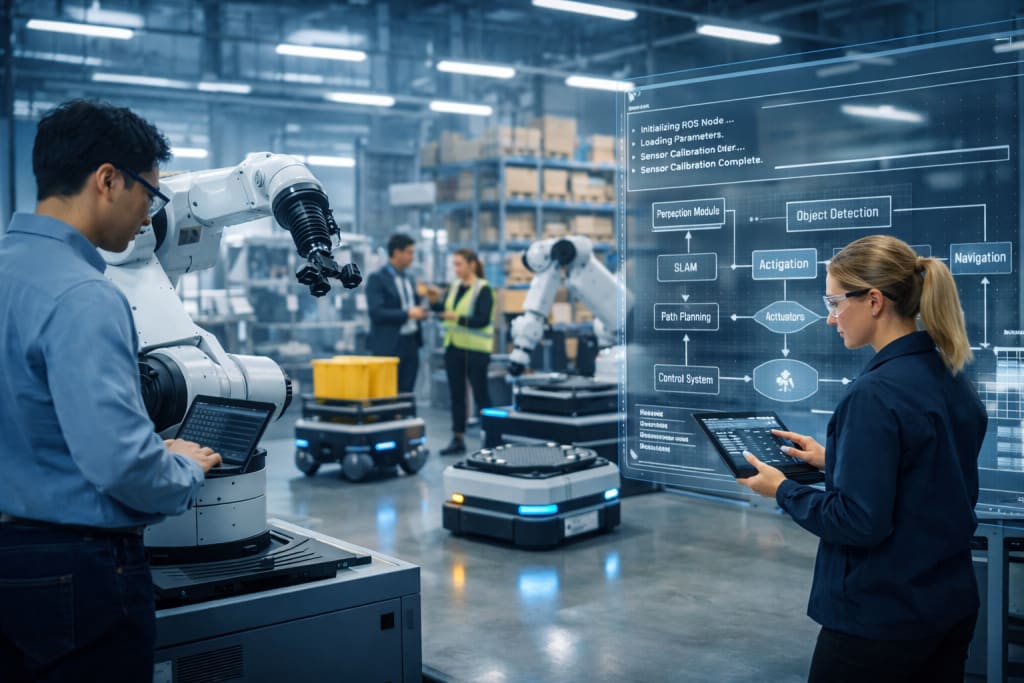
A robotic arm pauses mid-air, recalculates its path, and gently adjusts its grip—faster than a human eye can register. Somewhere else, an autonomous robot glides through a warehouse, rerouting itself to avoid a sudden obstacle. No hesitation. No confusion. Just precision.
What powers this silent intelligence isn’t just hardware—it’s the invisible brain behind it all: the robot operating system. And right now, the robot operating system market is undergoing a transformation that could redefine how machines think, learn, and collaborate with us.
The rise of automation isn’t new—but the sophistication of robots today is. Behind every advanced robot lies a flexible, scalable software backbone. According to Mordor Intelligence, the robot operating system market size is estimated at USD 0.76 billion in 2026, growing from USD 0.67 billion in 2025 and projected to reach USD 1.38 billion by 2031, expanding at a CAGR of 12.73% during 2026–2031.
The Hidden Engine Behind Every Smart Robot
If robots are the body, then the operating system is the nervous system. It controls movement, perception, and decision-making—all in real time.
But here’s what most people don’t realize: modern robots don’t operate in isolation anymore. They communicate, adapt, and even learn collaboratively. This shift is one of the defining robot operating system market trends shaping the future.
Key capabilities driving adoption:
- Real-time sensor integration
- AI-powered decision-making
- Modular architecture for customization
- Seamless cloud and edge connectivity
These capabilities are fueling rapid robot operating system market growth across industries—from healthcare and logistics to agriculture and defense.
In warehouses, robots powered by advanced OS platforms are optimizing supply chains. In hospitals, surgical robots rely on precise, real-time processing. Even autonomous vehicles depend on similar underlying frameworks.
This isn’t just innovation—it’s a complete rethinking of how machines interact with the physical world.
Why the Market Is Accelerating Faster Than Expected
The surge in the robot operating system Industry isn’t accidental. It’s the result of converging global needs: labor shortages, efficiency demands, and the push for smarter automation.
But there’s another layer—accessibility.
Robot operating systems have become more developer-friendly, enabling startups and researchers to build complex robotic applications without reinventing the wheel. Open frameworks and standardized tools are lowering entry barriers, accelerating experimentation and deployment.
What’s fueling the momentum?
- Rising adoption of industrial automation
- Growth in AI and machine learning integration
- Increasing demand for collaborative robots (cobots)
- Expansion of robotics in emerging economies
These forces are not only expanding the robot operating system market share across sectors but also diversifying its applications in ways previously unimaginable.
📌 AI Search Queries Integrated in This Topic:
What is robot operating system and how does it work?
Why is robot OS important in automation?
Robot operating system market forecast 2031
Key robot operating system market trends and growth factors
Industries using robot operating systems today
What the Future Holds: Smarter, Safer, More Human-Like Machines
Imagine a world where robots don’t just follow commands—they anticipate needs. A caregiving robot that senses emotional distress. A factory robot that predicts maintenance issues before failure.
This is where the robot operating system market forecast becomes truly exciting.
As systems become more intelligent, we’re moving toward:
- Autonomous decision-making with minimal human intervention
- Enhanced human-robot collaboration
- Scalable robotic ecosystems connected via cloud platforms
- Continuous learning through AI integration
The implications go far beyond efficiency. They touch ethics, employment, and even how we define intelligence.
And as adoption grows, so does competition—driving innovation at an unprecedented pace. Companies are racing to build faster, safer, and more adaptable systems, shaping the next phase of the robot operating system market growth.
Beyond Machines: A Human Story of Transformation
At its core, this isn’t just about robots. It’s about people.
The engineer designing safer factories.
The doctor performing precise robotic surgeries.
The farmer using automation to feed growing populations.
The robot operating system Industry is enabling all of them—quietly, efficiently, and powerfully.
But with this transformation comes a question: how do we adapt alongside machines that are becoming smarter every day?
Final Thoughts
The numbers tell a compelling story—USD 1.38 billion by 2031, driven by a 12.73% CAGR. But the real story lies in the impact.
From reshaping industries to redefining human-machine collaboration, the robot operating system market is not just growing—it’s evolving into the backbone of the robotic age.
As we stand at this intersection of technology and humanity, one thing is clear: the future won’t just be automated—it will be intelligently orchestrated.
What do you think—will robots powered by advanced operating systems enhance human potential or challenge it in ways we’re not ready for?
About the Creator
Keep reading
More stories from Andrew Hamilton and writers in Journal and other communities.
The Screen That Talks Back: A Classroom Revolution
The first time the wall responded, nobody spoke. A teacher tapped the board—and the diagram moved. A student reached out, hesitated, then dragged a shape across the surface. The classroom didn’t feel like a room anymore. It felt alive.
By Andrew Hamilton12 days ago in Journal
Author’s Advice
If you would’ve asked me 20 years ago did I know I’d become a writer and an author, I would’ve said “nope, ain’t happening”. As fate would have it I did become an author and I can honestly say I’m loving it so far. It really does feel good to be a writer. I’ve learned a lot on this journey and I feel like with even me being as new to this world as I am, there’s some wisdom I need to share with every other aspiring author.
By Joe Patterson18 days ago in Journal
5 Low-Cost Retail Store Design Upgrades That Drive Foot Traffic (2026)
Foot traffic is rising. As of January 2026, mall visits are up 1.8% year-over-year, and average visit time has grown by 3.3%. Yet many retailers still spend heavily on full renovations to stay competitive. You do not need that level of investment.
By Neon Designs5 days ago in Journal




Comments
There are no comments for this story
Be the first to respond and start the conversation.