
🌕 Humanity Returns to the Moon After 50 Years
From NASA’s Apollo Program to the Artemis Program — The Moon Becomes Humanity’s Next Frontier Again


A New Era of Space Exploration
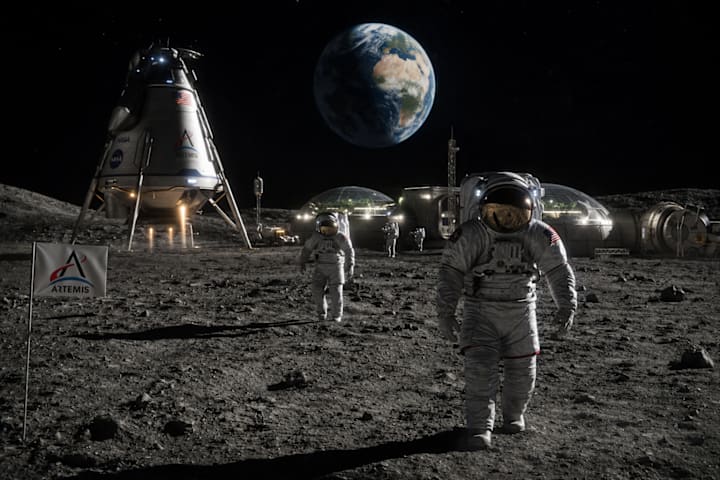
For the first time in more than 50 years, humanity is preparing to return to the Moon. The last time astronauts walked on the lunar surface was during Apollo 17 in 1972. Since then, the Moon remained quiet, visited only by robotic spacecraft and satellites. But today, a new space race has begun — and this time, the goal is not just to visit the Moon, but to stay.
The return to the Moon marks one of the most exciting moments in modern history. Governments, private companies, and international partnerships are working together to build a permanent human presence beyond Earth.
Why Did Humans Stop Going to the Moon?
After the success of the Apollo missions, interest in lunar exploration declined. The missions were expensive, and governments shifted focus toward building space stations and exploring other planets. Programs like the International Space Station became the new priority.
Additionally, technology at the time was limited, and there were fewer long-term benefits seen from lunar missions. As a result, human exploration of the Moon paused for decades.
However, today the situation has changed.
Why Are Humans Going Back Now?
There are several important reasons why the Moon has once again become a priority:
1. Preparing for Mars Missions
The Moon serves as a testing ground for future missions to Mars. Scientists want to test technologies like long-term habitats, life support systems, and resource extraction before sending astronauts to Mars.
2. Discovering Water and Resources
Recent discoveries show that the Moon contains frozen water at its poles. This water could be used for drinking, growing food, and even producing rocket fuel. This makes long-term lunar missions more practical.
3. Building a Permanent Lunar Base
Unlike the Apollo missions, which lasted only a few days, the new missions aim to build a permanent base. This could allow astronauts to live and work on the Moon for months at a time.
The Artemis Program: The Next Giant Leap
NASA has launched the Artemis Program, which aims to return astronauts to the Moon. This program is historic for several reasons:
- It will land the first woman on the Moon
- It will land the first person of color on the Moon
- It aims to build a sustainable lunar presence
The Artemis program includes multiple missions:
- Artemis I — Uncrewed test flight (completed successfully)
- Artemis II — Astronauts orbit the Moon
- Artemis III — Humans land on the Moon again
This will be the first human Moon landing in more than 50 years.
Private Companies Join the New Space Race
Unlike the 1960s space race, today private companies are playing a major role. Companies like SpaceX and Blue Origin are developing rockets and lunar landers.
Elon Musk’s Starship rocket is expected to carry astronauts to the Moon as part of the Artemis missions. This marks a new era where governments and private companies work together.
A New Global Space Race
The United States is not alone in this effort. Countries like China, India, and Russia are also planning lunar missions.
China has already landed robotic spacecraft on the Moon and is planning to send humans in the future. India’s lunar missions have also gained global attention. This growing competition is often called the New Space Race.
But unlike the Cold War era, today there is also strong international cooperation.
What Will Humans Do on the Moon?
Future astronauts will not just plant flags. They will:
- Build lunar habitats
- Conduct scientific research
- Mine resources
- Test new technologies
- Prepare missions to Mars
Scientists believe the Moon could become a stepping stone for deep space exploration.
The Future of Humanity Beyond Earth
The return to the Moon is more than just another space mission — it is the beginning of humanity becoming a multi-planetary species. Living and working on the Moon will help humans prepare for exploring deeper into space.
For the first time in history, children growing up today may one day see permanent human settlements on the Moon.
After 50 years of silence, the Moon is calling humanity again — and this time, we are going back to stay.
About the Creator
Wings of Time
I'm Wings of Time—a storyteller from Swat, Pakistan. I write immersive, researched tales of war, aviation, and history that bring the past roaring back to life
Keep reading
More stories from Wings of Time and writers in Humans and other communities.
When International Relations Shape the World We Live In
When International Relations Shape the World We Live In International relations are not limited to world leaders shaking hands at summits or exchanging sharp words on television. They represent a complex system of interactions that quietly shape economies, security, culture, and the daily lives of people across the globe. Every treaty signed, every sanction imposed, and even every diplomatic silence carries consequences that often reach far beyond borders.
By Wings of Time 3 months ago in Humans
12 Life Lessons The Golden Girls Taught Us
Picture it: Miami, 1985. Four middle-aged actresses agree to play the characters of Blanche, Rose, Dorothy, and Sophia who share a home in a TV sitcom called The Golden Girls, unaware at the time of the kind of impact the show would leave on its adoring fans. The show aired until 1992, ending with a one-season spinoff called Golden Palace. The seven years we were graced with The Golden Girls on our television screens made its mark. More than three decades after Susan Harris’ imagination sparked the creation of these iconic characters, fans from around the world still watch reruns of The Golden Girls, spend time discussing the show on social media in Facebook groups like The Golden Girls Fanatics, carry Sophia-inspired handbags and relate to the episodes in their daily lives.
By Criminal Matters5 days ago in Humans
Something Is Beginning, I Think Challenge Winners
This challenge wasn’t about clean starts. It was about that weird in-between where something is beginning, but no one really knows what yet. A lot of these stories leaned into hesitation, into pauses and false starts and that feeling that something is about to happen but hasn’t quite.
By Vocal Curation Team7 days ago in Resources



Comments
There are no comments for this story
Be the first to respond and start the conversation.