
The Charm in the Seed Linen
Rural Institutional Horror

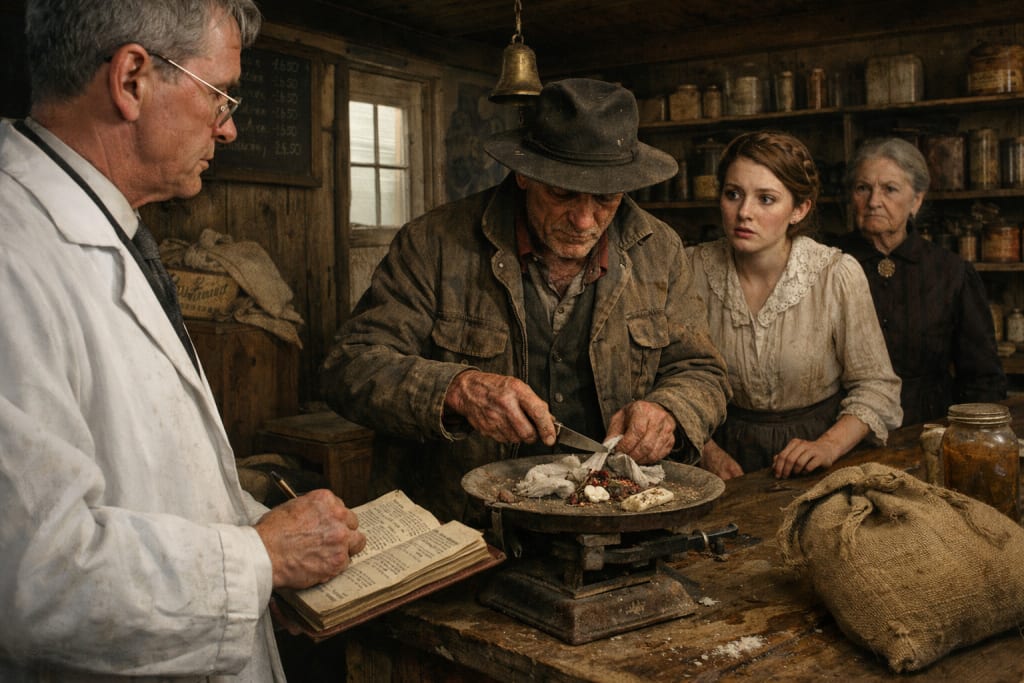
By August our town smelled of boiled starch, horse sweat, and the sort of virtue that has to be ironed flat every morning. I was stitching up a boy’s thumb in the back room of my surgery when Mrs. Vale remarked, quite cheerfully, that the Reed girl had begun asking where the charm-cloths came from, and that was how I knew something tiresome was afoot.
We were three hundred souls, give or take a burial and a christening, which in practice meant everyone belonged to everyone else’s opinion. In a place like ours, respectability was not a moral quality but a communal appliance. One kept it polished, and if it shocked you now and then, that only proved it was functioning.
The town’s order was maintained by custom, which is to say by women with straight backs and men too tired to oppose them. Mrs. Hester Blain, who had outlived two husbands and most objections, oversaw the little courtesies that made up our civic theology. She praised those who asked no vulgar questions. She corrected a hand laid wrong on a table. She answered concern with compliments. “Alma’s a clever girl,” she would say, smiling a fraction too long, “which is why she needn’t go poking in what older folks have already put right.” Praise is the cheapest bridle ever made. That is why society prefers it.
Miss Alma Reed taught sums to the younger children and reading to the older ones, which put her in daily conflict with the town’s interests. Education is admirable in girls right up to the moment it begins to produce conclusions. She was twenty-six, neat, capable, and still untrained in the first rule of communal life: never follow a tradition to its source if the source can stain the table linen.
All summer the charm-bundles hung where they ought to hang: over stable doors, beside pantry shelves, above the flour scale at Granger’s store. Little packets of folded white cloth tied with red thread, pressed flat as prayer books. They were said to keep rot from potatoes, fever from nurseries, milk from turning, men from wandering, and talk from spreading. One must admire efficiency. Modern medicine, for all its instruments, had never managed so broad a jurisdiction.
The script around them was perfectly serviceable. We do not discuss old materials. We do not pry at women’s work. We do not bring dirt into the house, nor house-things into the yard, nor either sort of truth into company. If a child pointed at a charm, some aunt redirected the hand. If a hired boy asked what was sewn inside, somebody laughed too loud, then regained composure and told him to fetch water. If Alma raised the matter at the post office, she received a smile, a loaf, and a warning not to get herself a reputation for oddness. In communities of refinement, ostracism is often delivered in pastry.
The outsider arrived on a Thursday at Granger’s feed store, where the floorboards held so much old grain dust that any step seemed historical. His name was Mr. Tobias Wren, a county livestock inspector out of Fairwick, though he had the look of a man who had been educated past his own comfort. He had the habit of brushing soil from his cuffs before speaking to anyone, as though he preferred his facts free of local seasoning. He also had a dry, unfinished cough he apologized for each time, which made people distrust him. Nothing alarms the healthy like a polite symptom.
Alma met him there while ordering copybooks and lamp oil. I was present because Granger’s wife had developed a swelling she wished to call “nothing at all,” and I indulge that diagnosis in paying customers. Mr. Wren noticed the charm above the flour scale. Alma noticed that he noticed. In human terms, this was courtship only in the sense that avalanches begin with weather.
He asked, mildly enough, who prepared the cloth packets. Granger said the women did, as they always had. Mr. Wren asked what cloth they used. Granger laughed. Alma did not. Mrs. Blain, who had entered without anyone hearing the bell, answered for the room. “Clean linen,” she said. “And family care.” Her tone made the phrase sound older than Scripture and less negotiable.
Then came the little maneuvers by which a town protects itself from knowledge. Mrs. Blain took Alma’s parcel from her hands without comment and set it aside. She complimented Alma’s dress instead of answering her question. Granger’s daughter offered Mr. Wren a shared cup of water, smiling too fixedly. Someone repeated, word for word, that one ought not meddle in remedies that had served since before the rail line. A farm boy reached toward the charm and Mrs. Blain corrected the placement of his wrist as if he had attempted indecency. A whisper moved through the room, private in the theatrical sense only. Even the store bell seemed to ring with disapproval.
Mr. Wren, being neither local nor prudent, stepped onto the counter ledge and cut the charm loose with his pocketknife.
That was the boundary. Not the question, you understand. The opening.
He unfolded the cloth on the flour scale as carefully as a clerk opening disputed wills. Inside lay a twist of hair, a child’s milk tooth wrapped in thread, and a second scrap of linen browned stiff at one corner. He touched it, sniffed once, and looked at me. “This was used at a bedside,” he said. “Likely to wipe the mouth. Fever house, I’d say.”
No thunder followed. The building did not darken. The horse outside kept swishing flies from its flank. That is the disappointment of truth: it rarely has enough theatre for the audience it deserves.
Alma stared at the cloth as if it had spoken. Mrs. Blain stared at Alma as if Alma had. Then Mr. Wren committed the final offense. He asked whether the packets were made from the linens kept after the Vanner children died in the spring outbreak.
Nobody answered. In my profession one learns that silence is not the absence of data but its storage.
Alma did what sensible people do when confronted with a fact too ugly for immediate use. She carried it home in her head and turned it over there, privately, where it could do the maximum damage. Over the next two days she visited three houses on one excuse or another and found the same folded cloth, the same red thread, the same warning smiles. Mrs. Blain told her not to distress herself. Her aunt said the old ways were old because they worked. The pastor’s wife said some matters became dangerous only when named. This is true of mold, taxes, and family lies.
A week passed. Time is never more sinister than when it behaves with complete administrative normalcy. The oats came in. The schoolroom was aired. The bell rang. I signed two birth notices, one land transfer, and a statement that a pig had died of nothing communicable. Bureaucracy is a splendid training ground for damnation because it teaches the hand to proceed even when the mind has raised an objection.
Alma fell ill on the twelfth day.
It began with soreness in the throat and a tiredness she blamed on heat. Then came the low fever, the pain behind the jaw, the breath that shortened when she climbed the stairs to her room. She told no one at first except her aunt, who told everyone in the approved language. Alma had overworked. Alma was run down. Alma had a delicate constitution under all that schoolmarm briskness. Mr. Wren had already left town; this improved matters immensely, as the absent are useful storage for blame.
When I examined her, I found inflamed glands, a foul membrane at the back of the throat, and the particular sweet-sick smell that tells a physician he is already late. I wrote down probable infection and said aloud that she must rest and avoid agitation. One says these things because they are medically adjacent and socially ideal. Her aunt asked whether it was catching. I replied that panic was never helpful. This satisfied everyone except Alma.
She could still speak then, though swallowing hurt her. She asked me if the Vanner linens had been cut up after the children died. She asked whether the women wet the thread with their mouths when tying the charms. She asked whether the packet above Granger’s scale had brushed the flour scoop. She asked whether we had done this for years.
I told her she must conserve strength.
That answer was considered kind. It was also, from an experimental standpoint, efficient. Under observation, communities prefer euphemism to intervention right up to the point where the subject stops objecting. After that, they call the whole process providence.
Mrs. Blain organized the house with admirable calm. Windows were polished but not opened. Visitors were admitted in a line and praised for brief calls. Questions were turned aside with remarks on Alma’s courage. Her schoolchildren sent posies and were instructed not to mention illness, death, old cloth, the Vanners, or Mr. Wren. In short, they were taught citizenship.
By the sixteenth day Alma could barely manage water. Her aunt dabbed her mouth with a folded handkerchief of very fine linen. I noticed the red thread on the hem and said nothing. Complicity, like most village products, is handmade.
The breaking point came from a child, naturally. They are forever stepping into adult systems with muddy boots. Little Ruth Granger arrived with a primer for Alma and, while waiting in the downstairs hall, opened the drawer of the side table because children assume furniture exists for inquiry. Inside she found Mr. Wren’s pocketknife, which Alma had taken from the flour scale that day and forgotten to hide, still clogged near the hinge with a tuft of white thread and a brownish flake.
Ruth carried it to me and asked, in the direct style of the untrained, whether this was from the dead-cloth.
I took the knife from her, shut the drawer, and told her not to say such things in a grieving house.
That was the moment, if you care for such accounting, when the town might have shifted from ritual to remedy. We might have burned the packets, boiled the linens, warned the houses, sent for antitoxin from the city with indecent haste. Instead I put the knife in my bag, and Ruth accepted my tone as proof of propriety. Children are remarkably educable where shame is concerned.
Alma died upstairs in the small front bedroom just after dawn, with the curtains pinned back to let in a respectable quantity of light. Her aunt held one hand. I held the wrist long enough to satisfy procedure. Outside, a wagon passed, and someone called for eggs, and from the yard came the ordinary scratching of hens at dirt that had outlasted better people than any of us.
The official cause was recorded as membranous inflammation following summer weakness. The actual cause, if one insists on the vulgarity of precision, was infection aided by custom, distributed through keepsakes, preserved by politeness, and defended by every person who preferred continuity to disgust. It is a very common condition.
Sanitization began before the body cooled. Mrs. Blain prepared the family statement: Alma Reed, beloved teacher, had borne a sudden decline with Christian quiet and had lately exhausted herself in duty. I copied a cleaner version into the parish notice. Granger removed the charm from above the flour scale and replaced it with a fresh one made, I am told, from proper household linen this time, which was progress of a sort. The Vanner materials were quietly burned behind the washhouse after dark. The ledger at my surgery lost one line regarding possible transmission. Mr. Wren’s name was not mentioned again except by those who wished to blame his unsettling manner.
A script was issued for questions. We do not speculate. Miss Reed had always been fragile. The season turns things. Heat does queer work in the blood. The town repeated this with the soothing unanimity of a hymn. At the memorial supper the women served cold ham on porcelain plates and praised Alma’s gentleness. No one observed that she had been most dangerous only after she became curious.
I kept the knife. Not as a token, exactly. More as an instrument from a completed study. Its hinge still catches on thread when I open it, which is useful. One dislikes to mislay the apparatus.
By first frost the charm-bundles hung in every proper place again, folded smaller, stitched neater, explained better. Mrs. Blain said the trouble had taught us to be more careful. She was right. Systems do improve under scrutiny. They learn to launder themselves.
Now, when a newcomer asks what the red thread signifies, we tell them it is only how we do things here, and they are generally too polite to ask a second time.
About the Creator
Jesse Shelley
Digital & criminal forensics expert, fiction crafter. I dissect crimes and noir tales alike—shaped by prompt rituals, investigative obsession, and narrative precision. Every case bleeds story. Every story, a darker truth. Come closer.
Keep reading
More stories from Jesse Shelley and writers in Horror and other communities.
The Homes Flagged for Follow-up
By eight each morning, our office smelled of coffee, disinfectant wipes, and printer heat, which is to say it smelled like concern that had learned to invoice. I unlocked the care-management dashboard and began assigning fifteen people to the homes where they would bathe strangers, sort pills, warm soup, and sign for it in blue ink.
By Jesse Shelley18 days ago in Horror
Ghostly Happenings in Arkansas
The Ghost of Ladell Allen In Monticello, the Allen House is a historic Queen Anne Victorian home known for its beautiful architecture and haunted history. Within the house ghostly spirits have been seen, and strange events have occurred. One of the ghostly inhabitants is Ladell Allen, who took her own life in the house in 1948 due to an unhappy love affair with her former high school sweetheart. Paranormal experts have toured the house and six spirits were identified. Unfortunately, the house was sold in 2024 and cannot be toured.
By Rasma Raisters2 days ago in Horror
A Visitor's Guide To Victorian England
A Book Review Being interested in all things Victorian, I am constantly looking for books on the Victorian Era. In fact, I should admit that I am obsessed about ‘all things Victorian’. From the clothes worn by men and women, rich or poor, to how they lived, where they lived, what they ate and would (or would not ) drink, what kind of transport there was, who worked where, who went to school (and who didn’t), the list really is endless.
By Ruth Elizabeth Stiff3 days ago in BookClub




Comments
There are no comments for this story
Be the first to respond and start the conversation.