
Who Killed Ramesses III?
How modern science unraveled a 3,000-year-old conspiracy and exposed one of ancient Egypt’s most shocking royal murders

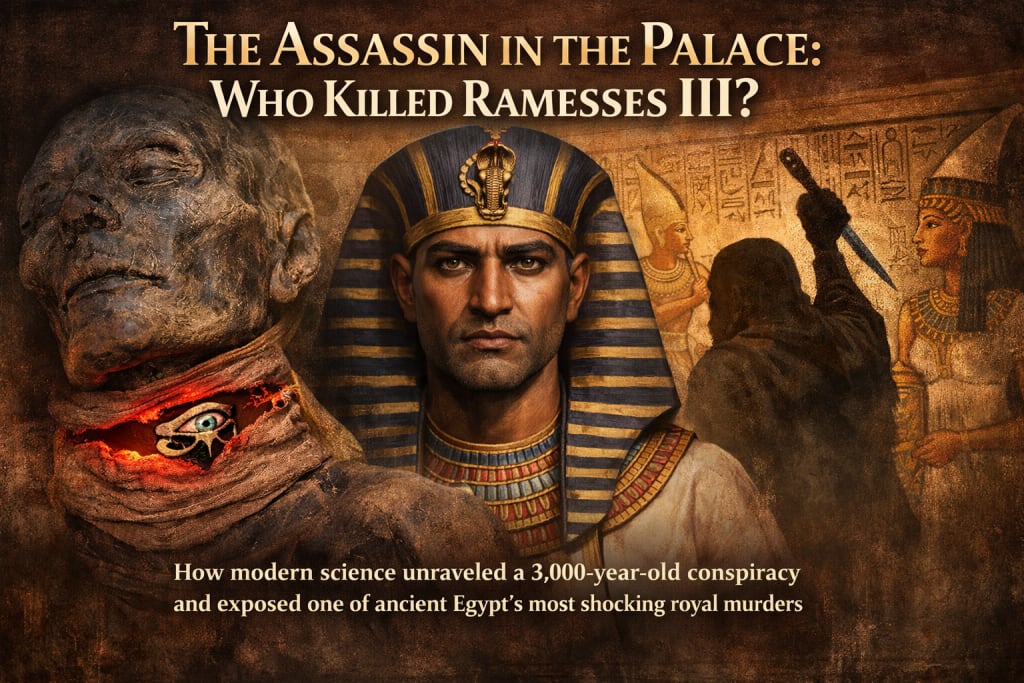
For centuries, the death of Pharaoh Ramesses III—one of ancient Egypt’s last great rulers—remained shrouded in mystery. Historians knew he died around 1155 BCE, but whether his death was natural or the result of foul play was unclear. Ancient texts hinted at intrigue, betrayal, and a palace conspiracy, yet definitive proof remained elusive. It wasn’t until the 21st century that science finally uncovered the truth, revealing a chilling tale of assassination at the heart of the royal court.
Ramesses III ruled during the 20th Dynasty and is often regarded as the last powerful pharaoh of the New Kingdom. His reign was marked by military victories, including repelling the invading Sea Peoples, and by large building projects such as his mortuary temple at Medinet Habu. However, beneath the surface of his achievements, tensions simmered within the royal household—particularly in the pharaoh’s harem.
The first clues to a conspiracy came from a remarkable ancient document known as the Judicial Papyrus of Turin. This papyrus records the trial of several individuals accused of plotting against the king. Among them were high-ranking officials, servants, and even members of the royal harem. The central figure behind the plot was believed to be a secondary queen, Tiye, who sought to place her son, Pentawere, on the throne instead of the rightful heir.
According to the papyrus, the conspirators used magic, secret messages, and alliances within the palace to orchestrate their plan. The goal was simple but deadly: assassinate Ramesses III and install Pentawere as the new ruler. Dozens of people were implicated, and the trials that followed were swift and brutal. Many of the accused were executed, while others were forced to take their own lives.
Yet, despite these detailed accounts, one crucial question lingered: did the assassination attempt actually succeed? For years, scholars debated whether Ramesses III survived the conspiracy or died from unrelated causes. The condition of his mummy, discovered in the Deir el-Bahari cache in the 19th century, offered few obvious answers. Wrapped in thick layers of linen and amulets, the body concealed any visible signs of trauma.
The breakthrough came with the advent of modern medical imaging. In 2012, a team of scientists conducted a CT scan of the pharaoh’s mummy, allowing them to examine his remains without unwrapping them. What they found was astonishing. Hidden beneath the wrappings was a deep, gaping wound across the king’s throat—so severe that it would have instantly killed him. The cut had sliced through the trachea and major blood vessels, leaving no doubt: Ramesses III had been brutally murdered.
Even more intriguing was the discovery of a small amulet placed inside the wound. Shaped like the Eye of Horus, the amulet was likely inserted by embalmers in an attempt to heal the injury in the afterlife. This detail not only confirmed the fatal nature of the wound but also showed the care taken to prepare the king for eternity despite the violent circumstances of his death.
Further evidence strengthened the case against the conspirators. Another mummy, known as the “Screaming Mummy,” was believed to be that of Prince Pentawere. DNA analysis revealed a close familial relationship between this individual and Ramesses III, supporting the theory that it was indeed his son. The unusual expression on the mummy’s face—mouth agape as if in agony—led researchers to speculate that he may have been forced to commit suicide, possibly by poison or strangulation, as punishment for his role in the plot.
Together, these scientific findings brought the ancient conspiracy into sharp focus. What had once been a story preserved only in fragile papyrus texts was now corroborated by physical evidence. The assassination of Ramesses III was no longer a matter of speculation—it was a confirmed historical event, solved through the combined power of archaeology, forensic science, and modern technology.
The story of Ramesses III’s death is more than just a tale of betrayal; it is a reminder that even the most powerful rulers are vulnerable to intrigue from within. It also highlights the incredible potential of science to illuminate the past, turning ancient mysteries into documented history.
In the end, the pharaoh who had defended Egypt from external enemies fell not on the battlefield, but within the walls of his own palace—victim of a deadly conspiracy orchestrated by those closest to him. After more than three millennia, his silent testimony has finally been heard, and the truth of his fate revealed.
About the Creator
Irshad Abbasi
Ali ibn Abi Talib (RA) said 📚
“Knowledge is better than wealth, because knowledge protects you, while you have to protect wealth.
Keep reading
More stories from Irshad Abbasi and writers in History and other communities.
From Parlors to Phantoms
In the late 19th century, amid velvet curtains and candlelit drawing rooms, a curious form of entertainment began to captivate the Western world. It wasn’t music, nor cards, nor storytelling—it was communication with the dead. What would later become known as the Ouija board started as a novelty, a playful curiosity rooted in a society obsessed with the afterlife. Yet over time, this seemingly harmless parlor game would evolve into one of the most feared objects in popular culture.
By Irshad Abbasi about 6 hours ago in History
The dark side of Albert Einstein
He is perhaps the most recognizable scientist who ever lived — a wild-haired, gentle-eyed figure whose name has become synonymous with brilliance itself. Mention Einstein in any corner of the world, and people instantly know who you mean. Yet for all his fame, the real Albert Einstein, the complicated, contradictory, deeply human man beneath the legend — remains surprisingly little known. Strip away the mythology, and what you find is far more fascinating than any caricature.
By Shirley Oyiadom7 days ago in History
The World’s BIGGEST Airplane & Its Crazy Transport Network
The Giant's Journey: How Airbus Transports the World's Largest Planes Airbus is a European powerhouse, producing nearly three aircraft every single day. But there is a massive catch: the parts for these planes are manufactured in different countries—wings in the UK, tails in Germany and Spain, and fuselage sections in France. Bringing them all to the final assembly line in Toulouse, France, is one of the most complex transport puzzles in the world.
By Imran Ali Shah2 days ago in History
Side Quest Goal Achieved: Placing an Alien Claim
This is a post that has me quite ecstatic. It's funny, I thought it was going to be one of my usual, "Hey, I achieved another one of my goals and checked it off" type deals. And it sort of is. But it sort of isn't. And it's also one of my greatest writing accomplishments of late.
By Stephen Kramer Avitabile4 days ago in Writers


Comments
There are no comments for this story
Be the first to respond and start the conversation.