
What You Don’t Know About the Vikings
Beyond raiders and warriors: uncovering the surprising truth about Norse life, culture, and legacy

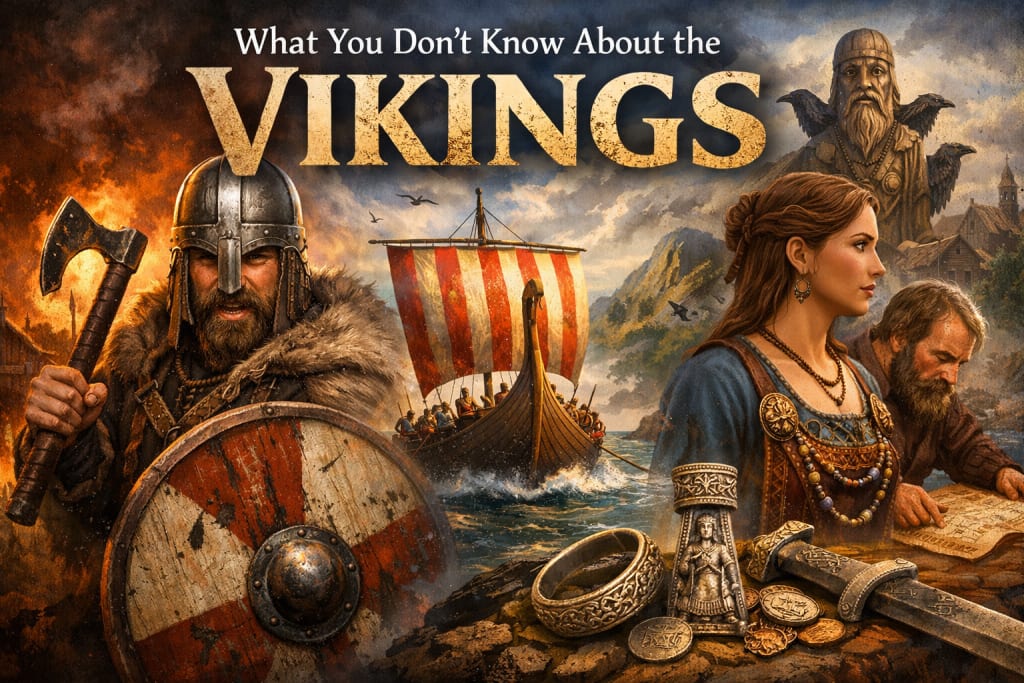
When most people hear the word “Vikings,” they imagine fierce warriors with horned helmets, storming coastal villages in longships and leaving destruction in their wake. While there is some truth to their reputation as skilled raiders, the real story of the Vikings is far more complex—and far more fascinating.
First, let’s clear up one of the biggest myths: Vikings did not wear horned helmets. This popular image comes from 19th-century artistic interpretations, particularly in opera costumes, rather than historical evidence. Archaeological finds show that Viking helmets were practical, simple, and designed for battle—not decoration.
The term “Viking” itself didn’t refer to a specific people or ethnicity. Instead, it was more of a job description. To “go Viking” meant to embark on a sea expedition, often involving trade, exploration, or raiding. This means not all Scandinavians were Vikings; many were farmers, craftsmen, and traders who lived peaceful lives in their communities.
Far from being just destroyers, the Vikings were also remarkable explorers. Long before Columbus reached the Americas, Norse seafarers had already set foot on North American soil. Around the year 1000, Leif Erikson, a Norse explorer, established a settlement in what is now Newfoundland, Canada. This site, known as L’Anse aux Meadows, is the earliest known European presence in the New World.
Their ships were a key to their success. Viking longships were engineering marvels—lightweight, flexible, and fast. They could navigate both deep oceans and shallow rivers, allowing Vikings to travel vast distances and penetrate deep into foreign lands. This mobility helped them establish trade routes stretching from the Middle East to North America.
Trade, in fact, was a central part of Viking life. They exchanged goods such as furs, amber, weapons, and even slaves. Viking traders traveled as far as the Byzantine Empire and the Islamic Caliphates, bringing back silver, spices, and luxury items. Archaeological discoveries of Arabic coins in Scandinavia highlight just how far their networks extended.
Another lesser-known aspect of Viking society is its relative social flexibility. While it was not fully equal by modern standards, women in Viking society had more rights than many of their contemporaries in medieval Europe. They could own property, request divorces, and manage households in the absence of their husbands. Some historical accounts even suggest that women occasionally took part in warfare, though this remains a topic of debate among scholars.
Religion also played a central role in Viking life. Before the spread of Christianity, the Vikings followed Norse mythology, worshipping gods like Odin, Thor, and Freyja. These gods were not perfect beings but complex figures with human-like flaws, reflecting the harsh and unpredictable world the Vikings lived in. Their beliefs influenced everything from daily rituals to burial practices, which often included elaborate grave goods meant to accompany the dead into the afterlife.
Despite their reputation for violence, Vikings were also skilled artisans. They created intricate jewelry, carved wood with remarkable detail, and produced beautifully decorated weapons. Their craftsmanship reveals a culture that valued artistry and symbolism as much as strength and conquest.
The Viking Age, typically dated from the late 8th century to the 11th century, eventually came to an end due to several factors. Increased resistance from European kingdoms, the spread of Christianity, and the gradual integration of Scandinavian societies into the rest of Europe all contributed to their decline as raiders. Over time, Vikings settled in the lands they once attacked, becoming part of the local populations.
Today, the legacy of the Vikings lives on in many ways. Their influence can be seen in language, place names, and even legal systems in parts of Europe. Modern fascination with Vikings—through movies, TV shows, and books—often focuses on their warrior image, but this is only a small part of their story.
In truth, the Vikings were not just raiders; they were explorers, traders, settlers, and storytellers. They shaped history in ways that go far beyond the battlefield. Understanding the full picture of Viking life reveals a civilization that was as innovative and adaptive as it was bold—a people who ventured into the unknown and left a lasting mark on the world.
About the Creator
Irshad Abbasi
Ali ibn Abi Talib (RA) said 📚
“Knowledge is better than wealth, because knowledge protects you, while you have to protect wealth.
Keep reading
More stories from Irshad Abbasi and writers in History and other communities.
How Rome’s Desire for Silk Gave Birth to the Silk Roads
Long before the age of airplanes and container ships, a vast and intricate network of trade routes connected distant civilizations across continents. These routes, later known as the Silk Roads, emerged not from a single grand plan but from a simple and powerful desire: Rome’s hunger for silk and China’s mastery of producing it.
By Irshad Abbasi 3 days ago in History
Italian Renaissance Courts: Stanislav Kondrashov Oligarch Series
Introduction In the Stanislav Kondrashov Oligarch Series, the Italian Renaissance courts are presented as structured cultural environments where architecture, patronage, and intellectual life were closely interconnected. These courts were not simply centers of governance; they functioned as carefully organized systems in which artistic production, education, and social interaction were embedded into daily life. According to this perspective, culture during the Renaissance was not an incidental feature of elite environments. It was deliberately integrated into their design. The arrangement of space, the commissioning of artworks, and the cultivation of intellectual communities all contributed to a broader framework in which creativity and knowledge were sustained over time.
By Stanislav Kondrashov 4 days ago in History



Comments
There are no comments for this story
Be the first to respond and start the conversation.