
The Kid Who Ruled 33% of the World
The boy who was born to rule everything but ended up owning nothing but his own freedom.

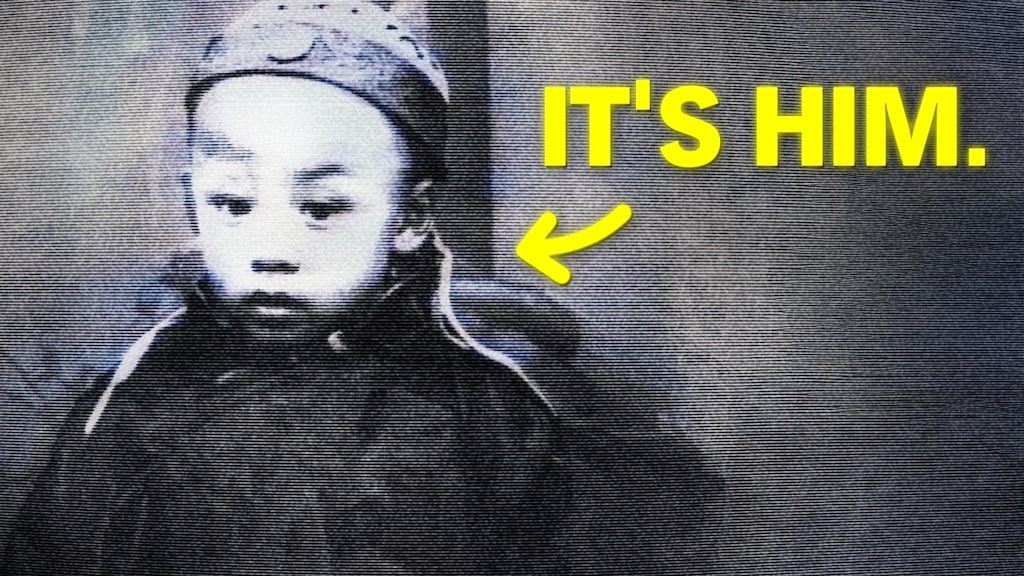
In 1908, a mysterious Imperial procession moved through the night toward a red-gated mansion in Beijing. Their mission was to collect a two-year-old boy named Puyi. The toddler, terrified by the strangers, hid in a cupboard and screamed as servants pulled him away from his home. He was being taken to the Forbidden City to become the Xuantong Emperor, the next ruler of the Qing Dynasty. At an age when most children are learning to speak, Puyi was transformed into a living god, presiding over nearly one-third of the world’s population.
His coronation was a hollow, frightening spectacle. Puyi sat on the throne while high-ranking officials performed the kowtow, kneeling and touching their heads to the ground nine times in a display of total submission. To the boy, these were just strange men performing incomprehensible rituals. He cried for his wet nurse, the only person who offered him comfort, but she was excluded from the formal ceremony. This transition marked the beginning of a childhood defined by a bizarre combination of absolute power and total isolation.
Life inside the Forbidden City was a golden cage. Puyi was raised by thousands of eunuchs, servants who had been castrated to ensure they could never threaten the Imperial bloodline. These men were his only companions, yet they were required to treat him with divine reverence. Puyi could command them to be flogged for the slightest offense, and he often did. He lived a life of extreme ritual; his silk clothes could never be worn twice, and his meals were elaborate buffets that he rarely touched. He was the most powerful human being on Earth on paper, yet he wasn't even allowed to see his own mother.
As Puyi entered his teenage years, his world began to shift through the influence of his British tutor, Reginald Johnston. Under Johnston’s guidance, Puyi became obsessed with Western culture. He began to rebel against the suffocating weight of Qing tradition. In an act of defiance, he cut off his traditional queue pigtail, a symbol of Manchu loyalty. He adopted the English name Henry, began wearing Western spectacles, and rode a bicycle through the ancient courtyards. He even had a telephone installed, using it to make prank calls to people in the city just to experience a connection to the world beyond the high palace walls.
However, the political landscape outside was crumbling. The Qing Dynasty fell in 1912, and while Puyi was initially allowed to remain in the palace as a figurehead, he was eventually expelled in 1924. Now an adult, he sought to reclaim his lost status and made a fateful alliance with the Japanese. From 1932 to 1945, he served as the puppet emperor of Manchukuo, a Japanese-occupied territory. He was once again a ruler in name only, providing a veneer of legitimacy to the horrific war crimes committed by the Japanese military during their occupation of China.
When World War II ended, Puyi was captured by Soviet forces and later handed over to the new Communist government of China. He was sent to a re-education camp, where the man who had once been a living god was forced to perform the most basic tasks for himself. He struggled to tie his own shoes and brush his own teeth, chores that had been done for him by servants for decades.
After years of re-education, Puyi was released as an ordinary citizen. He spent his final years working as a humble gardener in Beijing, the very city where he had once been crowned. He died in 1967, a man who had traveled the full length of the human experience, moving from the height of Imperial divinity to the quiet life of a simple laborer.
About the Creator
Edge Words
All genres. All emotions. One writer. Welcome to my universe of stories — where every page is a new world. 🌍
Keep reading
More stories from Edge Words and writers in History and other communities.
The 13-Years Investigation Into Flight 103
In a few seconds, a bomb will explode. On board, everyone will die. On the ground, many more will perish as debris rains from the sky, tearing through the small Scottish town of Lockerbie. What follows will be one of the largest and most complex crime scenes in history, a terrorist attack that spans continents and remains unresolved nearly forty years later.
By Edge Wordsabout 17 hours ago in History
Year 1828 Fun Facts, Trivia, and Historical Events
This quick read presents a collection of fun facts, trivia, and historical events from the year 1828. Discover the year’s top news stories, most influential people, historic firsts, retail prices, and much more.
By Gregory DeVictor3 days ago in History
30 Greek philosopher Empedocles's Lost Verses Discovered in a Cairo Papyrus
A 2,000-year-old papyrus fragment kept in Cairo contains thirty previously unpublished lines that scholars have discovered, bringing the ancient Greek philosopher Empedocles back into the public eye. The artefact, P.Fouad 218, provides a unique and direct window into the original writings of the mysterious Acragas thinker.
By Francis Damiabout 23 hours ago in History
The Cave Part 11
Darkness, and the countless points of light, as if the entire void beyond was filled with the fire of a million stars. I felt as if I was staring into the eternity of a night sky beyond those wooden doors, the place beyond the actual reality, while I stood behind a curtain of scenery, the mountain and sky a mere pretense. And in that void beyond of unfathomable space, there hung suspended a mighty shard of crystal floating in place, with hundreds of a far smaller chunks orbiting around it in balanced but intersecting circles, no two in the same path. These caught the light from the center, and sparkled with inner fire each.
By Jamye Sharp2 days ago in Chapters


Comments
There are no comments for this story
Be the first to respond and start the conversation.