
The Cognitive Tax of Debt: Why Africa’s Future Rests on the Shoulders of Masisi’s Women Beyond the Spreadsheet:
The Future of 5G in Rural Africa

The Human Cost of Macroeconomics While macroeconomists at the IMF track the Democratic Republic of Congo’s multi-billion dollar debt-servicing hurdles, women like Ms. Zaina, president of the Tuungana cooperative, are paying the interest in "mental bandwidth." In Masisi, the national debt is not an abstract figure; it is the bridge that was never built, the clinic that lacks medicine, and the land title that remains a legal ghost. The Behavioral Economy of Scarcity Psychology teaches us that chronic financial insecurity functions like a computer processor running too many background programs.
This "scarcity mindset" creates cognitive loads that shrink the mental space available for long-term planning, risk assessment, and innovation. For the women of Masisi, who provide nearly 80% of the agricultural labor but hold 0% of the land titles, this load is near the breaking point. When the state prioritizes debt servicing over rural infrastructure, the "farm-to-market" roads become more than a physical hurdle—they become a psychological barrier. Every hour spent trekking through mud is an hour of "cognitive tax" paid by a woman who could have been negotiating better prices. Market Failure and the Land Rights Paradox" The fields belong to men; women have no land rights," Ms. Zaina reports.
In pure economic terms, this is a total market failure. Without land titles, these women are "unbankable" by formal standards. This forces them into a predatory cycle of high-interest informal debt, with rates often exceeding 50% per season. They are not "poor" because they lack effort; they are "taxed" by a system that demands they produce for a nation that refuses to recognize their ownership. The Scarcity Loop: A Structural Breakdown To understand why effort doesn't always equal wealth, we must look at the cycle of scarcity: Input: Lack of Land Rights $\rightarrow$ No Formal Credit. Process: High-Interest Informal Debt $\rightarrow$ High Cognitive Load (Stress). Output: Short-term "Survival" Decisions $\rightarrow$ Low Productivity. Feedback: Continued Poverty $\rightarrow$ Back to Input. Collective Agency: The Psychological Shield However, a counter-movement is rising. The Tuungana cooperative and its Village Savings and Loans Associations (AVEC) are acting as a behavioral buffer. By pooling resources, these women are insuring one another against the state's absence. Trust replaces collateral: A landless woman gains liquidity through her social capital.
Resilience replaces relief: Through transformation locale (local processing), women learn to turn beans into flour or milk into cheese, creating value that lasts longer than a raw harvest. Conclusion: The Real Real Estate Opportunity As the 2026 health landscape faces a $101 billion financing gap, we must stop viewing rural women as an "underestimated driving force" and start seeing them as the de facto central bankers of their communities. The real real estate opportunity in Africa isn't just in "solar-kitted homes"; it is in the legal and psychological liberation of the women who feed the continent.
If the government fails to recognize their land rights, they aren't just losing a harvest; they are losing the foundation of the nation's economic future. But this isn't just a story of a broken system; it's a testament to female-led resilience. Let's expand on how the Tuungana cooperative is actively dismantling this loop from the inside, shifting the focus from scarcity to collective strength.
While the "Scarcity Loop" dictates short-term survival for many, Ms. Zaina and the 2,500 members of the Tuungana cooperative are engineering a new architecture for their community's future. They are transforming the very nature of agricultural value in Masisi, turning it into a bulwark against state indifference.
The true real estate opportunity in Africa is not just in "solar-kitted homes"—it is in the legal and psychological liberation of the women who feed the continent. If the government fails to recognize their land rights, they are not just losing a harvest; they are losing the foundation of the nation's economic future. The real real estate opportunity isn't just in the "physical real estate"; it is in the "human real estate" of Africa's female workforce.
Through transformation locale (local processing) training, women are learning to turn their perishable produce—like beans and milk—into value-added, longer-lasting products like flour and cheese. This mitigates the immediate "impatience" caused by poverty. No longer are they forced to sell raw beans at the height of the season when prices are lowest. Instead, they can store and sell flour or cheese throughout the year, commanding significantly higher prices and increasing their collective mental space.
"We are no longer just 'bean farmers.' We are processors; we are market leaders," Ms. Zaina shared with pride.
The transformation isn't just economic; it's psychological. In these circles, trust replaces collateral. A landless woman gains liquidity through her social capital—her reputation for hard work and reliability. Furthermore, resilience replaces relief. The cooperative isn't just a safety net; it's a springboard. They are the de facto central bankers of their communities, and it's time the rest of the world recognized that
About the Creator
Hermano Badete
uptime through advanced preventive maintenance and corrective engineering. Whether optimizing signal speed for remote medical clinics or securing digital assets, I build the systems that build wealth.
Keep reading
More stories from Hermano Badete and writers in History and other communities.
daily habits for successful folks
I used to beg for affection from some girls that pleased me and still do, but at certain happened event, I figured out through experience and progress practice to apply a master mind attitude even from leaders that inspired me to be their model. We have to protect our wellness and heart pressure attack, so some process are required to be applied properly.
By Hermano Badete11 days ago in Confessions
Once Wealthy Estates Now Lost to Ruins
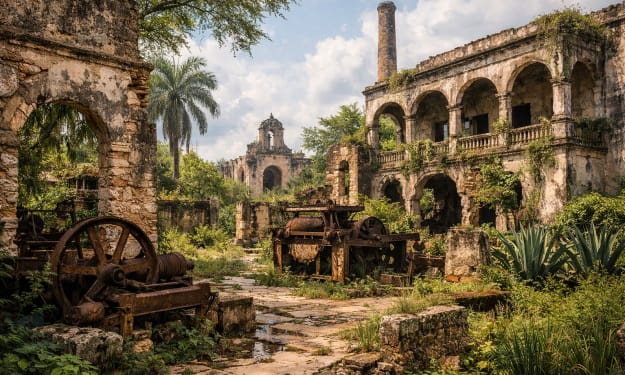
In the tropical landscapes of southern Yucatán, Mexico, the ruins of once-grand haciendas stand quietly among overgrown fields and crumbling stone walls. These estates were once the heart of a booming industry built around a plant that locals called “green gold.” For decades, the production of sisal fiber brought enormous wealth to the region, transforming the economy and shaping the lives of thousands of people. Today, however, many of these estates lie abandoned, their glory fading into history.
By Irshad Abbasi 3 days ago in History
March 15, 2026
Merriam Webster - Word of the day: Tranche refers to a division or portion of a whole. World Contact Day is commemorated every year on March 15. It is a unique observance held globally to focus on communicating with extraterrestrial life and exploring the possibility that intelligent beings may exist beyond Earth. World Contact Day inspires people to invoke their curiosity and spend time thinking about the universe and the mysteries surrounding it. What is the “Ides of March”? According to the Roman calendar, the Ides are a monthly occurrence. In March and other months with 31 days, the Ides always falls on the 15th; it falls on the 13th in months with 30 days. The Ides traditionally marked the arrival of the new Moon and was cause for celebration. The word “Ides” is derived from Latin, meaning “to divide.” Mothering Sunday in 2026 falls on Sunday, March 15. Mothering Sunday, celebrated in the United Kingdom and Ireland, occurs on the fourth Sunday of Lent, which is exactly three weeks before Easter. Unlike the fixed-date Mother's Day in countries like the United States, Canada, and Australia, Mothering Sunday’s date changes each year according to the Christian liturgical calendar. On March 15, 2026, several notable observances and events are celebrated: Dumbstruck Day: A day to express frustration. Everything You Think is Wrong Day: A day to challenge and celebrate wrong beliefs. International Day Against Police Brutality: A day to raise awareness and advocate against police violence. My look at today, March 15, 2026 below:
By Denise E Lindquista day ago in Writers


Comments
There are no comments for this story
Be the first to respond and start the conversation.