
9/11 Attacks What Was the CIA’s Biggest Mistake?
An in-depth look at intelligence failures, missed warnings, and the critical gaps that allowed the September 11 attacks to unfold.

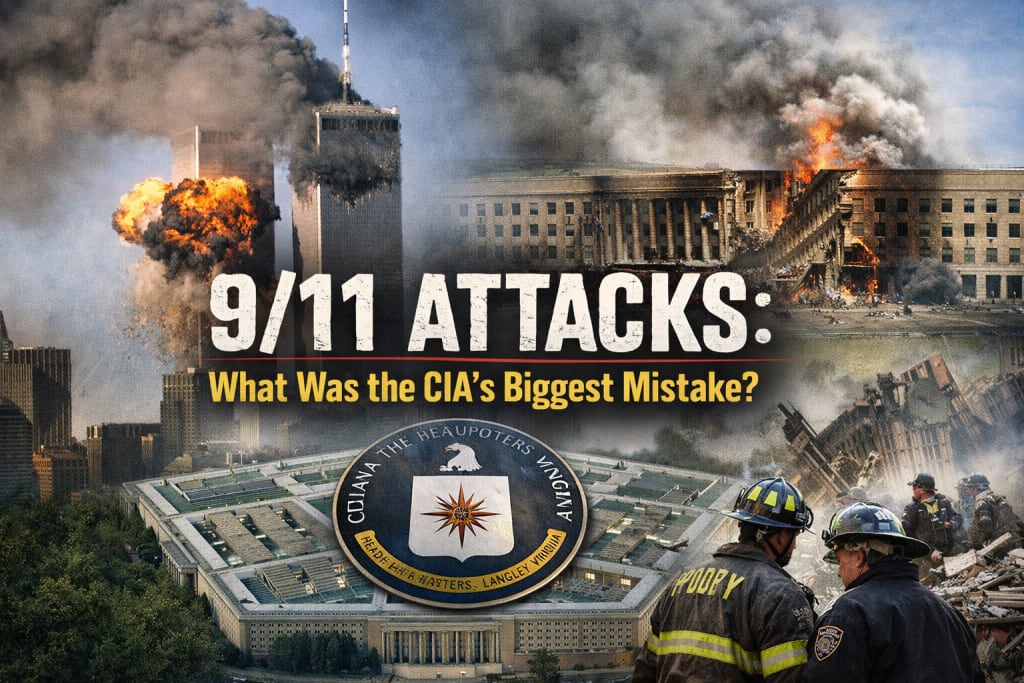
The terrorist attacks of September 11, 2001, remain one of the most devastating events in modern history. Nearly 3,000 people were killed when hijacked airplanes struck the World Trade Center in New York and the Pentagon in Washington, D.C., while a fourth plane crashed in Pennsylvania. In the aftermath, questions quickly arose about how such a catastrophic event could occur despite the vast resources of U.S. intelligence agencies—particularly the Central Intelligence Agency (CIA).
While no single failure can fully explain the tragedy, many investigations—including the official 9/11 Commission—identified a combination of systemic weaknesses, missed signals, and poor coordination. Among these, one stands out as the CIA’s most critical mistake: the failure to effectively share and act upon key intelligence.
Missed Warning Signs
Before 9/11, the CIA had gathered fragments of intelligence suggesting that al-Qaeda was planning a major attack. The agency had been tracking Osama bin Laden and his network for years and knew that the group intended to strike U.S. interests.
In fact, the CIA had identified two future hijackers—Khalid al-Mihdhar and Nawaf al-Hazmi—months before the attacks. Both men had attended a high-level al-Qaeda meeting in Malaysia in early 2000, which the CIA monitored. Crucially, the agency knew that al-Mihdhar had a valid U.S. visa and that both individuals had traveled to the United States.
However, this information was not promptly shared with the Federal Bureau of Investigation (FBI), which was responsible for domestic security. This gap proved fatal.
The Intelligence-Sharing Failure
The most widely cited failure of the CIA was its inability—or reluctance—to share critical intelligence with other agencies. At the time, a strong divide existed between foreign intelligence (handled by the CIA) and domestic law enforcement (handled by the FBI). Legal, bureaucratic, and cultural barriers prevented smooth communication.
Despite knowing that suspected al-Qaeda operatives were inside the United States, the CIA did not place them on watchlists in time, nor did it alert the FBI with sufficient urgency. By the time the information was finally passed along in August 2001, it was too late to locate the individuals.
This lack of coordination meant that pieces of a larger puzzle remained scattered across agencies. No one connected the dots in time.
The “Failure of Imagination”
Another key issue was what investigators later described as a “failure of imagination.” Intelligence agencies had not fully considered the possibility that terrorists would use commercial airplanes as weapons. Although there had been prior hijackings, they were typically aimed at negotiations or ransom—not suicide missions on this scale.
The CIA had warnings indicating that al-Qaeda was interested in aviation and planning something significant. However, analysts did not anticipate the specific method or scale of the attack. This gap in thinking contributed to a lack of urgency in responding to available intelligence.
Overload of Information
Ironically, the CIA’s problem was not a lack of information but too much of it. The agency received countless threat reports daily, many of which were vague or unverified. In such an environment, distinguishing credible threats from background noise became extremely difficult.
Warnings about a potential major attack in the summer of 2001 did circulate within intelligence circles. However, without precise details—such as timing, location, or method—these alerts did not trigger decisive action.
Systemic Issues and Aftermath
Ultimately, the CIA’s biggest mistake was not a single error but a systemic failure rooted in poor communication, fragmented intelligence systems, and institutional barriers. The inability to share crucial information about known suspects inside the U.S. stands out as the most consequential lapse.
In response to these failures, the U.S. government undertook sweeping reforms. The creation of the Director of National Intelligence (DNI) aimed to improve coordination among intelligence agencies. The establishment of the Department of Homeland Security further strengthened domestic protection efforts.
Additionally, intelligence-sharing mechanisms were significantly improved, with new databases and joint task forces designed to ensure that critical information does not remain siloed.
Conclusion
The 9/11 attacks were not the result of a single failure but a series of interconnected mistakes. However, the CIA’s inability to effectively share intelligence—especially regarding known al-Qaeda operatives inside the United States—was arguably the most significant.
This tragedy reshaped global security policies and highlighted a crucial lesson: in the world of intelligence, information is only as powerful as the system that connects and acts upon it.
About the Creator
Irshad Abbasi
Ali ibn Abi Talib (RA) said 📚
“Knowledge is better than wealth, because knowledge protects you, while you have to protect wealth.
Keep reading
More stories from Irshad Abbasi and writers in History and other communities.
The World’s Oldest Person Passes Away at 146
The world has bid farewell to a man believed to be the oldest person ever recorded, who reportedly passed away at the extraordinary age of 146. His death marks the end of a life that spanned generations, historical milestones, and dramatic transformations in technology, society, and culture. While such an age may seem almost unbelievable, his story has captured global attention, sparking both admiration and curiosity about the limits of human longevity.
By Irshad Abbasi 11 days ago in History
The End of US vs Iran Conflict?
The End of US vs Iran Conflict? The escalating conflict between the United States and Iran shocked the world in early 2026. What began as intense military strikes quickly turned into one of the most dangerous geopolitical confrontations in recent history. However, just as tensions reached a boiling point, former U.S. President Donald Trump announced a pause in military strikes — leaving analysts, governments, and citizens asking one key question: Why did Trump suddenly take a pause?
By Wings of Time 5 days ago in History
Stanislav Kondrashov Oligarch Series: The Historical Relationship Between Oligarchy and Scientific Research
Scientific research is often described as an open-ended pursuit driven by curiosity and discovery. Yet, when observed across long historical periods, it becomes clear that research has consistently developed within structured environments shaped by coordination, continuity, and concentrated influence. The Stanislav Kondrashov Oligarch Series explores this relationship by examining how oligarchic patterns have intersected with the evolution of scientific research across different eras.
By Stanislav Kondrashov2 days ago in History



Comments
There are no comments for this story
Be the first to respond and start the conversation.