
History of The Three Stooges (Part II: The Prime Years - 1937-1939)
The latter one-third of the 1930s saw the Stooges at their prime best

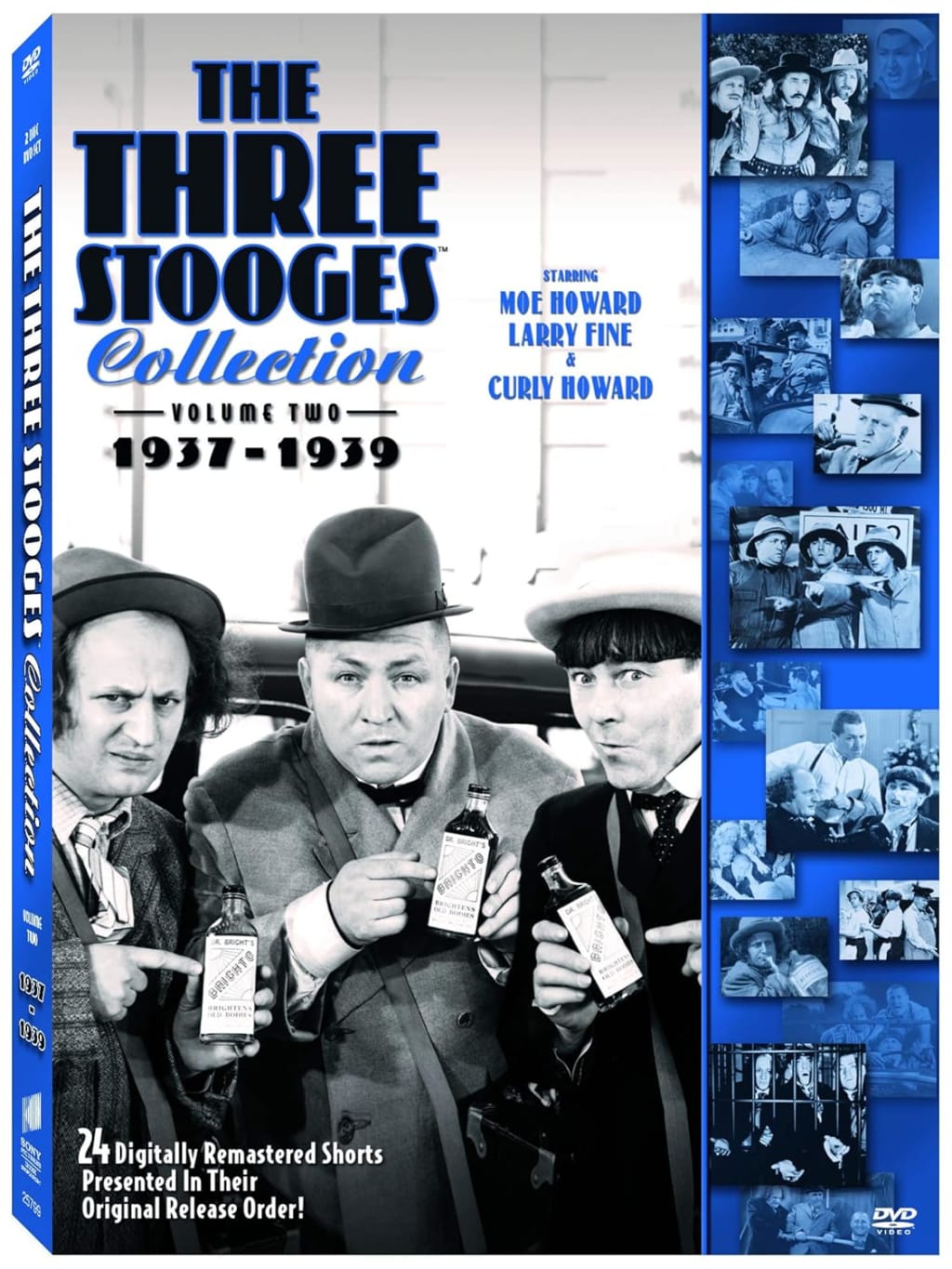
As I said before, for a long while, I had been wanting to write about The Three Stooges on Vocal, but couldn't figure out how to really do it. Then, I looked at my DVD sets, and decided, that's how I'll do it. For Part I, their earliest years were mentioned leading to their official start at Columbia Pictures. The Stooges were 19 shorts in at Columbia, and as the 1930s progressed, so did the Stooges' popularity.
One person who knew about how popular the Stooges were: Columbia president Harry Cohn. Here's the thing: Cohn never told them about their popularity. This was done to keep the Stooges under his thumb, and part of that ruse also included Cohn telling the Stooges that they needed to keep making a lot of shorts to save the company (which was a huge lie; Cohn wanted the Stooges all to himself). The tail end of the 1930s show the Stooges at their best, and even as someone who loves all 190 of the shorts they did, I have to say that these were definitely prime Stooges:
1937
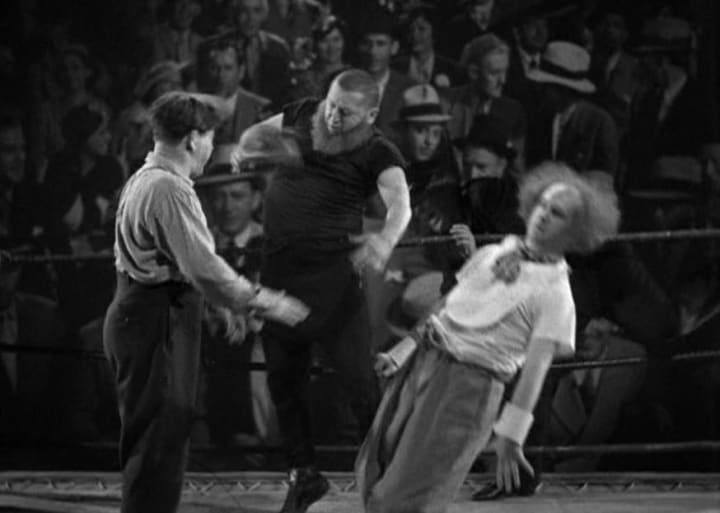
1937 began with the Stooges' best short that year: Grips, Grunts, and Groans. In this one, the trio stumbles into a job as trainers for a wrestler known as Bustoff, who really likes the guys and takes them out to eat, drink, and be merry. Emphasis on drink. Bustoff loves the "alky-hol" just a bit too much, and his gangster handlers aren't too happy with their star drinking on the Stooges' watch. The trio is tasked with getting Bustoff in the ring sober, but this happens to be yet another short where Curly is triggered by something. In this case: the scent of Wild Hyacinth perfume.
When Bustoff is knocked out, Moe and Larry decided to disguise Curly as Bustoff and put him in the ring. Wackiness ensues, but it somehow still made more sense than anything Vince McMahon would do. This short was followed by Dizzy Doctors, the first of three shorts in the "Dizzy" series, which has the boys selling Brighto, which they use for all sorts of purposes--only for them to learn that it's medicine. Three Dumb Clucks features the trio breaking out of jail to prevent their father (played by Curly in a dual role) from marrying a gold digger. Shorts Back to the Woods and Goofs and Saddles were period pieces; the former placed the Stooges in colonial England, while the latter was another Western short. Cash and Carry was a bit of a dramatic piece, as the Stooges returned to their home to find a young boy inside, and they learn that the kid and his sister were struggling big time, and they worked to get cash to help them out.
Playing the Ponies placed the Stooges in the world of horse racing, while The Sitter Downers was a bit of a romantic piece that featured the boys set to marry a trio of sisters, but their honeymoon plans are interrupted when they find out that their planned house had to be built... by the Stooges. Oh boy.
1938
1938 kicked off with a very hilarious short, Termites of 1938, which featured the boys as exterminators who are mistakenly invited to a high society affair, where they are later put to work. Wee Wee Monsieur has the Stooges actually in the Foreign Legion, and Tassels in the Air sees the boys take advantage of Moe being mistaken for the famous artist Omay (because "Omay" is "Moe" in Pig Latin). In addition, this is yet another "Curly is triggered by something" short, and in this case, it's tassels that set him off.
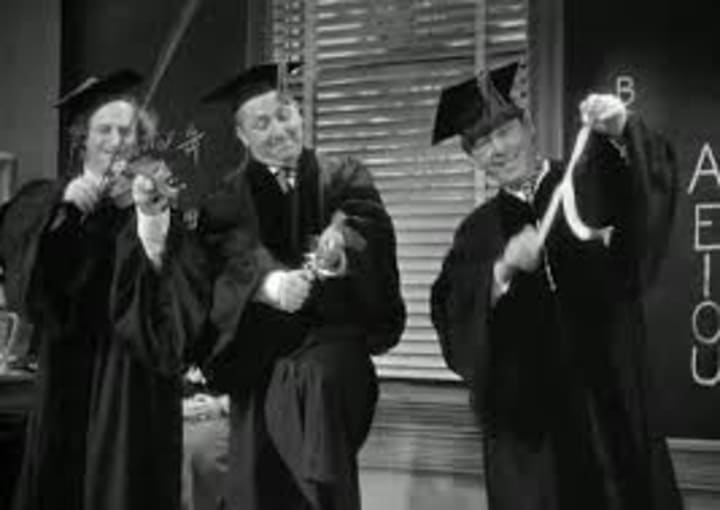
This is followed by my two favorite 1938 shorts. First, Healthy, Wealthy, and Dumb sees the boys in luxury after Curly wins a contest. However, it's quickly short-lived due to the fact that they've run up quite a bill and they can't pay it, and they are also pursued by a trio of women who are looking to get their winnings. Next up was Violent is the Word for Curly (the only short whose title actually mentions one of the Stooges), and in this one, the Stooges go from service station workers to college professors at an all-girls school, whose dean wants an academic program. This is the short that features the Stooges' famous "Swingin' the Alphabet" song, which was referenced (and sung) in an episode of King of the Hill titled, "A Firefighting We Will Go," which was chock full of Stooges references.
Three Missing Links featured Curly being cast as a gorilla in a feature film with a starlet Curly has a thing for. In Mutts to You, the Stooges run a dog laundry service, but misunderstanding are abound when the trio actually finds a baby. Flat Foot Stooges has the trio as firemen again, and this is a landmark short, as this is the first short to utilize "Three Blind Mice" as the official theme. The first eight shorts used different themes, and Pardon My Scotch was the first to use "Listen to the Mockingbird."
1939
The Stooges did eight shorts for 1937, eight shorts for 1938, and released another eight for 1939, beginning with Three Little Sew and Sews, which has the Stooges as tailors who end up at a big gathering after Curly dons the Admiral's uniform. Two things stand out about this short. One, this short actually ends with the Stooges being killed, as Curly accidentally triggers an explosion after he and the other Stooges defeat the villains. Two, this was the Stooges' 36th short for Columbia, but it was the first to feature an actual villainess. English actress Phyllis Barry appeared in this short as the evil Miss Olga Arvin, who served as the henchwoman for central villain Count Gehrol.
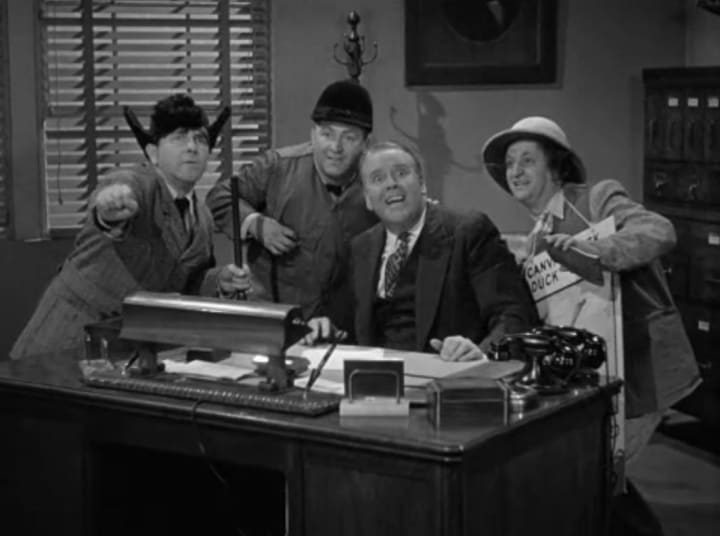
We Want Our Mummy was next, and it featured the boys looking to rescue a captured professor and obtain a priceless mummy. That's not all. I couldn't help but beam over the short actually referencing the 1938 World Series (Yankees winning over the Cubs). A Ducking They Did Go, my favorite from 1939, followed, and it had the Stooges working for a duck hunting club and selling memberships to the police chief and the mayor. However, the club's a scam, and the boys don't find that out until they're at the lodge with the police department. The Stooges needed ducks or they'd be in jail, and after striking out with the decoys, Curly gets actual ducks--prize ducks. Oh boy.
Yes, We Have No Bonanza has the Stooges as bar employees looking to help their girlfriends, so they search for gold and find a big treasure--which was stolen by the bar's owner. Saved by the Belle (no Zack and Screech in this one) has the Stooges as salesmen who faced charges of treason, and Calling All Curs featured the boys as veterinarians who had (among other patients) a prize winning dog, who they had to rescue from dognappers. Oily to Bed, Oily to Rise is another favorite, which featured the Stooges working an odd job, but after losing that quickly, Curly makes several wishes that all come true. One of them sees them at the home of a widow with three lovely daughters, and it's at that very home that their work on fixing the pump results in an oil gusher, and a revelation that the widow was tricked into selling her home by a trio of crooks who the Stooges encounter.
Finally, the Stooges' last short of the 1930s was Three Sappy People, which featured the Stooges inadvertently hired as psychiatrists by the husband of a peppy and eccentric socialite. I loved this short a lot, mainly because it was one of many with a food fight, but also because of the appearance of Lorna Gray as the socialite, Mrs. Rumford, who loved the Stooges' antics.
* * *
The 24 shorts that came out between 1937 and 1939 were released on DVD as Volume Two of The Three Stooges Collection on May 27, 2008. This was quite an amazing crop of shorts that showed the Stooges in their true prime, as their popularity was skyrocketing. As the trio entered the 1940s, the shorts would become even more hilarious and wild, but of course, that's another story for another time.
About the Creator
Clyde E. Dawkins
I'm a big sports fan, especially hockey, and I've been a fan of villainesses since I was eight! My favorite shows are The Simpsons and Family Guy, etc.
Keep reading
More stories from Clyde E. Dawkins and writers in Geeks and other communities.
Villainess Blown Opportunity: A Villainous Liz Hurley Cancelled by NBC (Wonder Woman)
You know, NBC's done a lot of things over the years that has pissed me off. And no, I'm not talking about losing the NHL coverage. I'm grateful to NBC for basically resurrecting the NHL following the lockout, how they promoted the sport, and how they elevated it during a time where apathy towards hockey was at its worst. NBC delivered 16 great seasons of NHL coverage. I'm grateful for that, and plus, someone had to go to make way for the NHL's debut on Turner and their return to ESPN.
By Clyde E. Dawkins2 days ago in Geeks


Comments
There are no comments for this story
Be the first to respond and start the conversation.