
Anna Karenina by Leo Tolstoy
Why It's a Masterpiece (Week 111)


Background and Context:
I love this book, it is one of my favourite books of all time. I first read it in my teens and I had this notebook with all the characters and their personalities written down alongside important things they said and who they were married/related to. It spanned perhaps some fifty or so pages. It's a fantastic book which is written in a style that is immersive, emotional and quite literally makes you feel every single word. When it comes to this and War and Peace - I often have trouble deciding which one is better. I would say that you should skip the movie and simply read the book, the movie adaptations do not live up to the feeling of losing yourself in upper-class pre-revolution Russia.
Anna Karenina by Leo Tolstoy
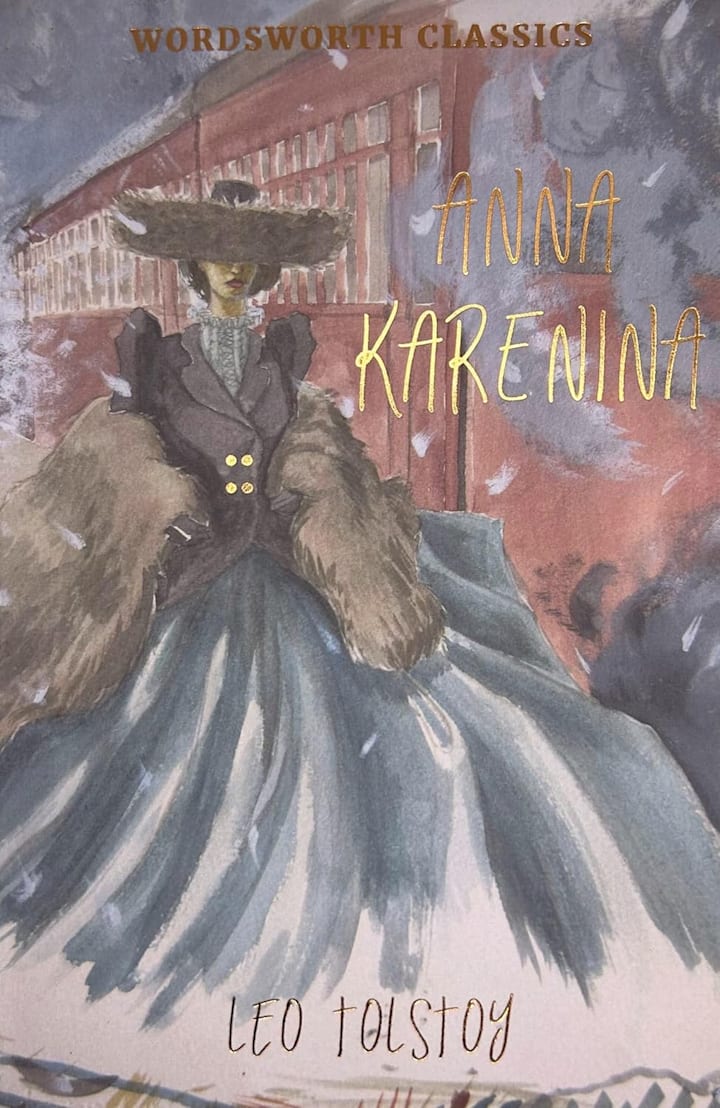
First published in serial form between 1875 and 1877, Anna Karenina is one of the greatest works of world literature and a huge achievement of 19th-century Russian fiction. Leo Tolstoy, already renowned for War and Peace, crafted a novel that blends intimate human drama with terrifying social critiques.
Often described as a novel of adultery, Anna Karenina is far more than just a tragic love story. It explores the conflicts between personal happiness and societal expectations, the shifting nature of morality, and the search for meaning in life. The novel is deeply philosophical, embodying Tolstoy’s growing spiritual concerns and reflections on Russian society - especially those of the aristocracy who are always pontificating on how much better than others they are.
Set in these rich and famed circles of Russia, the text contrasts the passionate, doomed love of its eponymous heroine with the more grounded and philosophical journey of Konstantin Levin, who serves as something of a Tolstoyan figure and we can tell Tostoy definitely saw himself in this man.
Plot

The novel begins at a moment of family crisis: Prince Stepan Arkadyevich Oblonsky (Stiva) has been caught having an affair with his children’s governess. His wife, Darya Alexandrovna (Dolly), is devastated, and their household is in turmoil. To reconcile the couple, Stiva calls upon his sister, Anna Karenina, to come to Moscow.
Anna, the wife of the high-ranking government official Alexei Karenin, arrives in Moscow from St. Petersburg. On the way, she meets Count Vronsky, a young, charismatic cavalry officer. Their mutual attraction is immediate, though unspoken. Meanwhile, another romantic subplot unfolds: Konstantin Levin, an idealistic landowner, returns to Moscow to propose to Kitty, Dolly’s younger sister. Kitty, however, rejects Levin because she is infatuated with Vronsky, unaware that he is already falling for Anna.
At a grand ball, Kitty is crushed when she realises that Vronsky only has eyes for Anna. Heartbroken and humiliated, she falls into an emotional decline. Anna, troubled by her growing feelings for Vronsky, returns to St. Petersburg and attempts to resume her life as a dutiful wife and mother. However, Vronsky follows her, and their flirtation turns into a passionate affair.
Anna soon becomes pregnant with Vronsky’s child, and Karenin, deeply concerned for his social reputation, demands that she end the relationship. Anna, torn between her love for Vronsky and her duties as a wife and mother, eventually confesses the affair. Karenin initially insists on maintaining appearances but later, upon finding Anna near death during childbirth, forgives her and even plans to adopt the child. Anna, however, refuses reconciliation and leaves him for Vronsky.
Their love affair, once filled with passion and excitement, begins to sour. Cut off from society and tormented by jealousy, Anna grows increasingly paranoid and unhappy. She becomes convinced that Vronsky no longer loves her, and in a moment of despair, she throws herself under a train, ending her life in one of literature’s most famous tragic climaxes.
Parallel to Anna’s story is the journey of Levin, whose struggles with love, faith, and the meaning of life provide a philosophical counterpoint. After Kitty recovers from her heartbreak, she and Levin reunite and marry. Levin, an intellectual and a man of the land, grapples with existential questions about faith, happiness, and his place in the world. In the end, he finds a form of spiritual peace, concluding that life’s meaning lies in simple acts of goodness and love.
The book closes with Levin embracing this newfound understanding, in stark contrast to Anna’s despair. While Anna’s passion leads to destruction, Levin’s journey towards faith and acceptance offers a more hopeful resolution.
Into the Book

Happiness and Society:
One of the main conflicts in the text is the tension between personal happiness and societal expectations. Anna’s affair with Vronsky is not just a private tragedy but a public scandal. Russian aristocratic society is willing to overlook male infidelity (as seen in Stiva’s case) but punishes women like Anna, who defy conventional roles.
Karenin, for all his flaws, represents the rigid moral and legal codes of the time. He is not a cruel man, but his obsession with reputation and propriety blinds him to Anna’s suffering. Apart from this, Levin and Kitty’s relationship, while facing its own difficulties, conforms to societal norms and is ultimately rewarded with stability and happiness.
Anna’s tragic fate demonstrates Tolstoy’s critique of a world that demands conformity at the expense of personal fulfilment. She is punished not just for her infidelity, but for daring to pursue happiness on her own terms.
"I am lost! But what can I do? I cannot bear deceit and falsehood. But with whom am I to live? With him, my husband, who will never allow me to love him?"
- Anna Karenina by Leo Tolstoy
Passion:
The book also examines how passion, when unmoored from stability, can curdle into obsession and self-destruction. Anna and Vronsky’s affair, once thrilling and illicit, becomes a source of torment. Anna grows increasingly paranoid, fearing that Vronsky no longer loves her.
In contrast to this, Levin and Kitty’s love, though marked by struggles, is built on mutual respect and growth. Levin’s insecurities about marriage and his place in the world mirror Anna’s fears, but he ultimately overcomes them through trust and faith.
Tolstoy suggests that love alone is not enough to sustain happiness; it must be accompanied by trust, stability, and shared values. Anna’s downfall is not just caused by society’s judgment, but by the nature of her love itself, which becomes all-consuming and destructive.
"Love is not enough. I want him to love me the way I love him. I want to be his whole world, but I know I am losing him."
- Anna Karenina by Leo Tolstoy
Levin's Journey of Sel-Discovery:
While Anna’s story is one of disillusionment and despair, Levin’s journey is one of self-discovery. Throughout the novel, he struggles with existential questions: What is the purpose of life? Can you find happiness in a world filled with suffering?
Unlike Anna, who seeks fulfillment in passionate love, Levin finds meaning in simple, everyday acts of kindness and connection to the land. His journey is deeply Tolstoyan, reflecting the author’s later spiritual beliefs.
"I shall go on in the same way, losing my temper with Ivan the coachman, falling into angry discussions, expressing my opinions tactlessly; there will still be the same wall between the holy of holies of my soul and other people. But my life now, my whole life, regardless of all that may happen to me, every minute of it, is not only not meaningless as it was before, but has the unquestionable meaning of the good which it is in my power to put into it!"
- Anna Karenina by Leo Tolstoy
Why It's a Masterpiece

Anna Karenina is a novel of extraordinary depth, blending psychological realism with philosophical inquiry - I have often gone back to particular sections of this book just to re-read something philosophical. For example: Part 1 Chapter 27 is in my opinion, one of the best chapters ever to be written into a novel. It starts with the description of Levin's emotionally empty home and this is a complete juxtaposition to the emotional sensation surrounding him by the end of the text.
Tolstoy’s characters are richly drawn, complex, and deeply human. The novel’s dual structure: contrasting Anna’s tragic arc with Levin’s philosophical awakening, offers a profound meditation on love, faith, and the search for meaning. Also, the prose is immersive, filled with lush descriptions, intricate psychological insight, and moments of breathtaking beauty. His ability to capture both the grandeur of 19th-century Russia and the intimate struggles of the human heart makes Anna Karenina one of the greatest novels ever written.
Conclusion

There are perhaps very few books that move me quite like Anna Karenina and very few books that are able to make me feel so deeply about the characters. To this day, Levin is one of the most awe-inspiring characters in all of fiction. Filled with philosophy, self-idealism and want, Levin (like other characters) must confront what he really wants: not just in his life, but in his soul. The characters there remain as vivid and compelling today as they were when the book was first published. By contrasting passion with stability, despair with faith, Tolstoy creates a work that continues to resonate across generations. It is, quite simply, a masterpiece.
***
If you want to read some other stuff I've written that is either about, or includes, Anna Karenina then seek below (some of this stuff is more than a few years' old though...):
***
Next Week: Cat on a Hot Tin Roof by Tennessee Williams
About the Creator
Annie Kapur
I am:
🙋🏽♀️ Annie
📚 Avid Reader
📝 Reviewer and Commentator
🎓 Post-Grad Millennial (M.A)
***
I have:
📖 300K+ reads on Vocal
🫶🏼 Love for reading & research
🦋/X @AnnieWithBooks
***
🏡 UK
Keep reading
More stories from Annie Kapur and writers in Geeks and other communities.
Book Review: "Henry VIII: King and Court" by Alison Weir (Pt. 8)
Remember when we talked about money and how Henry was supposed to be cutting back? Well, now he's the head of the church receiving all the taxes for religion and it's time for pregnant Anne's coronation. You can imagine the splendour. Alison Weir describes it as being one of the most splendid and regal events in the reign of this King. The falcon symbol of Anne was everywhere, the ground was freshly graveled and this was the cheapest stuff. Honestly, this man has no concept of saving money. Alison Weir's writing about Anne is slightly different to Hayley Nolan's though. It is less sympathetic and presents Anne as a machiavellian social climber as well as a woman who was a victim of societal circumstance. I don't think we will ever really know the truth.
By Annie Kapurabout 7 hours ago in Geeks
The Drama - A Movie Review
Are you sure you want to do this now? The Drama was released to theaters in 2026. Charlie and Emma are a week away before getting married. However, when Emma reveals a dark secret from her past, it makes Charlies reluctant and question the woman he is about to marry.
By Marielle Sabbag5 days ago in Geeks
FilmsNotMade Podcast
Every screenplay sitting in a discard pile is a potential hit. About 125 movies are released every year. There are tens of thousands of screenplays floating around the entertainment industry. Some screenplay concepts — zombies on e-bikes, flowers that cause autism, and murderous dating apps — never see the light of day, but others…
By Frank Racioppia day ago in Geeks



Comments
There are no comments for this story
Be the first to respond and start the conversation.