

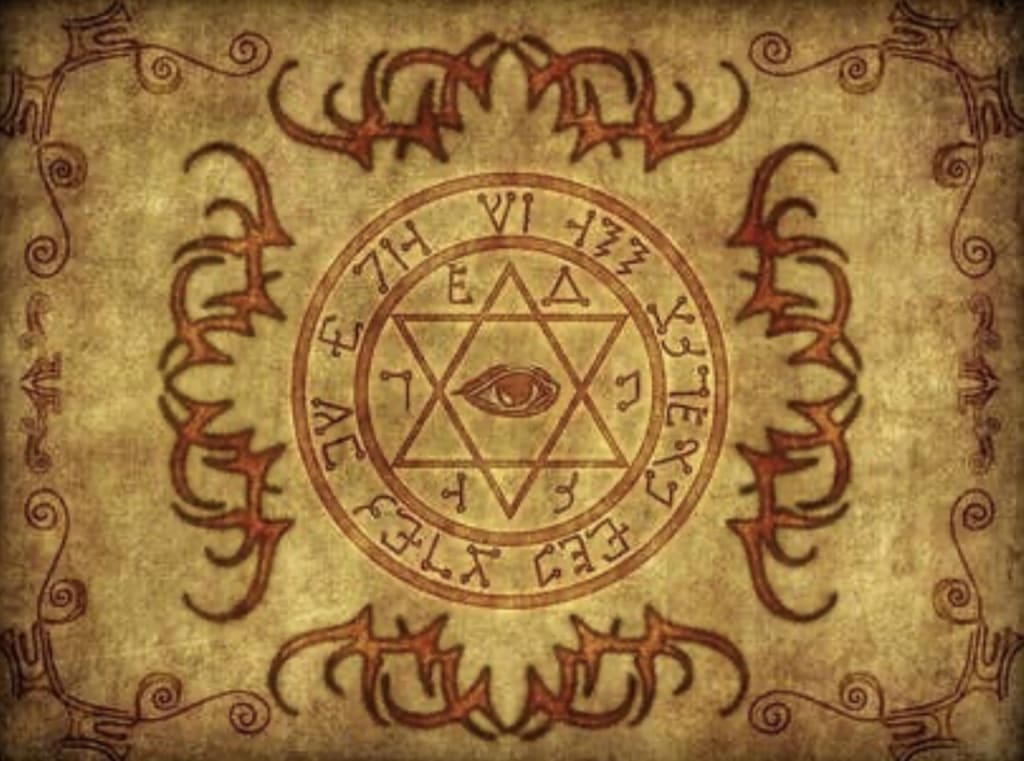
Some may go as far as to say that death is nature's only flaw. Some of us may fear the end of life so much so that they may seek to obtain the secret to immortality.
I mean, think about it, society has an obsession with ageing. How social media has us chasing youth, from forehead lines to creases on the neck. Ageing, death, it comes for us all, but maybe for some of us, it doesn't.
Whether it's Camelot's quest for the Holy Grail or Flamels' Philosopher's Stone, the subject of which has followed civilisation since the first fine line appeared on anyone who managed to survive past the age of 25.
The Alchemist
To begin our story, let me take you to the dense, noisy, muddy streets of 15th-century France. In the heart of Paris, known copywriter Nicolas Flamel is preparing his things before he embarks on his trip to Santiago de Compostela. He will meet with Jewish scholar Maestro Canches to discuss the contents of the book that Flamel envisioned in his dreams, The Book of Abramelin.
People believed Flamel spent twenty-one years attempting to decipher the coded language (Greek and unfamiliar languages/dead languages).
Canches agreed to help translate the rest of the book, understanding that the Kabbalah contained elements of mysticism and magic.
Sadly, Canches fell ill along the return journey to Paris and died. As such, Flamel, alone on his quest once more, spent the next three years translating and deciphering. Where, or so they say, he discovered the elixir of life and created the philosopher's stone.

At this point in the story, I will interject to address a common misconception about the Philosopher's Stone. It does not grant immortality; it merely prevents decay. The stone transmutes and rejuvenates, and it cannot bring back the dead.
Therefore, if one were to obtain the stone, one would become undead, more vampire than immortal. All of which I ask you to keep in mind as we continue the subject of immortality.
This is also a good time to briefly discuss alchemy and how it became the foundation for chemistry as we know it today. Alchemy is the art of turning base metals into gold, granting you access to the elixir of life. Which, by the way, scientists early this year accidentally did turn lead into gold while trying to recreate the Big Bang.
I want to stress that this was very, very small quantities of gold and most likely radioactive, so even though theoretically possible, it is still beyond our reach. Furthermore, chemistry replaced alchemy in academia during the 18th century and was placed into the realm of mysticism and folklore.

Okay, back to the story.
Flamel, in his elder years (60s-70s), had indeed become wealthy. He made donations to churches and the communities of Paris. Many people suspected he had achieved his lifelong mission, even the King of France.
However, most historians claim his wealth came from his wife, Perenelle, who came from an affluent family.
Another mysterious layer surrounding Flamel involves the headstone he designed. Dating it two years before his supposed death. Which is both morbid and odd. It is preserved and on display at the Musée de Cluny (the National Museum of the Middle Ages) to this day.
One year after Flamel and Penelle's deaths, a priest, who had grown suspicious, ordered the local gravedigger to open the caskets. His suspicions must have been strong if a priest was willing to desecrate a grave. And his suspicions were correct, because both caskets were empty.
So the story goes...
Shock ricocheted through the crowded streets of Paris as rumours began to fly around that Flamel had really done it, and he and his wife fled to India in search of the fountain of youth.
As to the whereabouts of Flamel and his undying body, it is all but speculation. From a local man who helped people with their taxes to an immortal alchemist, the story of Flamel as we know it today was solidified in the 18th century, where another supposedly immortal figure enters the frame.
Dear Count Saint Germain, Are You Still Out There?
Although not actually a Count, Count Saint Germain is another man shrouded in mystery. Even when he was alive. His lineage and birth are unknown and heavily speculated, yet in the 18th century, the immortal man is everywhere.
The key details about the count are as follows:
- Violinst
- Painter
- Scholar
- Speaks approximately 8-12 languages as naturally as if it were his native tongue: Sanskrit, Chinese, Arabic, Swedish, Portuguese, French, Italian, German, Spanish and Russian.
- Casually turn base metals into gold and create diamonds. Infusing them into his paintings.
- Never seen eating, but may have the occasional tea.
- Never ages, always described as a man in his 40s to mid-40s.
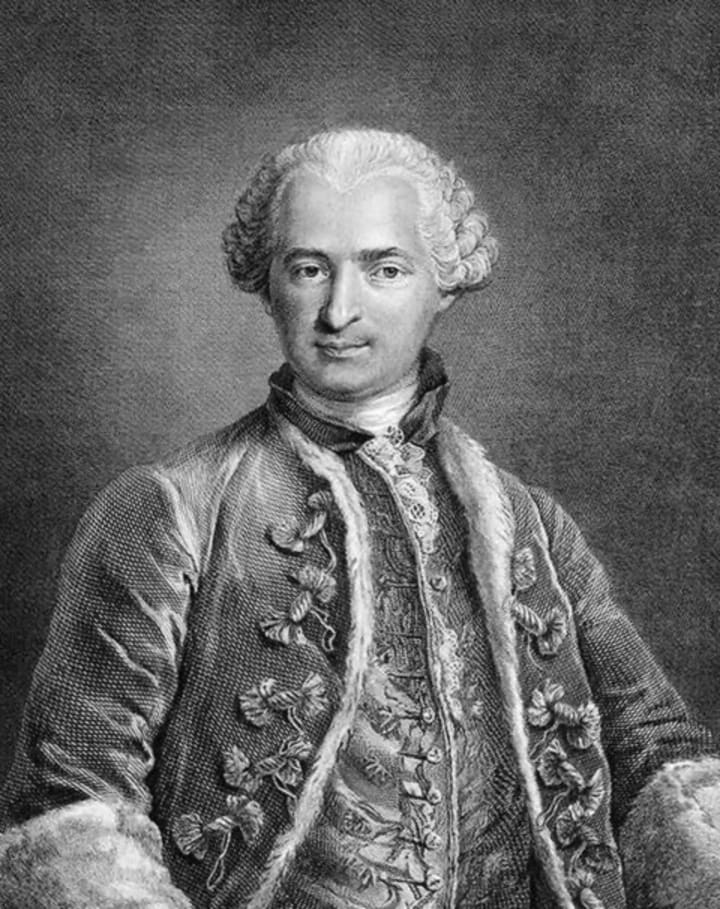
The Count's origins have always been of wild speculation, even during his time. Toward the end of his 'life' (27th February 1784), he claimed to be the son of Francis II Rákóczi, the prince of Transylvania, although this is, of course, unverifiable.
Germain appears in the history books around 1710. He reappears while he is studying alchemy in Persia from 1737-1742.
Among the packed streets of London, Germain was arrested for Jacobite espionage in 1743. During interrogation, it was noted that he was an odd man. Strange and not at all sensible. A man of clear wealth.
His arrest captured the attention of high society, including the Prince of Wales and the Gothic novelist Horace Walpole (The Castle of Otranto).
Walpole describes Germain as pale, with extremely black hair and a beard. Mentioning that -
"...he sings, plays on the violin wonderfully, composes, is mad, and not very sensible. He is called an Italian, a Spaniard, a Pole; somebody who married a great fortune in Mexico, and ran away with her jewels to Constantinople; a priest, a fiddler, a vast nobleman."
The count even gave two private musical performances in London, before he was next spotted in various places across Europe. Crossing paths with Volitaire, who added to the mystery surrounding Germain, calling him -
"a man who never dies and knows everything."
However, famed lover, Cassonova wasn't at all impressed by the count in the slightest and was highly suspicious of his 'immortality'. Nevertheless, the alchemist had high society across the European Courts hooked so much so that he received protection from figures such as:
- Madame de Pompadour
- King Louis XV of France
- Prince Charles of Hesse-Kassel (Germany)
In addition to many other members of the aristocracy. Including Catherine the Great. In 1760-62, Germain was present during the coup and had allegedly advised and assisted Catherine amidst the chaos. Although there is no evidence of his political influence, there is only a record of his presence.
Curious still, the count wanders across the continent during the years of 1763-1774. Germany, Italy, and France, even crossing paths with the classical musician Mozart along the way.
That's until he arrived in Hesse-Kassel (Germany) as the Prince's guest in 1774, where he remained until he died in 1784. Yet, the rumours persisted, and the legends grew.
There are claims that the count had attended the execution of Marie Antoinette in 1793. Sightings of the Count go all the way up to the 1970s, when some believe he was the actor.
There have been no recent sightings of Count Saint Germain, and as I did nearly four years ago, I wonder...are you still out there, lacing paintings with jewels?
Speaking of jewels, let's look into tales of knights and kings.
Knights, Kings and Holy Things.
It's inevitable when discussing the subject of immortality that acknowledgement of the Holy Grail is a must. Although the Holy Grail is anchored in Christian scripture, it does not appear named directly in the bible. However, later tradition identifies it as:
- The chalice Jesus used at the Last Supper.
- The vessel used by Joseph of Arimathea to collect the Blood of Christ during the crucifixion.
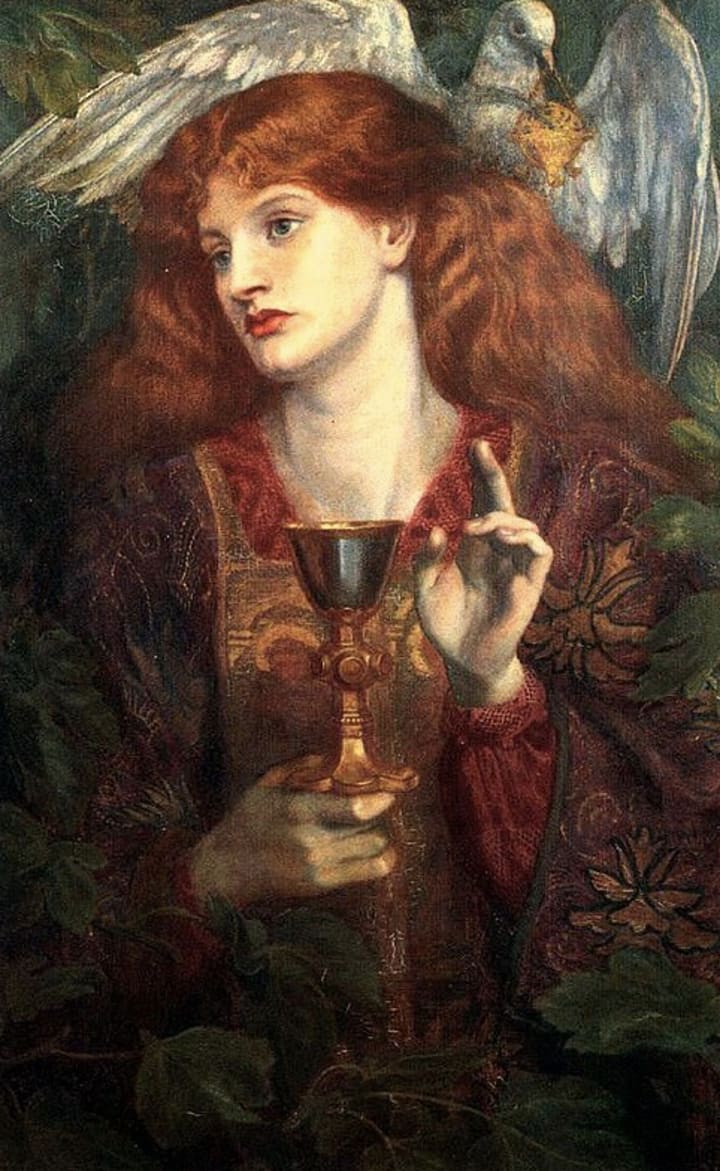
Naturally, Joseph becomes foundational in Grail lore. In Medieval texts, it claims he transported the Holy Chalice to Glastonbury.
In the 12th century, the first explicit mention of the Grail as we know it today occurs in the unfinished romance novel Percival or The Story of the Grail (1180). Yet it was never referred to as Holy.
It is Robert de Boron who comes along and Christianises the Grail by infusing the lore with the chalice of Christ and establishing the rule that only those who are pure of heart and morally and spiritually fulfilled may access the Grail, aligning Christian ideals of sin, redemption and grace.
Chrétein de Troyes introduces us to the story of the wounded Fisher King. A King whose sterile land is devoid of spirituality. The Grail has the power to sustain the Fisher King and heal his groin wounds. Thus restoring the land's fertility and the overall cosmic order.
We then crossroads with Camelot in Sir Thomas Malory's Le Morte dé Arthur, where the grail becomes the ultimate trail for the Knights of the Round Table. Linking Joseph of Arimathea's lore to the tales of Arthur Pendragon, the once and future king.
Sadly, the quest marks the end for Camelot, as the grail is taken from this realm (thanks, Galahad), along with it, its graces.
Conclusion
Stories around the subject of immortality allow our anxiety around ageing and death to be manageable. Turning the sacred quest into a story laced with certain conditions and rules, full of obstacles, allows us to reconcile the struggles of the human experience in a controlled manner that can symbolically provide a resolution.
These legends endure because they adapt through the ages. In the Middle Ages, stories of immortality reinforced religious and moral hierarchies. Compared to modern retellings, which imply that this is forbidden knowledge and can lead to hubris.
Our obsession remains; only the language changes. However, I think in our time we have achieved the prospect of immortality, but in a different sense. After we have left the realm of the living, our profiles remain. If our ancestors saw us today, they would think we were all mages.
But what is immortality without a legacy to follow?
Did Flamel really find the elixir of life? The fact that his headstone was designed years in advance suggests a man very much in control of his own "myth." If he didn't find the elixir, he certainly found the secret to a legendary PR campaign.
Did the Count truly die? Or did he retire because the 18th century was becoming too scientific? It’s hard to be a man of mystery when people start demanding peer-reviewed evidence and high-resolution portraits.
Does the holy grail exist, or is it just endless hope that something like this might be real?
What do you think?
________________________________________________
Thank you for taking the time to read my work. If you like the vibe, don't forget to like and subscribe. Make sure you stay tuned for the real-life story behind the most famous anonymous man who ever existed: The Man in the Iron Mask.
*Originally published on Substack:
About the Creator
Keep reading
More stories from Rosie J. Sargent and writers in FYI and other communities.
How Long Does Scalp Micropigmentation Last in Atlanta’s Climate?
Scalp micropigmentation or SMP is a popular non-surgical solution for hair loss, which offers the appearance of fuller hair through carefully applied pigment. But, one of the most common questions people ask before undergoing this procedure is: How long does it last, especially in a city like Atlanta where the climate condition is unique.
By Milla Rosen3 days ago in FYI
Celebrating Mother's Day When Your Mom Has Passed Away
Losing Your Mom If you have lost your mom, it's difficult enough, but it's even harder when her special day comes around. I know how it feels. I lost my mother. The first year was the worst. I remember how lost I felt. I just couldn't understand why she had to die when so many other people I knew still had their mothers.
By Janis Masyk-Jackson7 days ago in Families



Comments
There are no comments for this story
Be the first to respond and start the conversation.