
Automotive Artificial Intelligence Market Trends: Edge AI, Connected Car Ecosystems & Industry Outlook to 2033
How edge AI computing, cloud integration, and over-the-air updates are enabling seamless connectivity, enhancing vehicle performance, and supporting next-generation automotive innovations globally

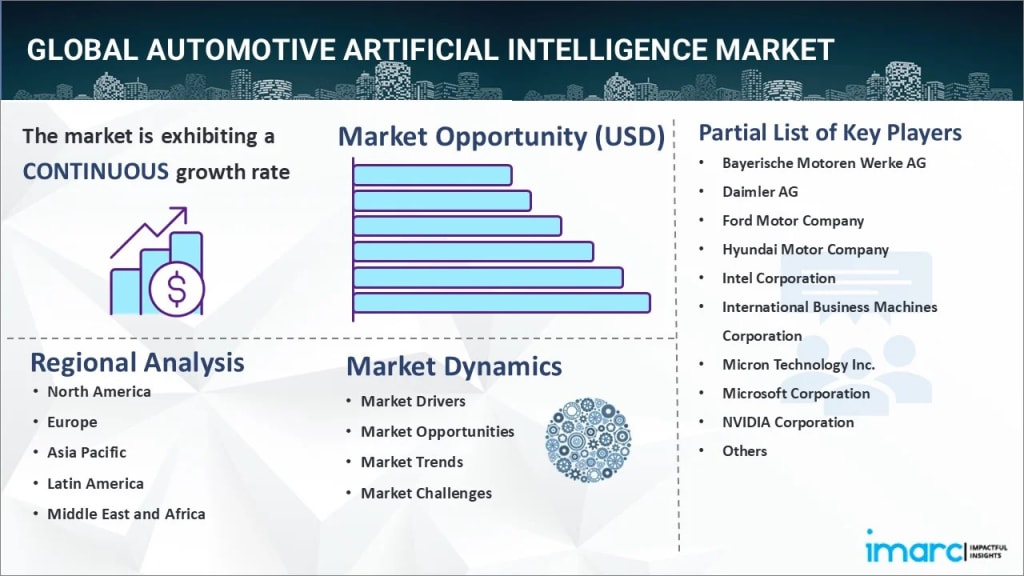
The global push for smarter, safer, and more autonomous mobility is fundamentally reshaping the automotive landscape, with artificial intelligence serving as the primary engine of this transformation. According to IMARC Group’s latest data, the global automotive artificial intelligence market size was valued at USD 5.0 Billion in 2024. Looking forward, IMARC Group estimates the market to reach USD 47.3 Billion by 2033, exhibiting a CAGR of 25.3% from 2025-2033.
Automotive AI has transitioned from a futuristic concept to a multi-billion-dollar industrial backbone. This evolution is characterized by the widespread adoption of Advanced Driver Assistance Systems (ADAS), the rise of software-defined vehicles, and a significant shift toward deep learning for real-time decision-making. Today, AI is not just about self-driving cars; it is deeply embedded in predictive maintenance, voice-activated cockpits, and sophisticated energy management for electric vehicle (EV) fleets. As consumers demand more personalized and hands-free experiences, the integration of high-performance computing and cloud-connected platforms continues to accelerate, turning the modern vehicle into a mobile data center.
Access In-Depth "Automotive Artificial Intelligence Market" Analysis with a Free Sample!
Automotive Artificial Intelligence Market Growth Drivers:
- Growing Integration of ADAS and Autonomous Functions
The push for safer roads is a massive catalyst, with features like lane-keeping assistance, adaptive cruise control, and automatic emergency braking now becoming standard expectations. These systems rely heavily on complex AI algorithms to process sensor data instantly. In fact, regulatory bodies like the U.S. National Highway Traffic Safety Administration (NHTSA) recently moved to mandate automatic emergency braking for all light vehicles by 2029. This regulatory pressure, combined with the goal of reducing human error—which causes over 90% of accidents—makes AI-powered safety a top priority for global manufacturers.
- Rising Electric Vehicle (EV) Adoption and Energy Optimization
The global shift toward electrification is creating unique opportunities for AI to manage complex battery ecosystems. AI is now essential for monitoring battery health, predicting discharge cycles, and optimizing thermal management to extend vehicle life. With over 14 million electric cars sold annually in recent cycles, manufacturers are leaning on AI to solve "range anxiety" through smarter routing and energy-efficient driving modes. These intelligent systems analyze real-world driving data to adjust power consumption in real-time, aligning vehicle performance with global sustainability goals while providing a more reliable experience for EV owners.
- Demand for Personalized and Intelligent In-Car Experiences
Modern drivers view their vehicles as an extension of their digital lives, driving a surge in AI-powered personalization. From natural language processing for voice assistants to biometrics that adjust seat positions and climate control, AI is making cabins more intuitive. In early 2025, major players like Cerence launched hybrid AI platforms that use large language models to provide conversational assistance even without internet connectivity. By catering to the desire for "agentic AI"—systems that can proactively schedule service appointments or manage infotainment—automakers are successfully narrowing the gap between initial consumer interest and long-term brand loyalty.
Automotive Artificial Intelligence Market Trends:
- Shift Toward Software-Defined Vehicles (SDV) and Subscriptions
A major transition is underway as vehicle value moves from hardware components to software capabilities. Automakers are increasingly adopting architectures that allow for over-the-air (OTA) updates, enabling them to improve features like lane-change accuracy or infotainment long after the car has left the lot. This shift has birthed new revenue models; for instance, Tesla and General Motors have successfully converted AI features into monthly subscription services. By 2026, the number of connected cars is expected to reach 125 million, allowing manufacturers to monetize driving data and offer tiered levels of autonomous functionality to a growing digital-native audience.
- Advancements in Edge Computing and Chiplet Designs
The technical infrastructure of vehicles is being overhauled to handle the massive data processing required for Level 3 and Level 4 autonomy. The industry is moving away from decentralized control units toward centralized, high-performance compute platforms. Recent breakthroughs in chiplet designs have slashed the cost per tera-operation by nearly 70% since 2024, making advanced AI functions more affordable for mass-market vehicles priced under USD 25,000. These hardware innovations allow vehicles to process up to 1.4 GB of sensor data per second, significantly improving object detection and reducing system disengagements in complex urban environments.
- Expansion of AI-Driven Predictive Maintenance and Operations
Beyond the driver’s seat, AI is revolutionizing how vehicles are maintained and sold. Predictive analytics now allow fleet operators and individual owners to identify potential mechanical failures before they occur, reducing downtime and repair costs. In the retail sector, AI-driven platforms are being used to forecast vehicle depreciation at a granular level, helping dealers manage inventory more effectively. By 2026, operational integration will be the norm, with AI "agents" managing early-stage customer engagement and service scheduling. This end-to-end automation improves efficiency across the entire vehicle lifecycle, from the assembly line to the second-hand market.
Recent News and Developments in Automotive Artificial Intelligence Market:
- March 2026: Hyundai Motor and Kia announced an expanded strategic partnership with NVIDIA to accelerate the development of a unified learning pipeline for autonomous driving, aiming to scale Level 4 robotaxi capabilities through their joint venture, Motional.
- February 2026: The United Nations announced a landmark global regulation for Automated Driving Systems (ADS), establishing uniform safety standards to facilitate the driverless deployment of autonomous vehicles on public roads worldwide.
- September 2025: Polestar confirmed the integration of Google’s next-generation Gemini AI assistant across its vehicle lineup starting in 2026, focusing on enhancing natural voice interaction and complex task execution within the car’s ecosystem.
Note: If you require specific details, data, or insights that are not currently included in the scope of this report, we are happy to accommodate your request. As part of our customization service, we will gather and provide the additional information you need, tailored to your specific requirements. Please let us know your exact needs, and we will ensure the report is updated accordingly to meet your expectations.
About the Creator
Andrew Sullivan
Hello, I’m Andrew Sullivan. I have over 9+ years of experience as a market research specialist.
Keep reading
More stories from Andrew Sullivan and writers in Futurism and other communities.
Oats Market Outlook: Innovation in Oat Snacks, Consumer Preferences & Industry Forecast to 2034
Rising health awareness, expanding plant-based diets, and the demand for fiber-rich breakfast options are driving oats demand, supported by clean-label trends, product innovation in dairy alternatives, and a shift toward functional ingredients. According to IMARC Group’s latest data, the global oats market size reached USD 5.68 Billion in 2025. Looking forward, IMARC Group estimates the market to reach USD 6.62 Billion by 2034, exhibiting a CAGR of 1.63% from 2026-2034. Russia currently dominates the market, holding the largest market share in 2025 due to extensive production and high domestic consumption.
By Andrew Sullivanabout 10 hours ago in Futurism
France Creator Economy Market : USD 62,127.3 Million Projected by 2034
France Creator Economy Market Overview The France Creator Economy Market is projected to reach approximately USD 62,127.3 Million by 2034, increasing from USD 6,833.1 Million in 2024, reflecting a strong CAGR of 24.7% during the forecast period from 2025 to 2034. The expansion of this market is being driven by the rapid growth of digital content platforms, increasing internet penetration, and the rising number of independent content creators generating revenue through social media, streaming platforms, and online communities. Content creators across sectors such as entertainment, education, gaming, fashion, and lifestyle are leveraging digital platforms to build audiences and monetize their creative work.
By Roberto Crum6 days ago in Futurism
AI Skeptics vs AI Optimists
The brutal truth about AI nobody wants to admit (but you probably feel already) I was sitting in a cramped conference room last year, watching a very confident man explain how AI was going to “replace 40% of jobs by 2030,” when I realized something weird.
By abualyaanart5 days ago in Futurism




Comments
There are no comments for this story
Be the first to respond and start the conversation.