
The Reach

ARCHIVE MEMORY - The Reach
⋔
Locals called the village The Reach, though no one remembered why. The shape spilled across the estuarial sea, woven into mangrove and mist.
At night, the alitap came out. They floated down from the sparse trees like pulsing sparks of pale fire. The elders said they were echoes of the living, harmless mostly. Children chased them through the dirt, squealing barefoot past spell-kissed ghostvines and pools that glimmered fragmented images from other lives when you looked too hard.
The air smelled of rain and salt. Their father, Eaman—tall, wind-chapped, with the calm of someone who could read the tide by scent alone—blew out the lanete incense. He burned the bark in their hut when food was scarce, when he wanted the room to feel full.
He worked as a haggleman and scale purifier. Most days, he could be found hauling resonance scales—crystallized memory patterns shed from rootbound fauna and memoryfish—along the trade routes. He traveled between seavillages and upland clinics, swapping scales for salt, copper, and thread-ink. Equal parts magical fishmonger, postman, and smuggler.
He adjusted the woven strap of his satchel across his back and paused in the doorway, one hand braced against the frame. The lanete smoke curled between them.
Alon sat on the low step, arms wrapped around her knees. “You’re leaving again.”
Eaman didn’t answer at first. He kissed the top of Sinta’s head. Then he reached up and pinched the dying wardlamp above the door, whispering a correction to its flickering rune. When it steadied, he glanced down.
“Your mother’ll be back from the echo gardens late,” he said, “but she’ll be back before I am.”
Alon picked at a seam on her dress. “They talk about me…in town.”
“Who?” Eaman’s tone was light, but his posture tightened.
“The others. The shopkeeper’s girl. Toma and the fireweed twins. They say I’m—” she faltered, “—that I make things…weird.”
Sinta, sitting nearby with her knees tucked under her chin, piped up, “They said she freezes the air when she walks in!”
“That I make adults forget their own names,” Alon muttered, lowering her eyes.
Eaman let out a breath—half a sigh, half a spellward.
“Alon,” he said, “you’ve always felt things before others. That doesn’t mean you’re cursed.”
“They don’t think it’s a gift either.”
That evening, Alon had argued with her mother, just loud enough to send Sinta quietly scuttling to a corner of the hut. Alon had begged to go with her to the gardens, but her mother had refused.
Their mother, Ina Velra, a steel rod of a woman, was a master threader in the Echo Garden Circle. Her work was quiet, exacting: harvesting emotional residue from memoryroot systems, maintaining perimeter runes, restitching broken spellwards into the village’s defense web. She rarely spoke at meals. When she did, it was often to correct a rune. Her presence was heavy, respected, a little frightening.
“No one else has to miss both parents for days,” Alon had said.
Velra’s response had been flinty. “We’re not rich. We’re not council-bound. But we matter. Your father and I, we help hold the wardline.”
She’d glanced toward the door, then back at Alon. “They forget that until things fall apart. Until the tide eats another house or a spellward slips. Then they come running.”
The family’s role was essential but isolating. The Reach owed much of its protection to them, but gave little warmth in return.
Eaman stepped back fully into the hut, knees cracking as he crouched beside Alon. “Do you know why they fear you?”
She shook her head.
“Because you remind them of things they forgot on purpose.”
Alon blinked. “Like what?”
“Like our family came to this village generations ago. So long ago, some say we were the first.” His voice dropped low, conspiratorial.
Sinta inched closer, and Eaman drew her into his lap.
“That the story of the spring beneath us—where ancestral magic seeps up through the earth—is real. And we were its guardians. Still are.”
Both girls stared at him wide-eyed.
Eaman winked and grinned. He set Sinta aside and ruffled Alon’s hair in one swift movement.
“Now, off to bed, both of you, and stop fussing. Your mother and I’ll be here when you wake, which won’t be but a moment.” And with that, he was gone.
The door shut softly behind him. Sinta leaned her head against Alon’s shoulder.
“I like that you’re weird,” she said.
*****
The afternoon light had begun to slant, turning the square beside one of the east bridges into a honey-colored lattice of palm shadow and dust. The village weaving circle had gathered again—an old tradition, a public rite. Children sat cross-legged in a wide spiral, their knees brushing banig mats scrawled with faded ink.
Kagaw Revan stood in the center, pipe unlit, a coil of memory-thread between his fingers.
The Kagaw of The Reach—part shaman, part judge—was the village’s oldest ritual title. They were keepers of ancestral knowledge, a voice in ceremony, a figure both revered and obeyed.
His hair was combed and pinned back. A tall, thin man with drooping purple bags beneath his eyes. He was always damp somewhere—forehead, lip, palm.
“Memory,” he was saying, “is not just recollection. It is intention. What we choose to weave determines what remains.”
He let the thread twist in the air, then flicked it with a bony finger. The strand caught the light. One end flared silver, the other dull ash.
A basin of saltwater shimmered nearby, its surface disturbed by a single spellfish, circling lazily. Its scaled body glowed in flickers, emotions shifting through it like weather: fear, curiosity, hunger. The fish had been harvested from one of the closer mangrove pools for the lesson, for the show.
“Spellfish don’t lie,” Revan said, nodding toward it. “Their bodies remember what we won’t admit.”
He dipped the thread into the water. The spellfish spasmed. A ripple of grief lit its fins. Children gasped. It settled, glowing faintly violet now, residual ache, a heartbreak no one had named.
Sinta’s eyes widened. Alon barely looked up. Her fingers picked at the smooth reeds of the woven banig mat they sat on. She was watching her mother, Ina Velra, who sat to the side beneath a tattered sun canopy with two other women. They sipped palm cider and laughed at something Revan had said earlier. Velra’s burnt orange robe was loose at the shoulder, hair pinned high with a bone-ink stylus she never used. She hadn’t looked at the girls once.
Revan moved slowly through the circle, trailing the thread through the air like a ribbon. He let it dance over shoulders, across brows. When it brushed a younger boy’s temple—Ganel, maybe six—the child gasped, overwhelmed by the rush of borrowed feeling. Revan stepped closer.
“Easy,” he murmured. He cupped the boy’s face in both hands. His thumb stopped just below the eye, index finger brushing the hairline.
The child froze wide-eyed. One of the women flinched imperceptibly, but then said nothing. Instead, she lifted her drink and took a sip.
Revan smiled, stroked the boy’s cheek once, then let go. “Such sensitivity,” he said, loud enough for the circle to hear.
Ina Velra clapped lightly. “That one’s always been a sponge.”
The other mothers nodded. No one looked at the boy again.
Revan reached Sinta. She tensed. His fingers passed just inches from her face, letting the thread hover. “Resonant,” he murmured. “So open to the current.”
Sinta flushed, unsure whether it was praise or a warning. Alon shifted beside her, but said nothing. Her hand subtly found her sister’s.
Revan continued walking, letting the thread spiral. “Some of you carry too much,” he said, tone thick with a kind of reverence. “And some of you…hold on too tightly.”
His eyes flicked toward Alon. She met his gaze without blinking. “What happens if we drop it?” she asked flatly.
All activity paused, and the other children looked up.
Revan’s smile didn’t falter. “Then someone else picks it up.” He tapped the pipe against his leg. “Or it rots.”
A ripple of adult laughter. Ina Velra’s voice among them: “Alon’s always testing everyone. Like her father.”
“She has his spine,” Revan said smoothly, not looking at her.
“But not his tact,” Velra replied, sipping. “Honestly, she spends too much time watching and not enough just…being a child.”
“Some children don’t get that luxury,” he said, brushing moisture from his lip as he leaned in, eyes on Alon. “And some…inherit more than they should.”
He let the thread dissolve. It curled in the air, shimmered once, then broke apart.
The lesson continued. Thread drills, repetition of old syllables, finger signs half-formed. The children obeyed. Sinta tried. Alon didn’t.
Eventually, the circle disbanded. The children scattered to fetch water or chase echo beetles. Revan turned to speak to Ina Velra.
Alon tugged Sinta away quickly.
“Did you feel that?” Sinta whispered.
“The thread?” Alon asked.
“No. The way he looked at us. Like we were…” She didn’t finish.
Alon squeezed her hand. “I saw it too.”
They walked faster, sandals scuffing dust. Behind them, Revan laughed at something their mother said.
No one stopped him. No one said a thing.
The wind, heavy with salt and ash, rustled the ghostvines behind the square, murmuring the same stolen names the elders had tried to pull from the garden walls just days before.
*****
That night, Alon and Sinta were nestled in the crook of the old hammock, curled like mirrored commas beneath a thin spellwoven blanket, listening to the wind comb the few trees. The hut smelled of dried fish, acacia, and boiled rice. Smoke from the tiny hearth curled around the rafters like a small animal trying to settle.
The hut, made from wood, reeds, mud, and grass, sat on tall stilts above the tidal swells. Every monsoon season, the rains came like judgment, sweeping a few homes away. The gods willed it. The villagers accepted it. Shelter was never permanent. It was borrowed breath, not bone. Houses were meant to be rebuilt, not remembered.
The Reach looked fragile, but it pulsed with quiet purpose. It was a crucial supplier for Kalibayan’s threaders, archivists, and spellwrights—those who needed raw, emotionally charged material. Its primary industry was the harvesting and refinement of resonance-rich resources: echo gardens, memoryroot groves, ghostvines, and spellfish. The Reach also exported kelpline fiber, a flexible, conductive material essential for mnemjack manufacturing.
They had stayed up too late after Eaman left for the next village over, casting shadow puppets on the wall and making each other laugh. Sinta’s laugh, sharp and sudden, had darted like a tiny, winged calyptura between the reed-thin walls.
For a second, Alon flew in the sky with it—light and fast and free. Sisters not just in blood, but in breath. If one cried, the other flinched. If one ran, the other followed.
They’d finally fallen asleep naming the stars in their secret language. Sinta murmured in her sleep.
The village was quiet that night, too quiet. The older threaders, along with Ina Velra, were out tending the echo gardens—pulling ghostvine from the perimeter walls, its silver tendrils whispering stolen names. They siphoned memoryrot from the root tanks before it spread. Black and tar-thick, it bloomed from forgotten grief and fed on unspoken truths. They restitched the inner wards with thread soaked in ancestral ash and freshwater ink.
The house was dark but for the dull glint of one half-dead wardlamp hanging from a beam. Its rune flickered faintly. Down below, wind chimes clicked.
The soft sound of footsteps creaked on the ladder.
Alon drowsily opened her eyes, tensing. Not fear, not yet, but something in her blood pulled taut.
She eased out of the hammock, soft as breath, and padded across the creaking floor. Unbidden, she thought of the knife hidden in the wall seam behind the mat hooks.
A voice came from just below. “Child? Are you awake?”
Kagaw Revan.
She relaxed slightly. He wasn’t supposed to be here. But he’d come by before, always with some reason: a spell demonstration, a rite rehearsal. He was their teacher, after all. He knew things. People liked him. Still, her feet didn’t move.
“Child,” he said again, quieter now, “it’s me.”
Alon turned, glanced back at the hammock. Sinta was still asleep.
She stepped toward the door and opened it. What could he want at this hour?
The night wind rushed in, cool and salted, brushing her face. Kagaw Revan stood on the landing, his shawl wrapped loosely around his shoulders. He looked…ordinary, even gentle. His eyes, like always, were kind in that practiced way. The same way you spoke to birds.
“I saw your wardlight flickering,” he said. “Thought I’d check you were safe.”
“We’re fine,” Alon said.
His eyes flicked past her shoulder. “Your father?”
“Trade shift.”
He nodded slowly. “Of course.”
A slow silence opened between them, measured and awkward.
“I was working late,” he said, lifting a hand to show a small jar. “Found something I thought might interest you. A resonance curl from a redscale echo. Rare. I thought you’d want to see.”
Alon didn’t answer. Something in her bones crawled. She didn’t know what the redscale curl was, didn’t care.
He always brought gifts: curiosities, small wonders, a resonance trinket. A poem, once, about twins and the moon.
The adults cooed, “Aw, how sweet,” but Alon had learned to watch their eyes, not their mouths. The smiles never quite reached them. And whenever Kagaw Revan stood among the children, no one ever fully looked away.
“I could show you,” he said gently. “Just a moment. Then I’ll go.”
Behind her, Sinta stirred in the hammock.
“No,” Alon said. It surprised even her.
Revan tilted his head. “No?”
“I’m tired. And my sister’s sleeping. Come back tomorrow.”
A quick, cold flicker passed through his face, then was gone. “Of course,” he said, smiling again. “Tomorrow, then.”
He turned to go, but paused at the ladder. “Your mother tells me you’ve been dreaming again.”
Alon didn’t respond.
“Strange dreams,” he said, almost to himself. “Bright ones. Those are the ones that leave stains. Powerful.”
He smiled once more. “Some children carry the weight of the world too early. Be careful where you place it.”
He vanished down the ladder into the dark.
Alon closed the door and bolted it. She sank against it, her breath tight. Behind her, the hammock rustled.
“Was that him?” Sinta asked, voice small.
Alon turned. “Yeah.”
Sinta sat up, rubbing her eyes. Her voice had gone sharp. “Did he come in?”
“No.”
“Good.”
The wind shifted outside, clinking the chimes again.
“Has he ever…?” Sinta didn’t finish the question.
Alon shook her head. “No. But he always tries.”
Sinta looked down at her lap. “He used to come talk to me, you know. When you weren’t there. About resonance. About the body.” She paused. “I told him you said it was weird.”
Alon crossed the room and climbed into the hammock beside her.
They sat together in silence.
“I don’t want to be scared forever,” Sinta said.
Alon took her hand. “You won’t be. I’ll burn his house down before I let him touch you.”
Sinta smiled faintly. “I know.”
Outside, the alitap drifted past the windows. The wind combed the mangroves like a ghost.
Alon lay awake, watching the door until morning.
*****
ACTIVE MEMORY - Gindara
✦
Alon trudged up the stairs to Sinta’s sixth-floor walk-up in the Low Verge, on the corner of Maraña Steps and Taliman Row. The elevators had been ripped out years ago. The shafts were now unofficial trash chutes the building superintendent only cleared when she remembered or felt like it, which was almost never.
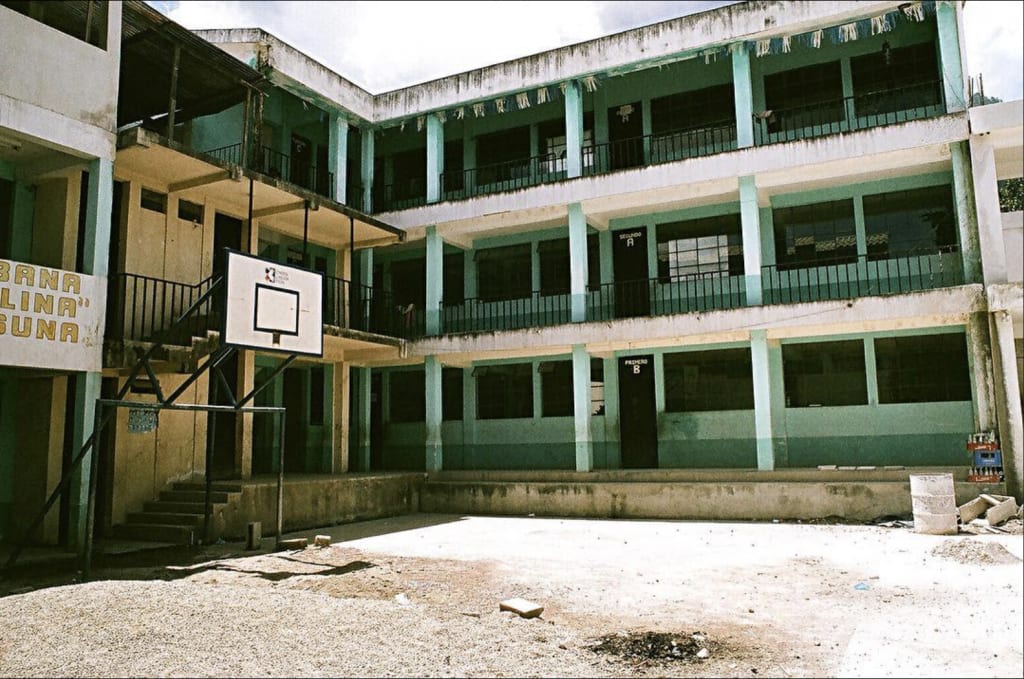
She paused at the landing and peered over the black railing into the cracked courtyard below. A heap of gravel covered most of it, scattered with the remnants of a campfire: burnt plastic, cigarette butts, bottles. An old basketball hoop with no rim or net stood over it all like a sentry that had given up.
The building was painted a bright mint green. Glittery blue and white tinsel rimmed the top floor, whether from a long-forgotten party or a meager attempt to liven the place up, neither she nor Sinta could remember. It made the place sadder.
Next door, a dry-goods stall sold pickled roots and old saltfish, the odors permeating the whole complex.
From the outside, the apartment looked like nothing: cracked paint, a rusted handle, a broken doorbell. But inside, it was all Sinta.
Alon palmed the lockward and let herself in without knocking.
The apartment was small, cluttered, and dimly lit by resonance candles and sputtering wardlamps. The foyer smelled of mint leaf, vinegar, and the incense Sinta used religiously after work. It wasn’t tidy in a decorative way, but in a practical one: mugs nested together, shoes turned toward the door, laundry drying on a cord stretched between the kitchen wall and a crooked coat hook.
A low table sat in the center, covered in half-filled clinic forms and a cracked mug of lukewarm tea. A rubber stamp lay beside it, leaving faint blue rings wherever it touched. In the corner, a short purple couch sagged at one end, its vinyl peeling but softened by a blanket stitched with old thread. Alon had helped drag the thing three blocks to the apartment on a scorching summer day—both of them bitching by the end, not because it was heavy, but because it was ugly, stubborn, and refused to fit through doorframes. By the sixth floor, they weren’t winded, just irritated. They bickered the whole way up, then collapsed on it laughing, hands smudged with rust and glue. Sinta kept it anyway, said it reminded her that some things were worth hauling even when they didn’t belong.
The window was always open, even when it rained. The Low Verge a steady background music: the roar of skimmers gunning through the narrow streets, distant singing, kids shouting half-spells they weren’t supposed to know. Sinta said she liked the noise. It helped her sleep.
The bedroom was barely a nook. The mattress on the floor had a single shelf above it that contained no icon, no candles, just a small stone on the shelf—smooth, dark, with a single chipped edge. Alon had given it to her once. She never said why, and Sinta never asked.
The place didn’t hum with magic, but it felt anchored, like no matter what the world forgot, this place remembered her.
“—ing Frel, that twat—” Sinta’s voice drifted in from the balcony. She’d started talking the moment the door opened, like they’d been mid-conversation and Alon had just stepped out to pee.
Alon crossed the apartment and slid open the balcony door.
“You’re late,” Sinta said, not looking up.
She knelt beside a row of planters made from busted crates and cracked mnemjack casings, fingers buried in soil. Her hair was tied up messily, and her shirt was stained. One of the plants glowed faintly—resonance-rooted. The setting sun lit her dark hair a deep bronze.
“I brought dumplings,” Alon said, lifting a still-steaming pouch.
Sinta stood, wiped her hands on her pants, and took the bag. “Good. I’m starving.”
They ducked inside. Alon kicked off her boots and sank onto the floor by the couch. Sinta grabbed plates and chopsticks, flipped on the electric teakettle, then returned, crashing onto the couch with the dumpling bag. Alon flinched, half-expecting the frame to snap.
They sat cross-legged—one on the floor, one on the couch—eating in silence. Through the open balcony doors, the city shimmered. Hollowsinks pulsed faintly on the horizon like bruised stars. Incense wafted up from a window a few floors down.
Sinta nudged her with a foot. “You threaded something today, didn’t you?”
Alon didn’t answer.
“You get that look when you do,” Sinta went on. “Like you’ve got glass stuck in your lungs.”
Alon picked at the edge of her dumpling. “It was minor.”
“Fucking liar,” Sinta said. “That’s not a word you get to use. Not when you come back looking like shit.”
Alon looked up. “Like what?”
Sinta shrugged. “Like you crawled out of a war memory.”
Alon gave a short, joyless laugh. “That’s probably because I did.”
They slipped into an old argument, not heated, just worn-in.
“Sometimes I think maybe forgetting’s a kindness,” Sinta said.
“It’s not,” Alon said quietly. Then, sharper, “It’s just a quieter kind of bleeding.”
Sinta frowned. “You always think hurting gets you some kind of badge. Ding-a-ling, here’s your door prize!”
“And you always want to be numb,” Alon bit back.
It landed.
But it wasn’t cruelty, just the truth, raw and stale between them.
Sinta looked away. “We should really practice this more. Don’t wanna get too rusty, y’know? Keeping each other fucking sad.”
For a moment, each thought the other might cry.
They both wanted to, but neither would go first. They waited, quietly daring, quietly hoping that the other would break first, to make it safe to follow.
But no permission was given, and none was taken.
Alon finally said, “You could’ve been happy, you know.”
“Not without you.”
Alon flinched. “That’s not fair.”
“Neither is any of this,” Sinta said, getting up to fetch the kettle.
The sound of her footsteps faded into the kitchen. Alon stared at the door.
And in her memory, another opened.
The night wind rushed in.
Kagaw Revan stepped into the room.
*****
ARCHIVE MEMORY - The Reach
⋔
Their hut was quiet again. Their hearth had long since gone cold.
Eaman had been gone longer than usual, off on a trade run to faraway Gindara. Velra was still at the echo gardens, restitching the perimeter wards through the night.
Alon and Sinta lay tangled in their shared hammock, wide awake, whispering silly stories to make each other laugh.
Something creaked on the landing. They both froze as the door began to open.
His robes whispered behind him. He kept licking his lips—slow, greasy, like tasting the air before claiming it.
He carried his long pipe in one hand, the bowl unlit. He tapped the stem against his left knee. Tap. Tap. Tap. A rhythm just slightly off-beat.
Something about the way he stood in the doorway, a rehearsed stillness, made the hairs rise on the back of Alon’s neck.
“Why are you girls still awake?” Tap. Tap. Pause. Tap.
Sinta sat up automatically. She had always been polite. Their mother had taught them to say thank you even when things felt wrong. “Sorry, Kagaw. We were just talking.”
“Ah,” he said, stepping inside. “Dreamtalk’s important. Powerful resonance. Especially between sisters.”
Alon climbed out of the hammock. Her feet met the cold floor. Her body moved, but her eyes stayed on his. “We were just going to sleep.”
Kagaw Revan smiled, not at her, past her. “Not yet. I want to show you something. Just you two.”
Sinta perked up. “Is it a rune test? A spellward game?”
“Of a sort,” he said. His pipe clicked once against his knee. “Come.”
Alon hesitated. Her hand brushed Sinta’s. The warmth of it steadied her—barely. She didn’t speak. She followed, but something in her chest tightened, like a thread being pulled.
*****
They walked quickly through the village. A few torches lit the wooden boardwalks, but Kagaw Revan led them down the unlit paths. The wind howled, making the boards creak loudly. It was a new moon. The only light came from distant flames, flickering like dying stars, too far from Alon and Sinta’s eyes to feel real.
Sinta’s hand in Alon’s felt so small, too warm. She clutched it tightly as their little legs struggled to match Revan’s long strides. His pipe tapped a new rhythm now—quicker, clipped, like a knock no one wanted to answer.
Most of the houses they passed had their wardlamps snuffed, doors shut, voices hushed.
They wove through narrower paths, slipping farther from the village center. When they passed a villager’s porchlight, he slowed and abruptly changed direction, taking them deeper into darkness.
Finally, they reached an older door. The wood was splintered and poorly oiled. It sat on higher ground, above the floodline, spared the worst of the monsoon season.
Inside was one of the old resonance rooms, veined with apophyllite and lined with echo slates. The kind used to amplify shared memory during rituals, though most had been sealed off after the fractures, before too many minds had opened at once and refused to close again.
Kagaw Revan lit a single flame. It flared green: spellburn.
“Stand here,” he said, pointing to a drawn circle. “Together.”
Alon didn’t move. Sinta did.
“What’s the exercise?” Alon asked.
Kagaw Revan smiled. “No exercise. Just listen to each other. Just remember.”
The apophyllite veins began to glow a pale green, light refracting in sharp, shivering angles.
A pressure filled the room, soft at first, then growing. Alon felt something pulling in her chest, like a thread unraveling.
Sinta wobbled. Her hand reached out, searching for Alon’s. “I feel…strange,” she murmured.
Kagaw Revan stepped closer. His voice dropped, “Don’t fight it.”
Without thinking, Alon moved. She shoved Sinta back out of the circle and stepped in front of her.
“Stop it,” she said.
Revan’s eyes stayed on Sinta. “She’s gifted,” he whispered. “So open. You both are.”
The walls pulsed. Alon could feel her sister breathing, shallow and catching.
Revan reached toward the apophyllite node nearest the floor. “Let me show you what you’re meant to—”
Alon screamed words not in any language. It was magic no one had taught her. She screamed a name, a wound, a sound too old for language.
The air split open. The room shuddered. One of the echo slates exploded. The apophyllite cracked like ice under fire.
Kagaw Revan reeled back, clutching his face. His nose gushed with blood. The green flame winked out. Grimacing in pain, he turned and stumbled out the door.
Silence swallowed the room.
The air glimmered, bending and warping.
Alon, panting, fell to her knees. Sinta dropped beside her. She was crying now, quietly, struggling to contain it.
“I didn’t know,” Sinta sobbed. “I thought—I thought it was a game.”
Alon pulled her close. “It’s not your fault,” she said.
But she said it too fast, because part of her wanted to scream, “Why didn’t you wait for me?”
They stayed there, curled together on the cold floor, while the green veins dimmed one by one.
*****
The resonance room was sealed off two days later. No one spoke of it. Questions weren’t asked. No rumors were spread. Not aloud, anyway. The Reach simply swallowed it, like it did all its strange weather.
Alon sat alone on the step outside their hut, one hand freshly bandaged. She was dipping the fingers of her other hand into the sand, relishing its cool resistance against her skin. Her eyes were fixed on the waterline, where the tide teased the edge of the mangroves.
Behind her, soft footsteps approached. Her father’s shadow fell across the step.
He stood behind her for a long moment. Then, slowly, he lowered himself beside her with a grunt and a creak of tired joints. He didn’t look at her hand. He didn’t ask about the sealed chamber. He didn’t speak for a while at all.
The air smelled like crushed sea hibiscus and wood smoke. Somewhere nearby, someone was laughing too loudly, pretending everything was fine.
Eaman finally said, “I heard the tide tried to come in early.”
Alon blinked once, but didn’t answer.
He nodded. “It does that sometimes. Slips past the markers. Makes people think it’s their fault for not watching closer.”
Another long silence. The wind combed the trees.
“I used to think that if I just watched hard enough, I could stop it. The sea, I mean.”
Alon turned her head slightly. “Could you?”
He chuckled softly. “Once. When you were little, you ran straight into the tide like it owed you something. I didn’t even shout. Just ran in after you. Scooped you up so fast you didn’t even get wet above the knees.”
She almost smiled. He looked at her then, really looked.
“If something ever comes for your sister like that again…” His voice dropped, not a threat, a promise. “I’ll be faster this time.”
Her breath hitched, just slightly. He stood and brushed the dirt from his palms. He started to walk away, but paused. Over his shoulder, he said, “You don’t have to tell me. Just don’t carry it alone.” Then he left.
For the first time in days, Alon let herself cry, but only a little.
*****
ACTIVE MEMORY - Gindara
✦
Alon stood near the balcony door, hands in her pockets, watching the darkness shroud the city.
Outside, the Low Verge had quieted into the hum of mnembiles, a baby crying somewhere, the buzz of a treadskiff misfiring in the distance. Night had taken the city slowly.
Holding her half-finished cup of tea, she quietly tiptoed past a sleeping Sinta on the couch, pausing at the door to the bedroom. She didn’t go in. Her eyes found the shelf above the mattress.
The stone was still there: smooth, dark, chipped. She remembered the weight of it in her hand. The sound Sinta made, once, in the middle of the resonance circle, when Alon had pulled her away too fast.
A half-cry, a half-question, echoed in her mind, “Why didn’t you wait for me?”
Alon looked away. She walked back to the couch and sat on the floor beside her sister. Sinta didn’t move, but her hand brushed against Alon’s on the cushion. Alon watched her sister’s face for a moment, idly tracing a rune on her own palm without casting it.
We’re still here. We’re still watching the tide.
Alon took a long sip of tea and let it burn her tongue a little. She turned from Sinta, leaned back, and closed her eyes.
About the Creator
Guia Nocon
Poet writing praise songs from the tender wreckage. Fiction writer working on The Kalibayan Project and curator of The Halazia Chronicles. I write to unravel what haunts us, heals us, and stalks us between the lines.
Keep reading
More stories from Guia Nocon and writers in Fiction and other communities.
Parting is such sweet and salty sorrow...
Dear Wife— At first, I hesitated to go forward with this resolution. But after your recent late-night binges scarfing down bags of chicharrónes—those pork rinds you dip in butter and the god-awful crunch they make, I knew I could no longer reach you.
By Lamar Wiggins7 days ago in Fiction




Comments
There are no comments for this story
Be the first to respond and start the conversation.