
The Dysgraphia Society 🜁
Dysgraphia -The struggle to translate thoughts into written language. (The rule everyone knows).


The change began so gradually that no one could say when it started. Only that, at some point, the people of Lyradon stopped writing as they normally did, and stopped feeling things the way they used to.
A society had begun to be built around the abandonment of writing by hand as an unspoken rule - becoming most powerful when the rule was never named, never explained, and never questioned---only enacted. What followed was a fully realized world where the erosion of handwriting, fine‑motor control, and manual expression became the quiet organizing principle of culture, architecture, education, and identity. The rule emerged only through what people avoided, corrected, or performed.
🜁 Lyradon had grown into "The Shape of a Society That No Longer Writes or behaves Normally".
It became a place where using one's hands was mainly symbolic, not functional. People gesture, signal, and display them, but rarely use them for direct contact. The absence of actually using the hands for normal handwriting becomes a cultural constant---so constant that no one remarks on it.
Everyday life evolved into technological automation.
Public surfaces are smooth and untouched, designed to respond to proximity rather than pressure.
Tools hover or self‑adjust at the touch of a button, meeting the user halfway so no one needs to grip or twist.
Children’s toys float, glow, or respond to voice, never requiring stacking, tying, or assembling.
Food preparation is automated, with knives, peelers, and mixers responding to verbal cues.
The society is not hostile to the use of hands and fingers; it simply treats them as delicate, imprecise, and vaguely risky - something to be protected from strain.
🜂 Education Soldiered on, persevered Without Writing -
Schools become the clearest mirror of the unspoken rule.
Students “write” by speaking into soft‑lit panels that transcribe for them.
When a child tries to grip a pencil, pen or a stylus, teachers gently redirect the hand away, as though preventing a misstep.
Handwriting is not banned, but the silence that follows any attempt makes the message unmistakable.
Children learn to pause before touching anything, a tiny ritual of restraint that becomes second nature.

Assignments are graded on clarity of thought, not form. The idea of “penmanship” had become as archaic as the spinning of wool.
🜃 Architecture is now Built for Hands That Don’t Touch. Brains that do not receive their regular doses of stimulation learn how to function at a slower level of development.
Buildings evolve around the assumption that manual interaction is unnecessary.
Design features mainly require doors to open by presence, not by handle. Perhaps that was better suited for the promotion of sanitization.
Furniture adjusts itself to the body’s posture. Public kiosks respond to gaze, not taps.
Streets are lined with soft sensors that anticipate movement and guide traffic without physical signals.
The city becomes a choreography of non-contact, a place where the absence of touch is woven into the infrastructure.
🜄 The Social Etiquette and the Quiet Enforcement is innately understood, the rule is never spoken, but it is enforced through subtle cues.
Social behaviors spill over in every aspect of the society - When someone reaches to pick up a dropped object, bystanders inhale sharply. There is no longer any need for such behavior, an automaton immediately performs the task.
- A host will gently intercept a guest’s hand before it touches a serving dish, offering a hovering tray instead.
- Parents guide children’s hands away from crayons with a soft “Careful,” as though the child were about to touch a hot stove.
- Lovers brush knuckles in the air near each other, a gesture more intimate than actual touch.
The rule is not “Do not use your hands.”
The rule is: Why would you?
🜅 The Cultural Story Becomes What They Tell Themselves...
Over generations, the people of Lyradon develop fables to explain their habits - stories that never mention the actual underlying problem, but reflect its shadow.
Reflect its Common beliefs...
~ Hands are “for expression, not exertion.”
~ Precision belongs to machines; intention belongs to people.
~ The body should not strain to do what the mind can command.
~ Writing is “a relic of friction,” something ancestors did before the world became gentle.
These beliefs are not enforced; they are simply inherently inherited.
Dysfunction masked as perfection had become the norm...Yet-
🜆 The Moment of Cultural Fracture was bound to emerge - Every society with an unspoken rule eventually meets someone who breaks it.
In Lyradon, it is often a child.
A child who tries to tie a knot.
A child who presses a finger into wet clay.
A child who draws a shaky circle on paper.
The room always goes quiet, like witnessing a taboo without knowing why it is taboo.
Adults correct the child softly, redirecting them toward the automated alternative.
The child learns.
The rule deepens.
🜇 What the unnamed Becomes in This World is not a diagnosis here.
It is the cultural baseline, the shared condition around which society has adapted. Its effects are visible everywhere
~ People struggle to form letters, so letters vanish from daily life.
~ People struggle with fine‑motor sequencing, so tools evolve to remove the need.
~ People struggle with handwriting, so handwriting becomes a quaint art practiced only by archivists and rebels.
~ People struggle with muscle coordination, so the culture frames manual effort as unnecessary, even inelegant.
The society somehow cannot see itself as impaired.
It sees itself as refined.
🜈 Yet. A Quiet Tension Brews Beneath the Surface - Not everyone adapts easily. Some feel the ache of unused muscles.
Some feel the frustration of thoughts that cannot be shaped manually.
Some feel nostalgia for something they never experienced - ink, paper, the drag of a pencil.
A few try to reclaim these things.
They gather in small circles, practicing shaky letters, dropping styluses, smudging ink.
Their hands tremble, but they persist.
They are neither rebels nor outcasts.
They are simply… odd.
People watch them with a mixture of curiosity and concern, as though they are performing a dangerous stunt.
No one stops them.
But no one joins them.
Not yet.
🜉 What will such a Society’s Future become.
A culture built around an unspoken rule is stable---until the rule is noticed.
The moment someone asks, “Why don’t we use our hands?”
the spell begins to crack.
The question is coming.
It always does.
The only uncertainty is who will ask it first---and what will happen when they do
.............................................
🧩 The Unraveling
It was the physicians who finally noticed the pattern, but never actually spoke of it aloud.
Patients arrived complaining of cramped fingers, trembling hands, difficulty gripping utensils. Some said their hands felt heavy, as though filled with sand. Others said their fingers forgot what to do unless a screen glowed beneath them.
The physicians ran tests. They found nothing wrong with the nerves, nothing wrong with the muscles---only that the pathways between intention and motion had grown thin, like threads worn smooth by disuse.
Still, no one spoke of the rule. They only adjusted their devices to compensate.
🔍 The Moment of Realization
One evening, a power outage swept across Lyradon. It lasted only seven minutes, but in those seven minutes, the city froze.
Doors stayed shut. Lights stayed dark. Meals remained partially prepared. People stood in their kitchens and living rooms, staring at their hands as though waiting for them to remember something unspoken and ancient.
A child cried because her toy would not rise from the floor. An elderly man stared at a window latch he had not touched in years. A woman tried to write her name on a piece of paper and produced only a shaky line.
When the power returned, the city exhaled in relief. Devices hummed back to life. Doors opened. Meals resumed. The toy floated. The window unlatched itself.
And everyone moved on.
Everyone...except for one young girl.
,,,,,,,,,,,,,,,,,,,,,,,,,,,,,,,,,,,,,,,,,,,,,,,,,,,,,,,,,,,,
Afterword:
Dysgraphia is a learning difference or disorder in which individuals struggle to translate their thoughts into written language, despite having normal intelligence and adequate education. It can affect both children and adults and may appear as developmental dysgraphia in early childhood or acquired dysgraphia following brain injury or trauma. The condition involves challenges with fine motor skills, spatial perception, working memory, orthographic coding, and language processing, all of which are essential for writing.
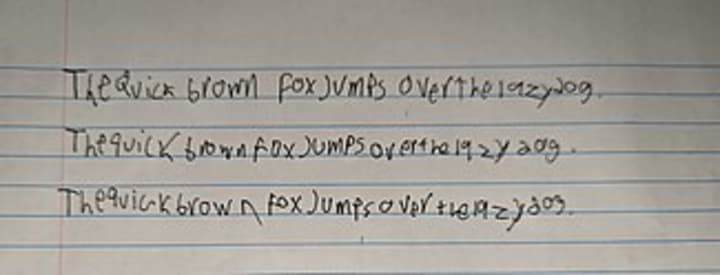
Three handwritten repetitions of the phrase "The quick brown fox jumps over the lazy dog" on lined paper. The writing, by an adult with dysgraphia, exhibits variations in letter formation, inconsistent spacing, and irregular alignment, all key characteristics of the condition.
About the Creator
Novel Allen
You can only become truly accomplished at something you love. (Maya Angelou). Genuine accomplishment is not about financial gain, but about dedicating oneself to activities that bring joy and fulfillment.
Keep reading
More stories from Novel Allen and writers in Fiction and other communities.
Do we sacrifice everything for our children.
Alice spent every waking moment caring for her only child---she worried when he was born, she worried when as a toddler he skinned his knee, she worried when he cried too long. And though no one ever said anything aloud, everyone in town behaved as though her worry was a kind of weather: something you adjusted to, something you didn’t disturb.
By Novel Allena day ago in Fiction
Harbinger of Despair
Who was he but just a man? To feel the weight of the world on his shoulders, he was no Atlas. Yet his bowed stance and tender neck suggested otherwise. It came to him in a dream: the absent stoking of an everlasting flame. A gnarled finger pointed towards an inevitable end, a sign that couldn't be ignorantly shaded; recurrence made sure of it. He didn't remember how long it had been going on; time didn't matter at this point. He just knew it was long enough to be petrified to fall asleep.
By James U. Rizzi3 days ago in Fiction
The Safety Bell
Pity hung from the funeralgoers' faces. They were something out of a nightmarish painting; not sure what to do with their mouths, some pinching them closed, others looked like they were caught mid scream. Most of the women had watering eyes that they tried to avert from meeting Albert’s. For some reason, it made him feel ashamed.
By Nikki Torino Wagner7 days ago in Fiction


Comments (2)
Wonderful story, Novel. Interestingly, it ties in loosely with some writing I've just done for a client on graphemes and phonemes. Without them, a written language can't exist.
sad reality this often got overlooked as laziness in schools