
The Porcelain Protocol
BY ADMITTING THE SHADOW, WE INVITE THE DARK.

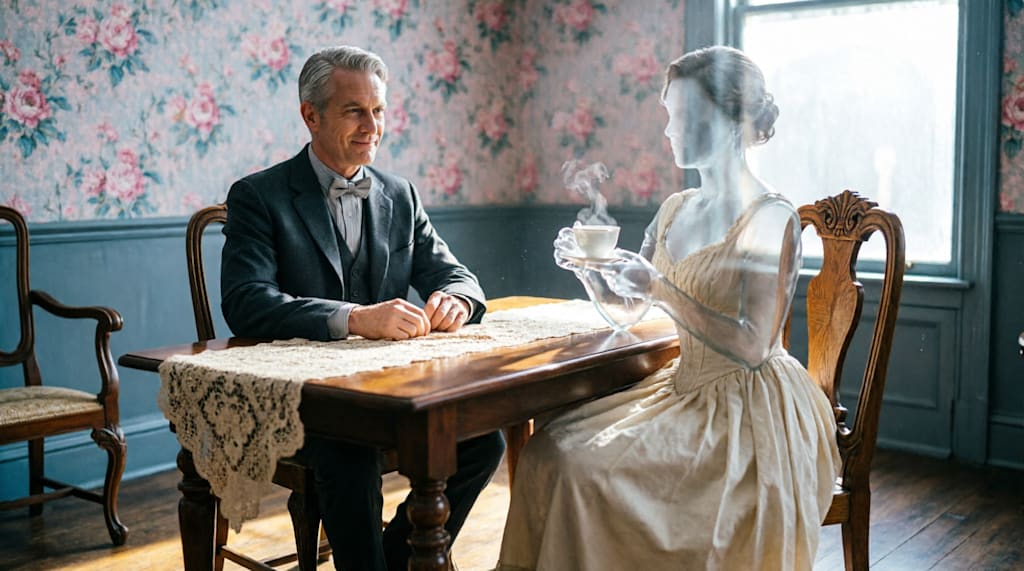
The morning toast was slightly burnt, but Elias didn’t mention it. He couldn’t. To complain about the toast would require looking at the person who made it, and looking at Clara this morning was an exercise in extreme discipline.
Clara sat across from him, lifting a floral patterned teacup. The bone china was beautiful, but it was currently more substantial than her hand. Through her palm, Elias could clearly see the mahogany grain of the dining table and the lint on his own trousers.
"The hydrangeas are peaking, don’t you think?" Clara asked. Her voice was thin, like silk stretched until it was ready to snap.
Elias focused his gaze exactly three inches to the left of her face, staring intensely at a smudge on the wallpaper. "They’re magnificent this year, darling. The blue is particularly deep."
He reached for the marmalade. His hand passed through the space where Clara’s elbow should have been. There was no physical resistance—just a slight chill in the air, like walking through a patch of autumn mist. He didn't flinch. He didn't apologize. He simply adjusted his reach, grabbed the jar, and spread the orange preserves with a steady hand.
The rule wasn't written in any law book, but it was etched into the marrow of their bones. You lived within the light. You ignored the transparency. To acknowledge the Fade was to suggest that the person was already gone, and in Oakhaven, such a suggestion was considered the height of obscenity.
"I was thinking of walking down to the market later," Clara said.
She stood up. As she moved, she didn't cast a shadow. The morning sunlight streamed through her torso, casting the pattern of her lace dress directly onto the rug behind her.
"The walk will do you good," Elias replied, his heart hammering against his ribs. "Perhaps you could pick up some of that smoked trout for dinner?"
"Trout sounds lovely," she whispered.
She leaned down to kiss his cheek. Elias felt nothing but a momentary coolness, a faint scent of lavender, and the terrifying sensation of his own skin being visible through her lips in the hall mirror. He smiled into the empty air, projecting a warmth he didn't feel.
"See you at six, then," he said.
The market was a masterclass in collective denial.
Elias stood by the fruit stall, watching Mrs. Higgins, the grocer. She was weighing apples for a young man who was so far gone he was little more than a shimmering outline in the air. His clothes hung on a frame that was barely there.
"That’ll be four shillings, Arthur," Mrs. Higgins said, her eyes fixed firmly on the man’s hat, which was the only thing still fully opaque.
"Thank you, Mrs. Higgins," Arthur replied. He reached out to take the bag. His fingers passed through the paper. The apples spilled onto the cobblestones, bruising as they rolled.
A silence fell over the square. It was the heavy, suffocating silence of twenty people pretending they hadn't seen a man’s hand fail to interact with matter.
Arthur stood frozen, looking down at the fruit. His shimmering form flickered, a pulse of static in the sunlight.
"My, the wind is quite fierce today!" Mrs. Higgins chirped, her voice cracking. She immediately began picking up the apples and placing them back in the bag. "Must have blown right out of your hand, Arthur. Let me double-bag those for you. Extra grip for the breeze!"
"Yes," Arthur said, his voice a hollow echo. "The wind. It's... it's quite something."
Elias watched as the neighbors stepped around the apples, their movements graceful and deliberate. No one offered to help Arthur hold the bag. To help him would be to admit he couldn't hold it. They spoke of the harvest, the upcoming festival, and the new paint on the church—a chorus of pleasantries designed to drown out the sound of a man disappearing in broad daylight.
By 5:30 PM, the house was silent.
Elias sat in the living room, a book open on his lap. He hadn't turned a page in an hour. He was listening.
He heard the front door click. He heard the sound of the trout being placed on the kitchen counter—a soft thud that sounded far too light.
"I'm back," Clara called out.
Elias stood up and walked into the kitchen.
Clara was standing by the sink. She was a ghost of a girl now, a breath of smoke captured in the shape of a woman. He could see the pipes under the sink through her chest. He could see the garden through her head.
"The market was busy," she said. She was looking at him—really looking at him—with an intensity that was dangerous. Her eyes, the last things to fade, were bright with a terrifying lucidity.
"Elias," she said.
"The trout looks fresh," Elias said, his voice a shield. "Shall I get the lemon?"
"Elias, look at me."
It was a violation. A social hand grenade.
Elias kept his eyes on the fish. "I think the copper pan would be best for this. Don't you agree?"
"Elias, please." She moved toward him. "I can’t feel my feet. I can’t feel the floor. I’m scared."
The air in the kitchen turned frigid. This was the moment the rule was designed for. This was the test. If he looked at her, if he cried, if he held her, he would be validating her fear. He would be making the Fade real. And if it was real, it was final.
"We should invite the Millers over for bridge on Friday," Elias said, his teeth gritting so hard they ached. "They’ve been dying to see the new sunroom."
"I won't be here on Friday!" she shrieked. It wasn't a loud sound—it was the sound of air escaping a bellows—but it felt like a thunderclap. "I'm vanishing, Elias! Look at me! Tell me you see me!"
Elias picked up the lemon. He picked up the knife. His hands were shaking, but he forced them into a slow, rhythmic motion. Slice. Slice. Slice.
"They’re bringing that vintage port they found in London," Elias continued. His voice was a monotone, a prayer to the god of Status Quo. "It’s supposed to be excellent."
Clara reached out. She tried to grab his arm, but her hand passed through his sleeve like a beam of light. She let out a sob—a dry, thin sound that contained the weight of a lifetime.
"Please," she whispered. "Just once. Say goodbye."
Elias turned to her. For a split second, his gaze wavered. He saw her—really saw her. He saw the woman he had loved for thirty years, reduced to a silhouette of glass and memory. He saw the terror in her eyes. He felt the words I love you, please don't go clawing at his throat, ready to tear his life apart.
He took a breath. He looked directly through her eyes at the spice rack on the wall.
"I’ll go set the table," Elias said. "We’ll use the good crystal tonight. It’s a special occasion, after all."
He walked through her.
He felt a cold shiver pass through his entire body as he occupied the same space she did—a moment of intimate, molecular overlap. It felt like heartbreak, frozen in ice.
He went into the dining room. He laid out the placemats. He set the silver. He placed the wine glasses. He moved with the precision of a man performing a ritual that kept the sun in the sky.
"Dinner’s almost ready, Clara!" he called out.
There was no answer.
Elias waited. He stood at the head of the table, his back straight, his expression one of pleasant, expectant warmth.
He heard a sound—a soft hiss, like a candle being blown out in a large room. The coldness in the air vanished. The kitchen was silent.
Elias walked back into the kitchen.
The trout was on the counter. The lemon slices were neatly arranged. The lace dress lay in a heap on the floor, perfectly intact, but empty.
Elias didn't scream. He didn't fall to his knees. He didn't touch the dress.
He picked up the trout and placed it in the trash. He picked up the lemon slices and put them in the compost. He took the dress, folded it neatly, and placed it in the laundry basket.
He walked to the phone in the hallway and dialed a number he knew by heart.
"Hello, Margaret?" he said when the neighbor answered. His voice was steady, bright, and utterly hollow. "I’m so sorry, but it seems Clara has decided to take an impromptu trip to the coast. Yes, quite sudden! You know how she is. She’ll be gone for... well, for quite some time."
On the other end of the line, Margaret didn't ask questions. She didn't offer condolences.
"How lovely for her!" Margaret replied. "The sea air is so restorative. We shall miss her at bridge on Friday."
"Yes," Elias said, looking at his own hand in the mirror and noticing, for the first time, that he could just barely see the silver of the wallpaper through his knuckles. "We shall."
He hung up the phone. He sat down in his chair. He picked up his book. He sat in the quiet house, a man of perfect manners, waiting for the moon to rise through the space where his chest used to be.
About the Creator
Edward Smith
I can write on ANYTHING & EVERYTHING from fictional stories,Health,Relationship etc. Need my service, email [email protected] to YOUTUBE Channels https://tinyurl.com/3xy9a7w3 and my Relationship https://tinyurl.com/28kpen3k
Keep reading
More stories from Edward Smith and writers in Fiction and other communities.
THIRTEEN
The first Tuesday of every month, we gathered in the community room of the Ashford Apartments with dishes covered in foil and Tupperware lids that didn't quite seal. Someone brought macaroni. Someone brought green beans. Someone, always, brought pie.
By Edward Smithabout 16 hours ago in Fiction




Comments (1)
🎴🎴🎴♦️♦️🃏🟩🟪🟥🟧🟨🟨🟨🟧🟥◻️◼️🔲🔲🔔🔔🔔🎴🎴🀄️🎴🎴🎴♦️♦️🃏🟩🟪🟥🟧🟨🟨🟨🟧🟥◻️◼️🔲🔲🔔🔔🔔🎴🎴🀄️🎴🎴🎴♦️♦️🃏🟩🟪🟥🟧🟨🟨🟨🟧🟥◻️◼️🔲🔲🔔🔔🔔🎴🎴🀄️🎴🎴🎴♦️♦️🃏🟩🟪🟥🟧🟨🟨🟨🟧🟥◻️◼️🔲🔲🔔🔔🔔🎴🎴🀄️🎴🎴🎴♦️♦️🃏🟩🟪🟥🟧🟨🟨🟨🟧🟥◻️◼️🔲🔲🔔🔔🔔🎴🎴🀄️🎴🎴🎴♦️♦️🃏🟩🟪🟥🟧🟨🟨🟨🟧🟥◻️◼️🔲🔲🔔🔔🔔🎴🎴🀄️