
Insurance.
We all need insurance. I need insurance for my apartment to show my landlord. You need insurance for your house and car. As one of the characters in To Catch a Thief says to the insurance agent when her jewels are stolen, insurance is a "bet" on the part of the insurer and the person buying the insurance. Will the insurer take your bet? What if it's a really big building and a very big bet? Then the odds have to be assessed by an actuary. What if it's a completely new undertaking? Then it's a tougher assessment. Then it's a meeting or two or three. So what's all the fuss about at this meeting? Big insurance. Would big insurance take my company's big bet? Darmstadt is known for its 'Giant Insurance Palaces.' Our story takes place in one of them... Let's listen in on the meeting.
"You really think this is the best next step, Jules? I mean not the next best step, really, THE Next Stage?"
"Yes I do."
"Then, don't take this as an insult, by why build it in France? And not in Paris, but the South of France? Really? Southern France? I trust the French to excel at topless sun-bathing, but nuclear fusion power generation? Shouldn't the facility be built somewhere more earnest and business-like? Bonn? Bern? St. Petersburg? Los Alamos? Anywhere?"
"Calm yourself, Berndt. It will be built by an international consortium. That should make you feel at ease."
"But Jules, it is a little backwater in Southern France, population, population..." Berndt Weber rifled through his paper...
"Population 886. Just what we wanted. Someplace small."
"But it's such a lot of money to invest. And it's an unknown technology. The questions of safety alone..."
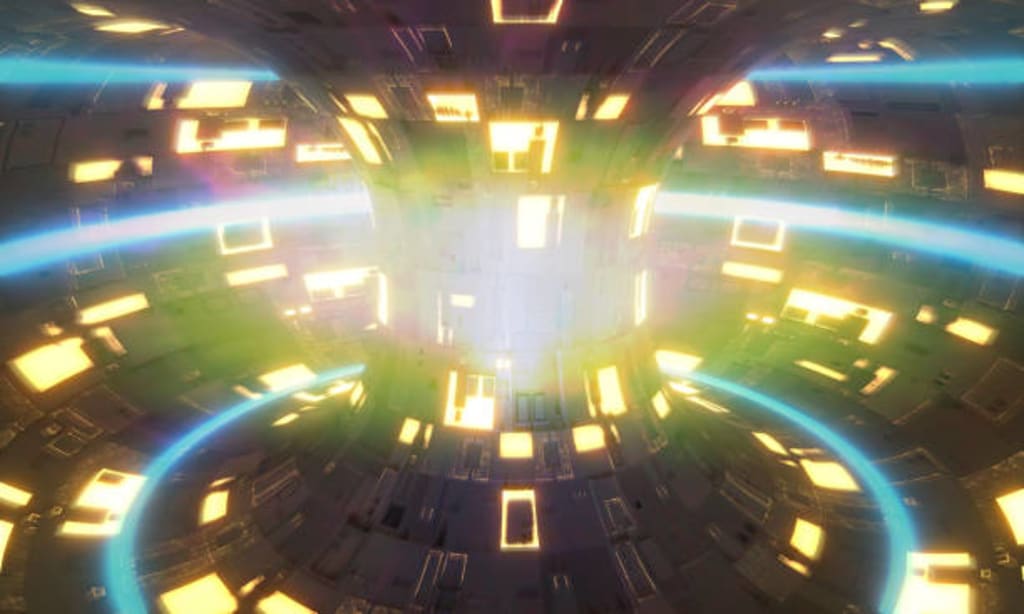
"Ladies and gentlemen, masters and doctors all, let us come to order," the chair of the session spoke in measured, mezzo-soprano tones. "This committee has been formed to take a sober, second look at project ITER, which promises the first generation of power from nuclear fusion that will have a net gain from the technology: much more heat output than energy input. This project promises much. Can it deliver? That is the question we are being asked. Dr. Weber, I think it is easy to see why you are on this committee, and clearly we need your input, but let us ask our questions in a good order, and perhaps it is not too much to hope that we can get at the heart of the issue without disparaging the reputation and expertise of the host nation." Berndt nodded. "And this seems a good moment to introduce you, chief actuary of Darmstadt-James, the worldwide re-insurance company we all know, and in whose well appointed premises we are meeting today." Nods and murmurs around the circular table.
The chair continued. "This project follows on the heels of the ground-breaking work done by China on EAST, the Experimental Advanced Superconducting Tokomak reactor, also called The Artificial Sun. Dr. Lee, your team succeeded in maintaining the reaction for an impressive 17 minutes," she gestured deferentially to the Chinese delegate, who inclined his head slightly, somewhere between a large nod and the slightest appearance of a small. seated bow.
Perhaps it is best to begin with a technical summary from Dr. Jules Lebloitte, scientific director of the ITER project."
A red-headed, middle aged Picard--or did he seem Flemish?--I knew that bloitte, or Blut was old Flemish for bald--cleared his throat and read his presentation rapid fire. "ITER builds on the success of EAST. The main difference is that ITER will show a net gain of power out over power in."
"On what order? What is the Q factor?" Lee asked.
"Q 10. Ten times the energy out." Nods around the table showed that the room was impressed.
"Containment?" Lee asked.
"Magnetic, of course," Jules answered.
"The atomic materials?"
"Hydrogen isotopes. Deuterium and tritium."
"Of course. The temperature?" this from Lee.
"One hundred fifty million degrees Celsius," Jules stated without batting an eyelash."
This figure was too much for Berndt, though he had already read it in the report. "And apart from the jazzy electromagnets and the donut-shaped particle loop, how on earth do you plan on containing that? I mean, in a way that the whole French Riviera does not burn down?"
"We are testing alloys," the French scientist said calmly.
"What material could possibly withstand that heat?" Berndt persisted. "And how will you test it? And don't say in the Chinese reactor, because that's not as hot as yours."
"It is a question of analytical chemistry and engineering," Dr. Kim, the Korean delegate answered matter-of-factly. "Molecular analysis and Markov chains."
The chair asked the next question, a practical one. "How long until the reactor can go on line?"
"We had hoped," Jules began, "to target the early 2030s, but there have been unavoidable delays. We expect to be ready in the late 2030s."
Berndt made a note and took out his calculator, muttering to himself.
"Availability of the isotopes?" the chair asked.
"Already secured and guaranteed from European reactors, sources duplicated for greater certainty," Jules explained.
"Operating procedures?" Berndt asked.
"Under development," Jules answered. Again Berndt shook his head.
"The contractor for the manufacture and assembly of the atomic section?"
As the official observer for the international construction consortium, I answered this question. "The Canadian company that produced the Candu reactor."
Satisfied nods at this. Even Berndt was satisfied. "Their safety record is perfect," he pronounced.
The Picard took several minutes to walk the group through the construction drawings and flow chart with project timelines. The follow-up questions brought them to lunch, which I had arranged to be served as a buffet. The theme was decidely southern French and German, starting with escargots, followed by a Salade NiÇoise. No wine was served. The insurance company and my consortium reserved all alcohol until the end of the day.
No German meal is complete without potatoes. A fine Vichysoisse served that function. Wild boar supplied the protein, then a slice of Black Forest cake, and, finally, coffee.
So far the meeting was going just as I expected. The two scientists were confident, well prepared, and excited. The insurance executive, or rather the re-insurer, was nervous. After all it was his job to worry, because if things went south, his company's money (and a lot of it) was on the line.
I wasn't at all sure what the afternoon would be like. The time was given over to discussion by a young American I had found online to replace a no-show at the last minute, an expert with a killer academic background and very relevant experience. She had an MBA degree from MIT and a law degree from Harvard. Her MIT thesis had involved some heavy mathematics on present and future costs and values concerning environmental challenges and efforts. As it turned out, her red hair matched that of our Picard. She passed out handouts, and copies of her report, which we had not yet read.
The chair invited her to present. "Thank you," she began, "Please just call me J. I'm used to that. I am not an expert in geopolitics, but I do know a lot about change management, and this technology addresses a problem of global change management, actually change management WITHOUT a manager." Berndt nodded at this.
"Consider the future in which ITER is operational, in which an artificial sun supplies low-cost energy, more than enough to meet the needs of the entire planet. More than enough for the future. Oil would not be worth the cost of removing it from the ground because all of the energy needed would be readily available from ITER. And a tenth of the energy output could be re-directed back into the reactor, which would then multiply that energy by ten, so that all of the energy will be renewable.
"How much disruption in energy delivery has taken place because of wars and lesser conflicts? And how many conflicts have grown up around oil and gas? What if they were worthless commodities? There would be no such interruptions, and the worth of a country would depend on the ingenuity and industry of its citizens, not on the circumstance of what is found in the ground.
"But how to achieve this change? I think we have all observed the effects of politics on the energy and climate-change crisis--one step forward and a wobbly step backwards, I think. I'm sure we would all agree that if we rely on politicians to manage this change it will not happen. Mark Twain once said that if Congress had been present when the Creator said 'Let there be light,' we never would have had it." The last remark made Berndt double over with laughter. She knew how to work the room. A lucky find for me and my company.
She directed our attention to the charts in our handouts. She had calculated costs and benefits in a very particular way. Present payouts were balanced against future benefits. Future payouts were estimated as sums in future dollars and euros. She used a range of numbers for cost increases and currency fluctuations. It took some time to read her graphs, which showed areas of possible costs, rather than simple curves. Then she had calculated probabilities through the areas under the curves. It was sophisticated mathematics, and she explained it all patiently, especially to Berndt, who followed it avidly.
She proposed several measures for safety and overall risk management, and this caught all of our interest, especially mine. There were approaches we had not even thought of. When had she found the time to do all of this careful work?
Jules and I made notes on these points and we asked several questions. I could see Berndt underlining parts of his papers and stroking his chin thoughtfully. At length he asked her if she was trained in actuarial science. She answered no, but she had studied some of the relevant mathematics. "You think like an actuary," he said. It was the highest compliment anyone had ever heard him make.
She turned in great detail to risks posed by the project, how they could be addressed, and a range of outcomes and ways of managing them. She borrowed Donald Rumsfeld's vocabulary of known unknowns and unknown unknowns. I was impressed, as were the others in the room. After an hour and a half she asked for questions. There were not many.
She turned to Berndt. "Your presentation has been very elucidating," he noted, "and I thank you very much. You have been thorough and circumspect."
She asked what were his reservations. "Only the risks you have addressed," he said, "and you have pointed out ways to mitigate and manage the largest ones."
She focussed her eyes on him and replied, "And I am sure it has not escaped your consideration that if this project does not go forward, the insurance industry, and undoubtedly your firm in particular, faces a host of problems, not just potential risks, but predictable costs and damages. Rising sea levels will bring flooding to the world's coastal cities, which is to say about 90 percent of the population. And that is just one risk that your industry is exposed to. This project comes with new risks, some of them hard to calculate, but they are small compared with the losses that are sure to follow if the world continues on this path. This technology is our best chance, and your industry's best chance to survive the coming decades."
I had not expected that. In a heartbeat she had switched from a cold neutrality in her risk analysis of the consortium's project to passionate and brutally logical prediction of the costs of doing nothing. The room fell silent.
Our chair invited further questions. There were none. She looked at me. I made three phone calls. First the photographer I had hired for the event came in, composed us into a tight group, and took several shots of us with different lighting. I don't often have my picture taken, but if I do, I want it done properly.
Next the bar was wheeled in, a trolley laden with oysters, Wurst, and Gewurztraminer, an Alsatian white wine I prefer.
I thanked each participant in turn, and, when I came to J, I was profuse. I told her that her presentation was excellent, and I was very impressed that she had prepared it so quickly and so well. I asked her if, when the project moved forward, she would be willing to act as a consultant. She said she would be glad to, that she could think of nothing more important.
I turned to Berndt last. He had changed from the bundle of nerves he was at the beginning of the day to a calm, jovial version of himself that I had not seen before. "That was excellent," he enthused. "I don't know how you found that MIT woman, but you should hire her on as a consultant. What a treasure!"
I told him that she already agreed. "Good!," he exclaimed. "Now don't act on this until you get official word, but I can tell you privately that we and others will insure this project. It's worthwhile. Actually it's necessary. It would be suicide to kill the project. And it's very well planned."
My work was complete, well, except, that was, for one more point.
In 1973, British Prime Minister Heath, that is Sir Edward Heath, successfully steered the United Kingdom into the European Economic Community. At an interview afterwards, he related that his cabinet, that evening, went to have a drink at a pub together, but he did not feel that was appropriate for a moment of such significance. He was an organist, actually the organ scholar at his university college. So instead of a libation, he sat down at an organ and played Bach. That was, to him, the most appropriate way of marking a moment that made a new beginning for Great Britain.
Is ITER the beginning of a change, a big change? That's not yet clear, but it might be.
If it is, what will I say to my grandchildren about how I marked this meeting? With a glass of Gewurztraminer? I think that would not be sufficient for the occasion, again, if indeed it is such an occasion. Is it? Best to be optimistic in choosing how to mark it, I think.
I don't play the organ. I always found that foot work awkward. The piano is my instrument. I ordered not a Steinway but a Boesendorfer. Steinways are more famous, but Boesendorfers have a better sound envelope, and they ring longer. I had specified a Boesendorfer that had been tuned that day.
I sat down to play Beethoven's Les Adieux. The instrument was gorgeous. All gathered around to listen. When I completed the piece, Berndt said, "Oh but why Les Adieux ?"
J answered. "Because, Herr Weber, in English schools we all read TS Eliot. 'To make an end is to make a beginning. The end is where we start from. The Four Quartets, Little Gidding.' Am I right?'" she asked me.
"You are absoutely correct," I said warmly, "and let us all hope that this dream takes root."
About the Creator
Paul A. Merkley
Mental traveller. Idealist. Try to be low-key but sometimes hothead. Curious George. "Ardent desire is the squire of the heart." Love Tolkien, Cinephile. Awards ASCAP, Royal Society. Music as Brain Fitness: www.musicandmemoryjunction.com
Keep reading
More stories from Paul A. Merkley and writers in Fiction and other communities.
The Boston-Davos Five
The Boston-Davos Five (that's what the five of us call our little mini, unfunded, unofficial think tank) started meeting once a year after Davos. You know, the international conference on the environment. We were there three years ago, all of us grad students then, and we promised we would work together to make a difference. We aren't idealists, at least not completely. Pete's the most pragmatic, and also the quietest, V-necked sweater, glasses as thick as Coke bottles. He's a biology postdoc at MI-fricking-T.
By Paul A. Merkley13 days ago in Fiction
GRANDMA NELSON
Daddy pulled off the interstate, and I saw the all familiar red barn, and I knew we had arrived at Grandma Nelson's farm. I always had mixed feelings about seeing my Grandmother. It seemed she had as many Grandchildren as the old Mother in the shoe nursery rhyme. I saw her as different, but that is not why I hestiated. The truth be known I always got in trouble at her house, and ended up sitting in the car after I had been scolded.
By Susan Payton3 days ago in Fiction



Comments
There are no comments for this story
Be the first to respond and start the conversation.