
The Wrong Story People Tell
And It Is Not a Personality Flaw


Originally published here:
A few years ago I found one of my brightest researchers standing in the stairwell between the fourth and fifth floors, eating dry cereal from a paper towel because she said a bowl would have felt “too committed.” She had just gotten reviewer comments back. Nothing unusual. The usual academic weather system: one reviewer who skimmed, one who wanted a different paper, one who seemed personally insulted by the existence of semicolons. She was crying in a very organized way, wiping under each eye carefully so her glasses would not streak.
She said, “I think this proves I’m not built for this.”
That sentence has been spoken in universities so many times it ought to be etched somewhere near the faculty senate office, probably beside a broken vending machine.
I did not tell her she was wrong. I have been in academia long enough to distrust easy reassurance. Some people are not built for certain academic environments. Some laboratories are emotionally primitive. Some departments survive on a diet of delayed praise and public ambiguity. Some supervisors should not be allowed near young talent without a chaperone and a clipboard. Calling all distress “imposter syndrome” can be a neat way of making the institution look innocent.
Still, what she was feeling was not evidence in the way she thought it was.
Before research, I came out of law, where insecurity wears better shoes and uses complete sentences. The vanity is similar. So is the appetite for hierarchy. The difference is that science pretends the pain is nobler because the lighting is worse and people carry pipettes instead of leather briefcases. In both worlds, smart people start mistaking chronic self-doubt for rigor. They come to believe that feeling fraudulent means they are paying attention.
After a while the feeling becomes devotional. They polish it. Feed it. Introduce themselves through it.
This is where the common advice starts to irritate me. Burnout is not always just overwork. Imposter syndrome is not always false belief. Sometimes you really are underprepared for the next task. Sometimes the room is more advanced than you are. Sometimes you gave a bad talk because the talk was bad. Academia attracts people who hate that kind of plain statement, because it does not let suffering glow. It just sits there, practical and rude.
But even then, the useful question is rarely “What does this say about me?”
The useful question is smaller. Almost insulting in its modesty. What is the next thing under my control?
I learned this late. Too late to make it graceful.
In my first years in research, I still behaved like a lawyer who had wandered into a lab and was trying not to touch anything. I over prepared for small meetings. I read papers with the hunted expression of someone looking for a hidden clause. When experiments failed, I reacted as though the universe had issued a professional opinion on my character. This is a very efficient way to exhaust yourself: convert every result into biography.
A failed assay is information. A rejected paper is information.
A grant you do not get is information, plus a little local politics, plus timing, plus somebody else’s taste, plus maybe one sentence on page four that should have been cut.
It is not a prophecy.
Brilliant students are especially vulnerable here because they are accustomed to feedback arriving as identity. Gifted. Promising. Exceptional. Then academia starts speaking a different dialect: unfunded, revise, not competitive this cycle, interesting but preliminary. Some of them adapt by becoming brittle. Some become pleasing in a desperate way. Some turn unpleasant.
One of the most gifted junior colleagues I ever worked with was also one of the least bearable. He corrected people’s pronunciation of technical terms he himself had learned six months earlier. He had the habit of leaning back during talks with one ankle on the opposite knee, looking faintly injured by the speaker’s existence. When his fellowship proposal was rejected, he announced at lunch that the committee “wasn’t equipped” to assess interdisciplinary work. This was not completely false. It was also not the whole truth. The proposal had a hole in the middle large enough to drive a departmental memo through.
He spent two years blaming the wrong machine.
That is the mind game nobody explains properly. Burnout does not come only from effort. It comes from leakage. From spending first-rate mental energy on variables you cannot move. Committee moods. Reviewer vanity. The charmed lives of other people on LinkedIn with their cheerful grant photos and suspiciously symmetrical success. If you let yourself, you can burn half your nervous system on resentment before lunch.
This is why I tell younger researchers something that sounds softer than I mean it: help somebody.
Not because kindness saves the soul. I am not qualified to speak about souls. I mean something more mechanical. Misery narrows attention until your own career becomes the only object in the room. Then every setback swells out of proportion. Helping a student fix a figure, reading a colleague’s abstract, showing a new lab member where the minus-20 freezer sticks on humid days — these things interrupt the narcissism of despair. They return scale to the picture.
And joy, if we are going to use that embarrassing word, has to be treated the same way. Not as a reward stored behind publication number twelve or the mythical grant cycle when people finally become calm. I have watched too many academics postpone their lives with the seriousness of monks. They defer rest, love, hobbies, decent shoes, sunlight, parenthood, solitude, friendships, all of it, until after tenure, after the paper, after the next move. Then the habit hardens. They become experts in arrival and amateurs at living.
So yes, take responsibility, but not in the punitive way institutions like. More like this: you are the principal investigator of a very unstable project with poor oversight and inconsistent funding. The project is your actual life. Today’s experiment may be embarrassingly small. Send the difficult email. Refuse the useless committee. Take the walk before the afternoon collapses. Rewrite the opening paragraph instead of mourning the whole paper.
I still know people waiting to feel legitimate before they let themselves enjoy anything. They may be waiting a long time.
The stairwell student eventually did fine, though “fine” is a word that hides a lot. She published. She learned to recover faster. She also left academia for a while, which might have been the sanest decision anybody made that year. I still think about that paper towel full of cereal. Not because it was tragic. Because it was ordinary. That is the ugly part. So much suffering in research does not look dramatic when you catch it up close. It looks like fluorescent light, stale sugar, and somebody smart confusing pain with proof.
About the Creator
KURIOUSK
I share real-life experiences and the latest developments. Curious to know how technology shapes our lives? Follow, like, comment, share, and use stories for free. Get in touch: [email protected]. Support my work: KURIOUSK.
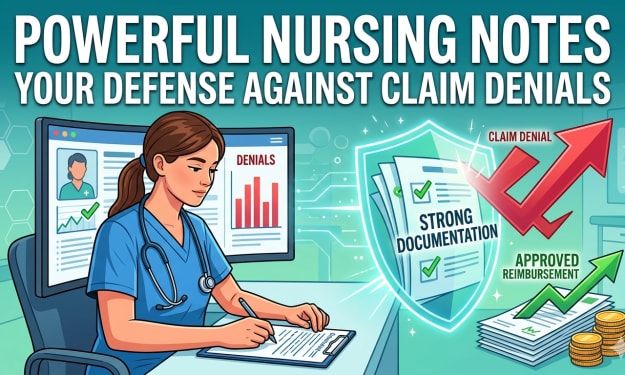
Beyond the Chart: Why Nursing Documentation Is the Secret Weapon in Denial Management
In today’s complex reimbursement environment, claim denials are one of the most significant hurdles for healthcare providers. While denial management is traditionally seen as the domain of billing teams and coders, the foundation of a successful revenue cycle is actually laid much earlier—at the point of nursing documentation.
By ampirebusiness5 days ago in Education
Understanding Digital Transformation in Modern Healthcare Operations
Digital transformation is redefining how healthcare organizations manage their operations and deliver care. As the demand for faster, more efficient, and patient-centered services continues to grow, healthcare providers are turning to digital technologies to modernize their systems. This transformation involves integrating advanced tools into everyday processes to improve efficiency, accuracy, and accessibility.
By Brady Beitlich7 days ago in Education



Comments
There are no comments for this story
Be the first to respond and start the conversation.