
How to Identify and Overcome Common Challenges in Mainframe Migration
A Practical Guide to Navigating Risks, Ensuring Data Integrity, and Modernizing Legacy Systems

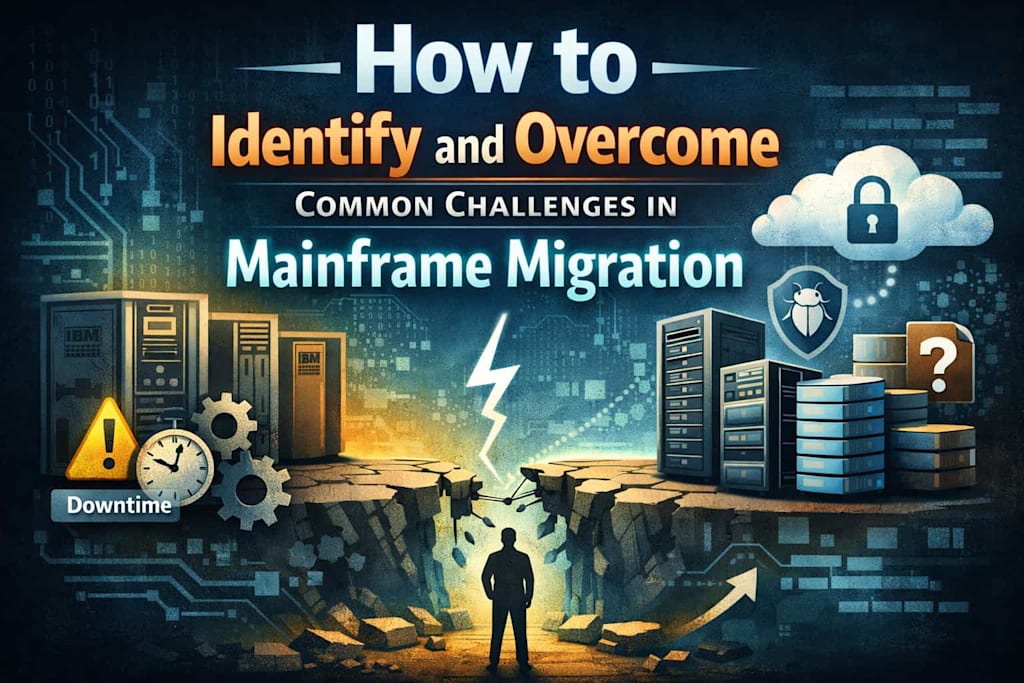
Mainframe migration has moved from a long-term consideration to an immediate priority for many organizations. As businesses push toward cloud adoption, scalability, and modern data architectures, legacy mainframes—once the backbone of enterprise IT—are increasingly becoming bottlenecks rather than enablers.
But migrating from a mainframe environment is not just a technical upgrade. It’s a complex transformation involving applications, infrastructure, people, and—critically—data. In fact, one of the most underestimated aspects of mainframe modernization is database migration, which often determines the success or failure of the entire initiative.
In this guide, we’ll walk through how to identify the most common challenges in mainframe migration and, more importantly, how to overcome them with practical strategies.
Understanding the Scope of Mainframe Migration
Before diving into challenges, it’s important to understand what mainframe migration actually involves.
Mainframe systems typically support:
- Legacy applications (often written in COBOL)
- Large-scale transaction processing
- Highly structured and tightly coupled databases
Migration can take several forms:
- Rehosting (lift-and-shift)
- Replatforming
- Refactoring or rearchitecting
- Replacing with SaaS or modern systems
Each approach introduces different complexities—but all of them share one common thread: data must move reliably and accurately, making database migration a central concern.
Challenge 1: Lack of Clear System Visibility
The Problem
Many organizations don’t have complete documentation of their mainframe systems. Over decades, systems evolve, patches are applied, and dependencies grow organically. As a result, teams often lack visibility into:
- Application dependencies
- Data flows
- Business logic embedded in code
This creates a major risk: you can’t migrate what you don’t fully understand.
How to Overcome It
Start with a comprehensive system discovery phase:
- Use automated code analysis tools to map dependencies
- Document workflows and integrations
- Identify critical vs non-critical workloads
For database migration, this step is even more crucial. You need to:
- Catalog all databases, schemas, and data formats
- Understand relationships between datasets
- Identify redundant or obsolete data
Creating a clear system inventory reduces surprises later in the migration.
Challenge 2: Data Complexity and Integrity Risks
The Problem
Mainframe databases are often highly complex, with:
- Hierarchical or network data models
- Proprietary formats
- Decades of accumulated data
During migration, there’s a high risk of:
- Data loss
- Corruption
- Misalignment between old and new schemas
How to Overcome It
A successful database migration requires a structured data strategy:
- Data Mapping. Map legacy data structures to modern relational or NoSQL schemas.
- Data Cleansing. Remove duplicates, fix inconsistencies, and archive unused data.
- Validation Mechanisms. Implement checks at every stage to ensure data accuracy.
- Parallel Testing. Run legacy and new systems side by side to compare outputs.
For example, a financial institution migrating from a mainframe to a cloud-based database must ensure transaction histories remain 100% accurate—any discrepancy can have regulatory consequences.
Challenge 3: Application Compatibility Issues
The Problem
Mainframe applications are often tightly coupled with the underlying hardware and operating system. This makes it difficult to run them in modern environments without modification.
Additionally, these applications frequently rely on:
- Legacy programming languages (like COBOL)
- Custom middleware
- Outdated APIs
How to Overcome It
You have several options depending on your goals:
- Rehosting: Minimal changes, faster migration, but limited modernization
- Refactoring: Modify code to work in modern environments
- Rewriting: Build new applications from scratch
When database migration is involved, application compatibility becomes even more critical. Applications must be updated to:
- Connect to new databases
- Handle modern query languages (e.g., SQL vs legacy query systems)
- Support distributed architectures
A phased approach—starting with less critical applications—can help reduce risk.
Challenge 4: Downtime and Business Disruption
The Problem
Mainframe systems often support mission-critical operations. Any downtime during migration can:
- Interrupt business processes
- Impact customer experience
- Cause financial losses
This is especially sensitive when migrating databases, as data availability is essential.
How to Overcome It
Minimizing downtime requires careful planning:
- Incremental Migration: Move workloads in stages rather than all at once
- Data Replication: Keep legacy and new databases synchronized during transition
- Blue-Green Deployment: Run old and new systems in parallel and switch when ready
For example, in database migration, you can use real-time replication tools to ensure that both systems stay updated until the final cutover.
Challenge 5: Skill Gaps and Resource Constraints
The Problem
Mainframe expertise is becoming increasingly rare, while modern cloud and database technologies require different skill sets.
Organizations often face:
- Shortage of COBOL developers
- Limited experience with cloud platforms
- Lack of database migration specialists
How to Overcome It
Address skill gaps proactively:
- Upskill existing teams through training programs
- Hire specialists for critical phases like database migration
- Partner with vendors or consultants experienced in mainframe modernization
Cross-functional teams—combining legacy system experts and modern architects—are especially effective.
Challenge 6: Cost Overruns
The Problem
Mainframe migration projects are notorious for exceeding budgets due to:
- Underestimated complexity
- Unexpected dependencies
- Extended timelines
Database migration can add significant costs, particularly when dealing with large volumes of data or complex transformations.
How to Overcome It
Control costs with:
- Detailed upfront planning
- Clear scope definition
- Phased implementation
Also, consider:
- Prioritizing high-value workloads
- Archiving unnecessary data before migration
- Choosing cost-efficient cloud storage and database solutions
A well-planned database migration can actually reduce long-term costs by improving performance and scalability.
Challenge 7: Security and Compliance Risks
The Problem
Mainframes are known for their strong security. Migrating to modern environments introduces new risks:
- Data breaches
- Compliance violations
- Misconfigured cloud resources
Database migration is particularly sensitive because it involves transferring and transforming large volumes of potentially sensitive data.
How to Overcome It
Build security into every stage:
- Encrypt data in transit and at rest
- Implement strict access controls
- Conduct regular audits and compliance checks
For regulated industries (e.g., healthcare, finance), ensure that the new database systems meet all legal requirements.
Challenge 9: Data Synchronization During Transition
The Problem
During migration, both legacy and new systems may need to run simultaneously. Keeping data synchronized between them is a major challenge.
How to Overcome It
Use:
Real-time data replication tools
Change data capture (CDC) techniques
Automated synchronization pipelines
This ensures consistency and allows for a smoother transition without disrupting operations.
Challenge 10: Resistance to Change
The Problem
Not all challenges are technical. Employees and stakeholders may resist migration due to:
- Familiarity with existing systems
- Fear of job displacement
- Concerns about reliability
How to Overcome It
Manage change effectively:
- Communicate the benefits clearly
- Involve stakeholders early
- Provide training and support
Highlight how database migration and modernization can:
- Improve efficiency
- Enable better analytics
- Support innovation
Challenge 8: Performance Issues Post-Migration
The Problem
After migration, organizations sometimes experience:
- Slower application performance
- Inefficient queries
- Increased latency
This often happens because modern environments behave differently from mainframes.
How to Overcome It
Optimize performance through:
- Database tuning: Indexing, query optimization, caching
- Load testing: Simulate real-world usage
- Monitoring tools: Continuously track performance metrics
Database migration should include a performance optimization phase to ensure the new system meets or exceeds expectations.
Conclusion
Mainframe migration is not just a technical upgrade but a strategic transformation that reshapes how an organization operates, scales, and competes in a digital-first world. While the challenges can seem overwhelming—from limited system visibility and application compatibility issues to data complexity and organizational resistance—they become manageable with the right approach and mindset. At the heart of this transformation lies database migration, which plays a critical role in ensuring that valuable business data is preserved, accessible, and optimized for modern environments.
Organizations that succeed in mainframe migration are those that treat it as a holistic process rather than a one-time project. They invest in understanding their existing systems, prioritize data integrity, and adopt phased, well-tested migration strategies. By aligning technical execution with business goals, they not only minimize risks but also unlock new opportunities for innovation, performance, and cost efficiency.
Ultimately, overcoming the common challenges of mainframe migration requires a balance of careful planning, modern tools, skilled teams, and continuous optimization. When done right, it enables businesses to move beyond the limitations of legacy systems and fully embrace the agility and scalability of modern architectures, turning migration from a daunting necessity into a powerful competitive advantage.
About the Creator
Chudovo
Chudovo is a custom software development company, focused on complex systems implementation.
Building Wealth with Purpose: The Synergy Between Financial Planning and Investment Management
Achieving financial security is rarely the result of chance; it requires careful strategy, thoughtful decision-making, and a comprehensive understanding of both present circumstances and future goals. Two crucial components in this journey are financial planning and investment management. While these areas may seem distinct, their true power lies in how they work together to help individuals grow, protect, and sustain wealth over the long term. Recognizing the connection between planning and investing can transform a scattered approach into a purposeful, goal-oriented financial strategy.
By Winston Feng4 days ago in Education
Top 7 Online Whiteboard Tools
The growing adoption of remote work, online education, and distributed product teams has made the online whiteboard one of the most important digital collaboration tools today. Whether teams are brainstorming new product ideas, educators are explaining complex concepts, or startups are mapping business strategies, visual collaboration platforms help transform conversations into structured outcomes.
By Rajiv Menon8 days ago in Education
Swan
“During the Metal Age, humans took photographs of everything beautiful, which was everything, yet machines did not even wear shoes. The Fauxna thought of a better way. They colored all of the light rose, for a corrupted source cannot be verified.” - Origin Parable, 011
By Nicky Frankly2 days ago in Fiction



Comments
There are no comments for this story
Be the first to respond and start the conversation.