
How To Buy A House Explained with Bananas
Monkey wants to own a home. The question is: how does Monkey actually make that happen? There are a few options on the table.

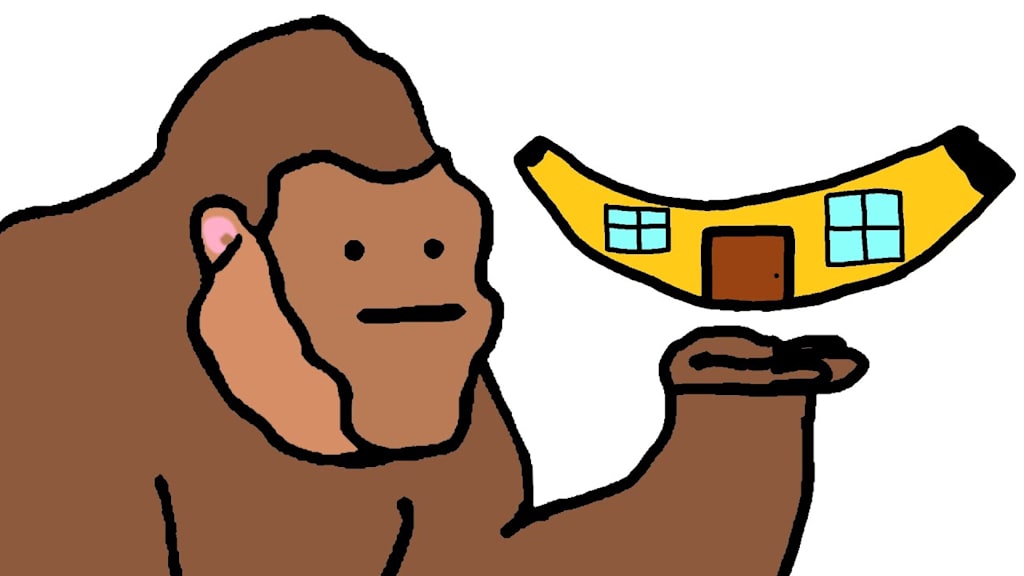
Option one: be rich. Simple enough. Just walk into the house you want and buy it outright. Unfortunately, most of us—Monkey included—do not have that kind of leaf count. Card declined. Moving on.
Option two: inherit your parents' house. Monkey's parents do have a very nice place. The problem is they're still alive, and, well... let's just say taking them out would be "financially unwise." Monkey was kidding. Mostly.
Option three: get a mortgage. This is the one. A mortgage is a loan that Monkey Bank gives to Monkey so Monkey can buy a house. Monkey then pays that loan back in small amounts over time—usually somewhere between 15 and 30 years. It's not glamorous, but it's how the jungle works.
First, Monkey Has to Prove Monkey Can Pay
Monkey Bank isn't just handing out leaves to whoever walks through the door. This isn't the 1920s. Before anything happens, the bank needs to know that Monkey is good for it.
That means three things: a stable job, a decent credit score, and enough leaves saved up to cover a deposit. The deposit is usually around 10 to 20% of the total home price. Think of it as a show of good faith—proof that Monkey isn't showing up completely empty-handed.
So if the house costs 1 million leaves, Monkey needs to bring at least 100,000 leaves to the table just to get started.
If everything checks out, Monkey Bank will hand over a pre-approval. That's basically the bank saying, "Alright, we trust you enough to go shopping." And with that, Monkey is officially ready to hit the jungle housing market.
House Hunting Is Not as Fun as It Sounds
Some houses are in a great location but look like they were hit by a falling coconut. Some look beautiful but are surrounded by nothing useful. And some are just... off. You know the ones.
But eventually, after enough searching, Monkey finds it. The banana house. Rare. Valuable. Perfect.
Monkey makes an offer—but so do a bunch of other monkeys.
When enough monkeys want the same house, the seller might call an auction. An auctioneer kicks things off with an opening bid, and then the chaos begins.
"The starting bid is 400,000 leaves. Do I hear 400,000?"
Four hundred. Four fifty. Four seventy-five. Five hundred. Five hundred and one. One million leaves. Going once, going twice—sold to the monkey in the back.
That's an auction. Highest offer wins, no exceptions.
In most cases though, it doesn't get that dramatic. Monkey makes an offer, the seller either takes it or passes, and if everyone agrees—
"Would you take 999,999 leaves?"
"Deal."
Papers get signed. Keys get handed over. Banana house is officially Monkey's.
Now Comes the Part That Lasts 30 Years
Monkey didn't buy that house with Monkey's own leaves. Monkey borrowed them from Monkey Bank. And now Monkey has to pay them back—plus interest.
Interest is the cost of borrowing. It's how Monkey Bank makes money off the deal.
There are two types of interest rates on offer:
A fixed rate stays exactly the same for the life of the loan. Like Monkey's love for bananas—constant, reliable, unwavering.
An adjustable rate moves up and down over time. Like Monkey riding an elevator. Could go great. Could also send your monthly payment through the roof without much warning.
Monkey Bank will offer a lower interest rate if they trust Monkey to pay, and a higher one if they're not so sure. The more trustworthy you look on paper, the better your rate.
The Fees Nobody Warns You About
Before Monkey gets those keys, there's a whole parade of fees waiting at the door. Here's what Monkey is actually paying for:
Application fee — You pay just to ask if you can borrow. Welcome to banking.
Appraisal fee — Someone comes out to verify the house is actually worth what you're paying.
Inspection fee — A professional crawls through every corner of the place looking for termites, leaks, and other surprises you don't want to discover after moving in.
Origination fee — The bank's cut for putting the loan together.
Credit report fee — They dig into your financial past to see whether you pay your bills.
Title search fee — Making sure there's no long-lost previous owner with a claim to the property.
Title insurance — In case someone does come forward with that claim after the fact.
Lawyer fees — Contracts need reviewing. That costs money.
Recording fee — Getting your name officially on the deed isn't free.
Transfer tax — The government takes its slice.
Mortgage insurance — If your deposit was on the lower end, the bank may require this so they feel protected.
Closing costs — A catch-all for the last round of fees before you finally get your keys.
It's a lot. No one is pretending otherwise.
So Is a Mortgage Actually Worth It?
Here's the honest case for mortgages: they let monkeys get into the housing market without having to save every leaf they'll ever earn. Instead of paying one massive sum upfront, Monkey spreads the cost out over decades. Monkey can also apply with a partner, a friend, a cousin, or even a complete stranger—as long as both parties can cover the payments.
And if money gets tight? Monkey can rent out a room in Banana House to help cover costs. Not ideal, but it's an option.
There's also a bigger picture worth considering. Every payment made on time builds credit. The bank starts to trust Monkey more. And over the years, Banana House will likely grow in value—meaning when it's fully paid off, Monkey can sell it for more than it cost.
That said, mortgages are not painless. The literal translation of the word "mortgage" is death pledge. Which is extremely on the nose. Monkey will be in debt to Monkey Bank for a very long time. If Monkey went with an adjustable rate, payments can spike fast. Even with a fixed rate, Monkey will end up paying significantly more than the original price of the house once all that interest adds up. And if Monkey can't make the payments? Monkey Bank takes the house back.
One Last Look at the Housing Market
So yes, buying a house is complicated. There's a lot of moving parts, a mountain of fees, and a 30-year commitment hanging over your head. But Monkey figures—can it really be that bad? How hard is it to just get into the market?
Monkey looks at current housing prices.
Oh.
Oh no.
Yeah. It's like that.
The Monkey metaphor is doing a lot of heavy lifting here, but the mechanics are real. Mortgages are genuinely one of the most important financial tools most people will ever use—and one of the least explained. Now at least Monkey knows what's going on.
About the Creator
Students as Emerging Strategic Influencers
Students today are moving beyond traditional learning environments to become influential actors in shaping global strategy. Their access to technology, international networks, and real-time information allows them to engage with complex issues and provide innovative solutions. By participating in research, leadership programs, and collaborative initiatives, students are transforming knowledge into actionable ideas that inform decision-making at local and global levels.
By Kurt James Wichman about 14 hours ago in Education
Why Consistent Air Travel Is Critical for Island Economies
Island nations operate within a geographic reality where distance and isolation shape nearly every aspect of development. With no direct land connections to neighboring regions, these countries must rely on efficient transportation systems to remain functional and competitive. As explained by Glenn Allyn, an aviation professional based in White Plains, New York, reliable air transport provides the critical link that enables island nations to maintain access to global markets, essential services, and economic opportunities.
By Glenn Allyn3 days ago in Education


Comments
There are no comments for this story
Be the first to respond and start the conversation.