
Why Australia Was Never Densely Settled Deep Into the Interior
Why most Australians live on the coast and why the continent’s interior never became a zone of dense settlement.
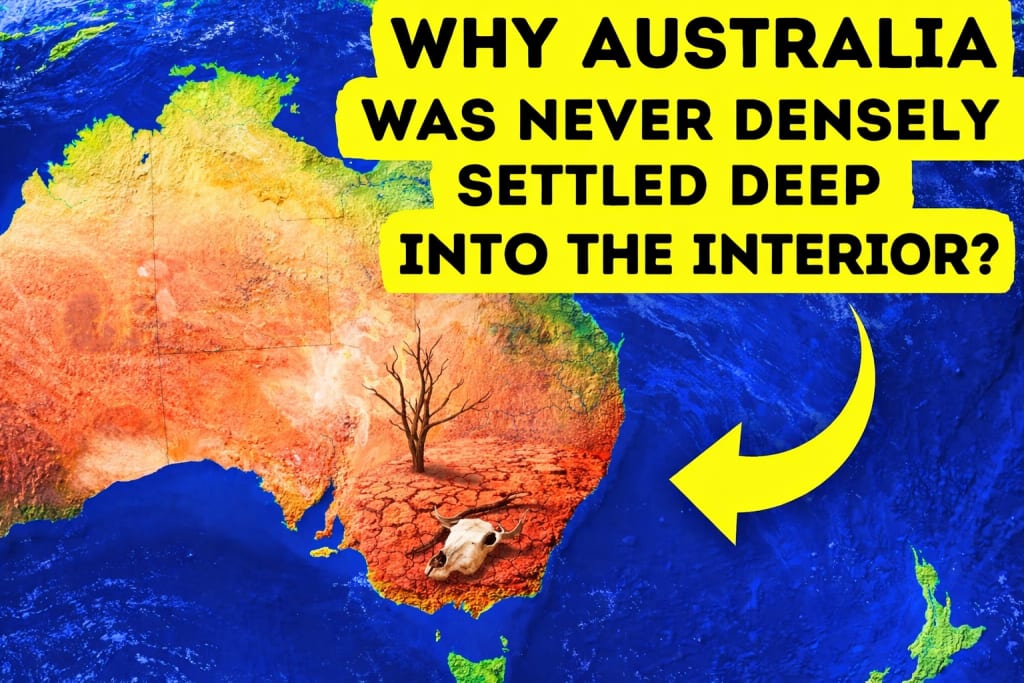
Australia looks on the map like a place that could have been settled much more densely. The continent is enormous, yet most of its population lives along the coast. That naturally raises the question: why did the interior never fill up with cities, farms, and roads the way it did in other large countries?
A big part of the answer is simple and unforgiving: Australia is extremely dry. It is the driest inhabited continent on Earth. Most inland regions receive very little rainfall, while evaporation is very high. For dense settlement and stable agriculture, that is a fundamental problem.
In the United States, inland expansion moved through vast areas with rivers, more reliable rainfall, large stretches of fertile soil, and the possibility of farming across a much wider range of conditions. Australia’s interior simply does not look like that.

Why Water Mattered More Than Colonial Ambition
The main limitation in inland Australia has always been water. It may seem that, with enough determination, the state could have built more roads, canals, and farms and gradually populated the center of the country. But the issue was never infrastructure alone. If a territory depends on rare rains, limited underground water reserves, and only a few river systems, then creating dense settlement there becomes both extremely difficult and extremely expensive.
Yes, Australia does have artesian water, and there are areas where life is sustained by cattle ranching, resource extraction, and a handful of river zones. But that is enough only for a sparse network of settlements, stations, mines, and small towns. It is not enough for dense settlement: the distances are too great, and dependable water is too scarce.
The Soil Also Worked Against Dense Settlement
The problem was not only water, but soil quality as well. In many parts of Australia, soils are poor and less suited to intensive agriculture. That means even where water problems could be partly solved, the land still could not easily be turned into highly productive farmland.
For that reason, Australia developed more through pasture, sheep raising, and cattle ranching than through continuous farming settlement across the interior. Where natural conditions are better, life and economic activity hold more firmly. Where they are worse, population density falls very quickly.
Why the Coast Won Almost Everything
Australia’s main cities did not grow by the sea by accident. The coast was better for trade, transport, and connection with the outside world. It was easier to build cities there, find work, and supply people with what they needed.
Once those centers were established, they began attracting even more people. The coast offered more opportunities and more familiar comforts, while inland conditions remained much harsher. As a result, life became increasingly concentrated by the ocean.
Why the American Example Can Be Misleading
The example of the United States does not fit very well here, because America and Australia are simply too different in their underlying conditions. In the United States, the interior had far more opportunities for agriculture, transport, and urban growth. In Australia, those opportunities were much more limited.
So the issue is not that Australia somehow “failed” to repeat the American path. It is that it never had the same starting conditions.
Does That Mean Australia’s Interior Is Empty?
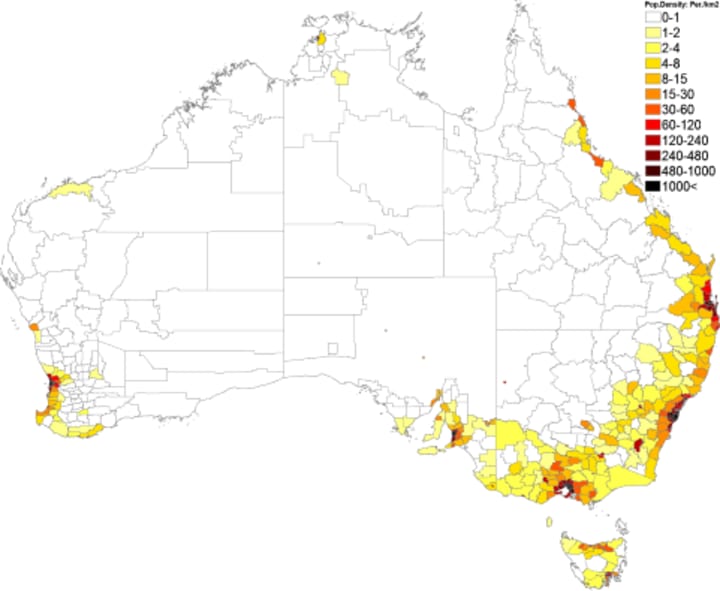
That is why the phrase “empty continent” may sound striking, but it explains reality badly. Inland Australia is occupied, used, and developed—it just was never shaped according to the model people are used to from places like the United States.
In that sense, Australia’s interior was not left unsettled because nobody wanted it. It remained lightly populated because water, soil, distance, and climate set limits that no amount of simple expansion could easily overcome.
About the Creator
Keep reading
More stories from writers in Earth and other communities.
Pakistan is Now the World’s “Guru”
Pakistan is Now the World’s “Guru” In recent years, Pakistan has quietly transformed its global image. Once viewed mainly through the lens of regional conflicts and economic challenges, Pakistan is now increasingly seen as a country offering diplomatic balance, strategic wisdom, and peace-focused leadership. This shift has led many analysts and observers to describe Pakistan as becoming a "world’s guru" — a nation offering guidance in an increasingly unstable global environment.
By Wings of Time 3 days ago in Earth



Comments
There are no comments for this story
Be the first to respond and start the conversation.