
Living Scripts: When Cinema Becomes Therapy...
—and When Therapy Becomes Fiction

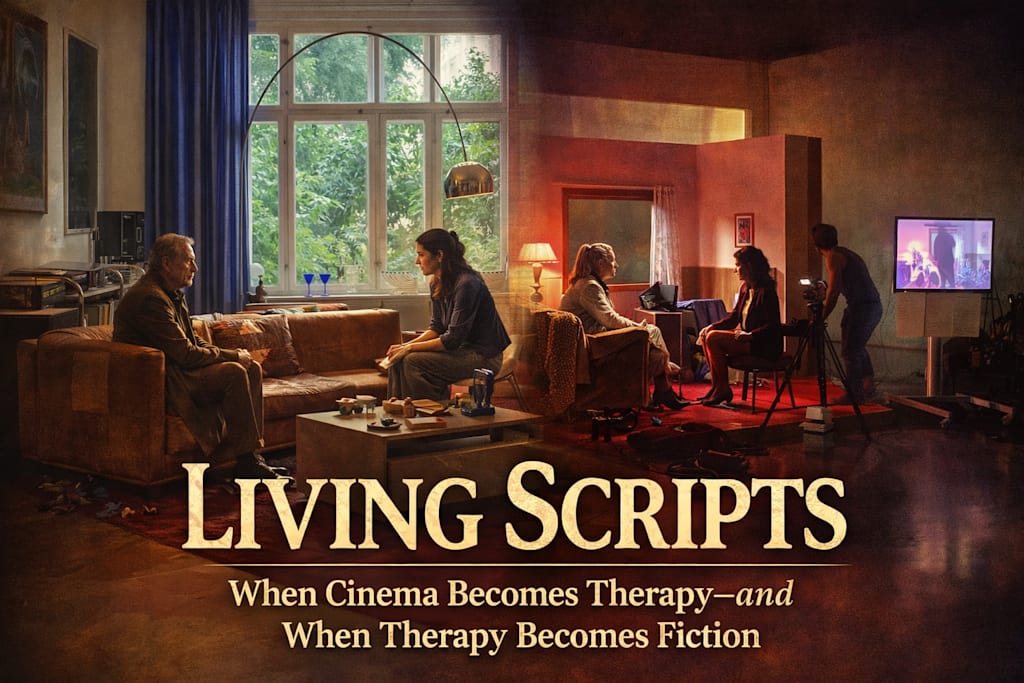
Cinema has always functioned as a mirror, but in certain films it becomes something far more unsettling: a stage where life is not merely reflected but reconstructed, rehearsed, and, in some cases, corrected. Joachim Trier’s *Sentimental Value* (2025) and Hirokazu Kore-eda’s *The Truth* (2019) belong to this rare category. Both films explore the same disturbing possibility—that art is not only an expression of life, but a substitute for it. More precisely, they reveal how artists, unable to communicate directly with those closest to them, begin to stage their own lives as a form of apology. In doing so, they transform cinema into a form of psychodrama, where the past is reenacted in the hope that it might finally be understood.
At the centre of both narratives stands a parent who has failed. In *Sentimental Value*, Gustav, a once-renowned film director, returns to his daughters not with words, but with a script. In *The Truth*, Fabienne, a legendary actress, publishes a memoir filled with distortions and omissions, while simultaneously acting in a film that eerily mirrors her relationship with her daughter. In both cases, the failure is not merely emotional but linguistic: these characters do not know how to say ‘I am sorry.’ Instead, they attempt to show it—through images, performances, and carefully constructed narratives.
This is where the logic of psychodrama enters. Originally developed as a therapeutic method, psychodrama invites individuals to act out scenes from their past in order to gain emotional clarity. It is based on a simple but powerful premise: some truths cannot be accessed through speech alone; they must be performed. Both films adopt this principle, but they radicalise it by embedding it within the machinery of cinema itself.
The most striking example of this is the “film-within-a-film” structure that both narratives employ. In *Sentimental Value*, Gustav writes a screenplay about his mother’s suicide, intending it as a bridge to his estranged daughter Nora. When she refuses to participate, he casts a young actress as a surrogate, effectively replacing his daughter within the narrative. The family home becomes the set, and the past is reconstructed with unsettling precision. What emerges is not a representation of memory, but its simulation—a controlled environment in which trauma can be replayed, adjusted, and, perhaps, redeemed.
A similar mechanism operates in *The Truth*. Fabienne, while promoting her memoir, takes on a role in a science-fiction film about a daughter who remains young while her mother ages. The premise is fantastical, yet its emotional resonance is unmistakable. As Fabienne performs this role, her real daughter Lumir observes from the margins, witnessing a version of their relationship refracted through fiction. The film set becomes a space where reality and performance overlap, allowing conflicts that cannot be resolved in life to be staged within art.
In both cases, cinema functions as a “healing stage”—a space where the unspeakable can be enacted. Yet this healing is never straightforward. The use of surrogates, doubles, and role reversals introduces a layer of instability that complicates any notion of catharsis. In *Sentimental Value*, the Hollywood actress does not simply play Nora; she becomes a composite figure, embodying both daughter and grandmother. Through her, Gustav attempts to rewrite his past, to direct a different outcome. But this act of substitution raises a troubling question: can reconciliation achieved through a surrogate ever be genuine?
In *The Truth*, the dynamic is reversed but equally complex. Fabienne, accustomed to controlling her image, finds herself inhabiting a role that forces her into the position of the neglected child. This inversion destabilises her identity, exposing the gap between the persona she has constructed and the reality she has avoided. The performance becomes a form of confrontation, but one that remains mediated by the conventions of acting.
What both films ultimately suggest is that psychodrama, when filtered through cinema, is both powerful and insufficient. It allows characters to approach truths that would otherwise remain inaccessible, but it also risks turning those truths into performances—repeatable, stylised, and therefore distanced from lived experience. The apology, instead of being spoken, is staged; the emotion, instead of being felt directly, is rehearsed.
This tension reaches its peak in moments of collapse. In *Sentimental Value*, the production begins to falter as the actress realises that the script lacks authenticity. Gustav’s carefully constructed narrative cannot contain the complexity of the past, and the illusion of control breaks down. Similarly, in *The Truth*, Fabienne’s memoir and performance are gradually exposed as partial fictions, revealing the extent to which she has edited her own life to preserve a coherent identity.
Yet these collapses are not failures; they are necessary ruptures. They mark the point at which performance gives way to something more immediate—often silence. In both films, the most meaningful moments occur not within the staged scenes, but outside them, in the spaces where language and performance fall away. A glance, a pause, an unspoken recognition—these become the true sites of connection.
If psychodrama uses fiction to reveal truth, these films also gesture towards its opposite: a phenomenon in which fiction begins to replace truth. This “inverse psychodrama” is not confined to artists or filmmakers; it extends to audiences themselves. In a media-saturated world, individuals are constantly exposed to narratives that offer clear structures, emotional resolutions, and coherent identities. Over time, these narratives begin to shape how people understand their own lives.
Psychologists describe this process through concepts such as “experience-taking” and “narrative identity.” Humans naturally organise their lives as stories, dividing them into chapters with beginnings, crises, and resolutions. When reality fails to provide this structure—when life remains messy, unresolved, and ambiguous—there is a temptation to borrow it from fiction. Memories are reshaped, events are reinterpreted, and personal histories are rewritten to resemble the arcs of films and novels.
This is the emergence of what might be called the “cinematic self.” In this mode, individuals do not simply live their lives; they perform them, adopting roles, gestures, and emotional scripts derived from media. Relationships are experienced as scenes, conflicts as dramatic beats, and identities as characters to be developed and refined. The self becomes a narrative project, constantly edited to achieve coherence and meaning.
Both *Sentimental Value* and *The Truth* can be read as warnings against this tendency. Gustav’s attempt to reconstruct his family through film represents an extreme version of cinematic self-construction. He does not merely reinterpret his past; he attempts to rewrite it, to impose a redemptive structure that reality never provided. Similarly, Fabienne’s memoir is not just a collection of lies; it is a deliberate reauthoring of her life, designed to maintain the integrity of her public persona.
In both cases, the result is a form of alienation. By turning their lives into narratives, these characters distance themselves from the very experiences they seek to understand. The more they perform, the less they are able to engage with the raw, unstructured reality of their relationships. The script becomes a barrier, not a bridge.
This dynamic is mirrored in the behaviour of audiences who internalise cinematic narratives. The “chameleon effect”—the tendency to mimic admired figures—extends beyond surface behaviours to deeper patterns of thought and emotion. Viewers form parasocial relationships with characters, adopting their perspectives and rehearsing their responses. Over time, this can lead to a subtle but significant shift: life is no longer experienced directly, but through the lens of potential scenes, imagined dialogues, and anticipated outcomes.
The danger here is not simply that reality is distorted, but that it is replaced. Instead of using narrative to make sense of experience, individuals begin to shape their experience to fit narrative. Pain is reframed as character development, conflict as plot progression, and even identity itself as a role to be played. What is lost in this process is precisely what psychodrama seeks to recover: the immediacy of lived experience, with all its contradictions and uncertainties.
In this sense, the relationship between psychodrama and its opposite effect can be understood as a paradox. Psychodrama uses performance to access truth; cinematic self-construction uses performance to avoid it. One moves from fiction towards reality, the other from reality towards fiction. Yet both operate within the same space—the space of narrative, of staging, of representation.
*Sentimental Value* and *The Truth* occupy this space with remarkable sensitivity. They do not reject the power of art; on the contrary, they affirm its necessity. But they also expose its limits, showing how easily it can become a substitute for genuine connection. The films suggest that while art can illuminate the past, it cannot replace the act of living through it.
The final implication is both simple and unsettling. In a world saturated with stories, the greatest challenge is not to find meaning, but to resist the temptation to impose it where it does not belong. To accept that some experiences cannot be neatly structured, that some relationships cannot be resolved through performance, and that some truths can only be encountered in silence.
In the end, both films return us to a fundamental question: are people living their lives, or are they rehearsing them?
About the Creator
Peter Ayolov
Peter Ayolov’s key contribution to media theory is the development of the "Propaganda 2.0" or the "manufacture of dissent" model, which he details in his 2024 book, The Economic Policy of Online Media: Manufacture of Dissent.
Keep reading
More stories from Peter Ayolov and writers in Critique and other communities.
Overproduction of Words
Peter Ayolov Sofia University "St. Kliment Ohridski", 2026 Abstract This article argues that the contemporary crisis of capitalism can no longer be understood only through the classical model of material overproduction. Drawing on the Marxist theory of crisis, especially the framework associated with P. K. Figurnov, it proposes that digital capitalism has displaced the contradiction of overproduction from the factory to language itself. In the age of artificial intelligence and large language models, words, narratives, arguments, and symbolic forms are produced at near-zero marginal cost and on an effectively unlimited scale. What follows is not an expansion of meaning, but its devaluation. As commodities once lost exchange-value when they could not be sold, language now loses meaning-value when it can no longer be absorbed, interpreted, or distinguished within an oversaturated symbolic market. The article develops this claim across four movements: the transformation of classical overproduction into linguistic overproduction; the collapse of intellectual value under AI automation; the need to oppose planned obsolescence with civilisational durability; and the ideological failure of accelerationist fantasies that confuse energy, speed, and scale with historical direction. It concludes that the deepest crisis of late capitalism is not simply economic, but superstructural: a breakdown of meaning, legitimacy, continuity, and symbolic order. Within this condition, Ayolov’s work is presented as one of the few contemporary attempts to map the totality of a decaying superstructure and the obscure emergence of a new one.
By Peter Ayolov14 days ago in Critique
The Road by Cormac McCarthy:
"If he is not the word of God, God never spoke." It's a line spoken by The Man, unnamed, early on in the 2007 Pulitzer Prize winning novel, "The Road" by Cormac McCarthy. It's this line, elegiac and moving, infused with despair and hope, that informs you, you're not reading something you'll easily forget.
By Adam Diehl11 days ago in Critique
Phase 1: The Ultimate Disconnection Protocol
The modern world is going through something that experts can't quite explain. What they call a "mental health crisis" or "failing to fit into society" is actually the spark of something much deeper. It is the exact moment when you begin to see the cracks in the sky of this cardboard reality.
By Lorena Alonso3 days ago in Critique



Comments
There are no comments for this story
Be the first to respond and start the conversation.