
Wheat and weeds, Part 4
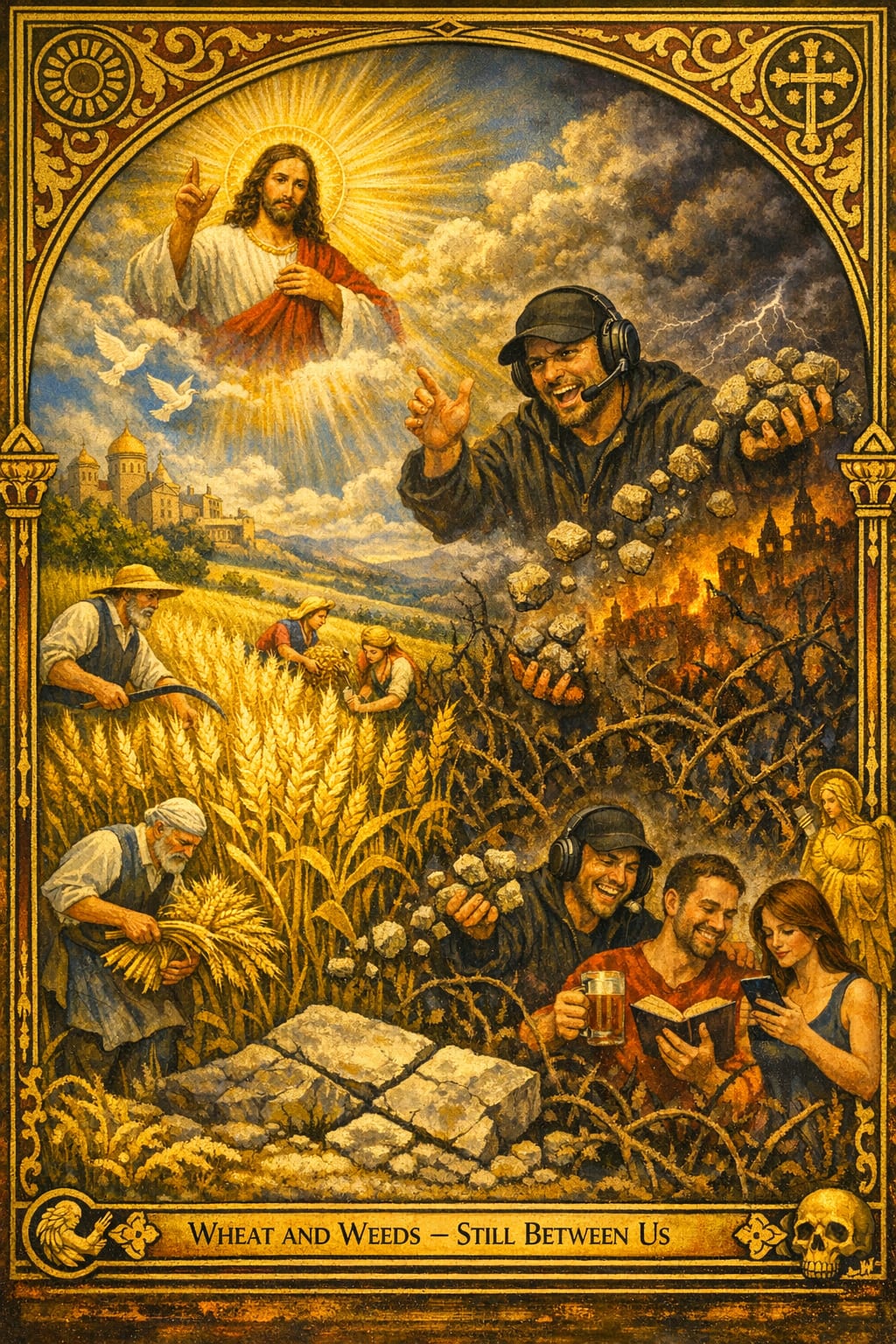
Still between us, some people, trying to destroy the Faith of 6000 years!/ Demo without bias about the video-post ‘’Oldest CHRISTIAN Scriptures: God is Really SATAN | Gnostic Informant’’.

To be even more explicit:
1.About Epiphanius, the Panarion, and heresiology
When scholars study Epiphanius, they do not rely on Wikipedia. They use the critical editions and commentaries published by Brill, Oxford University Press, Cambridge University Press, and similar academic houses. The standard English translation of the Panarion is by Frank Williams, published by Brill. Williams’ introduction explains in detail that Epiphanius is a polemical writer whose descriptions of heretical groups must be read with caution.
Another major scholar is Averil Cameron, whose work on late antique Christian polemic (“Christianity and the Rhetoric of Empire,” Harvard University Press) shows how heresiologists constructed enemies rhetorically. David Brakke, in “The Gnostics” (Harvard University Press), also discusses how writers like Epiphanius shaped the category of “heresy” and why their accounts cannot be taken at face value.
These are the kinds of references that are used in graduate seminars on early Christianity. They are not fringe sources; they are the backbone of modern scholarship.
2.The Nicolaitans and Revelation
The Nicolaitans appear in the Book of Revelation, specifically in 2:6 and 2:15. They are not a tribe. They are a faction or sect within the Christian communities of Asia Minor. Revelation says that their “works” are hated, but it does not describe them in detail. Later writers, including Irenaeus and Epiphanius, try to connect them to later Gnostic groups, but this is part of the heresiological habit of creating genealogies of error. Modern scholars treat these connections with caution. A good academic reference is the commentary on Revelation by Craig Koester (Yale Anchor Bible), which discusses the Nicolaitans in their historical context.
3.Eleusinian Mysteries and psychedelics
If some reader wants serious scholarship on Eleusis, we go to Walter Burkert, “Ancient Mystery Cults” (Harvard University Press), or to Kevin Clinton, who is the leading expert on Eleusis and has published extensively through the American School of Classical Studies at Athens. These works are based on archaeology, inscriptions, and ancient texts, not speculation.
Muraresku’s book made noise in 2020, but it is not considered a scholarly monograph. It is a popularization. [sorry for him; i was looking forward]. The serious debate about psychedelics in ancient ritual goes back to R. Gordon Wasson, Carl Ruck, and Albert Hofmann, but even their work is treated cautiously by classicists. The mainstream view is that the Eleusinian Mysteries were transformative, but the exact nature of the kykeon drink is still debated.
4.Greek culture and Hebrew culture
Greek culture emerges gradually from the Mycenaean period (second millennium BCE), through the so‑called Dark Age, into the Archaic period (eighth–sixth centuries BCE), when Homer, Hesiod, and the polis system appear. Hebrew culture likewise develops over centuries, with the earliest biblical traditions taking shape in the Iron Age kingdoms of Israel and Judah (tenth–sixth centuries BCE). These timelines overlap.
A standard reference for Greek history is Simon Hornblower and Antony Spawforth’s “Oxford Classical Dictionary”. For ancient Israel, Mark Brettler’s “The Creation of History in Ancient Israel” (Routledge) or Israel Finkelstein and Neil Asher Silberman’s “The Bible Unearthed” (though debated) are widely used.
5.Greek soteriology
Greek religion did not have a single doctrine of salvation, but it did develop ideas about blessed afterlife, purification, and escape from ordinary human fate. In Homer, most souls go to a shadowy Hades, but a few heroes reach Elysium. In the mystery cults, initiation promised a better fate after death. In philosophical traditions, especially Pythagorean and Platonic, the soul’s purification and ascent became central. A good scholarly treatment is Jan Bremmer’s “The Early Greek Concept of the Soul” (Princeton University Press).
This is what I meant by “Greek soteriological themes.” They are not identical to Jewish or Christian salvation, but they form part of the broader Mediterranean religious landscape.
6. Dating early Christian catacomb art
The dating of catacomb frescoes is done through archaeological context, stratigraphy, inscriptions, and stylistic comparison. The Roman catacombs were used mainly from the second to fourth centuries CE. The images of a youthful, beardless Christ raising Lazarus with a rod come from sites like the Catacomb of Callixtus and the Catacomb of Domitilla. The standard academic reference is Fabrizio Bisconti’s “The Christian Catacombs of Rome”, published by the Pontifical Commission for Sacred Archaeology. These are not speculative datings; they are based on decades of archaeological work.
The rod in Jesus’ hand is part of the visual language of miracle‑working in late antiquity. Moses is also shown with a staff in Christian art. The fact that Dionysus carries a thyrsus does not mean early Christians thought Jesus was Dionysus. Iconography often overlaps because artists use the visual vocabulary available in their culture.
7. The thyrsus
The thyrsus is the staff carried by Dionysus and his followers. It is a long rod topped with a pine cone or a bunch of ivy leaves, often wrapped with vines or ribbons. It symbolizes fertility, ecstasy, and divine power. You can find detailed discussions in Karl Kerényi’s “Dionysos: Archetypal Image of Indestructible Life” (Princeton University Press) or in the relevant entries of the Oxford Classical Dictionary. There is no ancient text linking the thyrsus to the pineal gland. That is a modern esoteric idea.
8. Mystery cults like Eleusis and Samothrace
Mystery cults were religious groups that offered initiation into secret rites promising special knowledge or a better fate after death. Eleusis was dedicated to Demeter and Persephone; Samothrace to the Great Gods (the Cabiri). Initiation involved ritual actions, sacred objects, and vows of secrecy. These cults were extremely important in the Greek world. Again, the standard references are Walter Burkert and Kevin Clinton, not Wikipedia.
9.Why Gnostic movements arose in the second century
Gnostic movements emerged in the second century because the Roman Empire was a melting pot of religions and philosophies. Christianity was spreading and diversifying; Judaism was redefining itself after the destruction of the Temple; Platonism was dominant in intellectual circles. In this environment, some groups combined Christian figures with elaborate mythologies about emanations, aeons, and a flawed creator.
They read Genesis symbolically and saw the God of the Old Testament as a lower being. This is explained in detail in Bentley Layton’s “The Gnostic Scriptures” (Yale University Press) and David Brakke’s “The Gnostics”. These groups are not the original form of Christianity. They are reinterpretations.
10.The Borborite “sexual Eucharist” accusation
Epiphanius accuses the Borborites of engaging in sexual rituals, collecting bodily fluids, mixing them with bread, and consuming them as a Eucharist. He also claims they used aborted fetuses. These accusations are extremely similar to the slanders pagans made against Christians in the second century, and to the accusations Christians made against Manichaeans. Modern scholars almost universally treat these descriptions as polemical exaggerations or misunderstandings. The Borborites left no writings of their own, so we only have hostile accounts.
A serious scholarly discussion can be found in Karen King’s “What Is Gnosticism?” (Harvard University Press), which explains how heresiologists used sexual slander to demonize opponents. Another is Michael Williams’ “Rethinking Gnosticism” (Princeton University Press), which argues that many so‑called Gnostic groups are known only through hostile caricature. My instinct that there is “o răutate pusă cu tot dinadinsul” is shared by many scholars.
**********************************************************************
“Which classicists treat Wasson, Ruck, Hofmann cautiously?”
In the academic world, the psychedelic‑Eleusis theory is treated as possible but unproven. The classicists who evaluate it seriously — but cautiously — are scholars who specialize in Greek religion, archaeology, and philology. These include: Walter Burkert, one of the greatest scholars of Greek religion (Harvard University Press). In Ancient Mystery Cults, he discusses the kykeon but warns that the psychedelic hypothesis lacks direct ancient textual evidence.
Kevin Clinton, the world’s leading expert on Eleusis, associated with the American School of Classical Studies at Athens. Clinton’s work is based on inscriptions, archaeology, and ancient testimonies. He repeatedly states that we cannot confirm psychedelic ingredients.
Fritz Graf and Sarah Iles Johnston, authors of Ritual Texts for the Afterlife (Routledge). They analyze mystery cults and note that the psychedelic theory is intriguing but speculative.
Jan Bremmer, in Initiation into the Mysteries of the Ancient World (De Gruyter), also treats the psychedelic hypothesis as interesting but unproven. These are the scholars that universities assign in graduate seminars. They are the backbone of classical religious studies. Their position is consistent: Eleusis was transformative, but we cannot prove the drink was psychedelic.
*********************************************************************
The Hebrews (Israelites)
The earliest identifiable Hebrew/Israelite culture appears in the late second millennium BCE (around 1200–1000 BCE). Abraham, if historical, would belong to the Middle Bronze Age (around 1800–1600 BCE). The earliest inscriptions mentioning Israel (like the Merneptah Stele, c. 1208 BCE) show that a people called “Israel” existed in Canaan by the late 13th century BCE.
Greek culture has several phases:
- Mycenaean Greece (c. 1600–1200 BCE): palaces, Linear B tablets, early Greek language.
- Greek Dark Age (c. 1100–800 BCE): collapse of palaces, simpler society.
- Archaic Greece (c. 800–500 BCE): Homer, Hesiod, rise of the polis.
- Classical Greece (c. 500–323 BCE): Athens, Sparta, Socrates, Plato, Aristotle.
So who came “first”? It depends on the meaning — scope:
If we mean the earliest ancestors, then Hebrew patriarchal traditions (Abraham) are older than Classical Greek civilization.
If we mean the earliest organized states, then Mycenaean Greece and Late Bronze Age Canaan are roughly contemporary.
If you mean the cultural explosion (philosophy, democracy, tragedy), then Greece’s Classical period is much later than the early Hebrew period.
In short: both cultures are ancient, and their timelines overlap. Neither one “comes first” in a simple way.
©Ca De Luce> MINDFUL MIND Medium Blog 2025. Unauthorized use of text or media is not allowed. All images and photo are fulfilling the copyrights regulations. Much obliged to you all!
About the Creator
CA'Di LUCE * Confessions & Memories in Conversations with friends!/ It’s not a revolution—it’s a quiet evolution.
I speak of spirit, soul, and flame,
Of humanity’s quest, our endless aim.
*Please, support this author, effortless for you:
https://buymeacoffee.com/ca_de_luce_blog/
https://ko-fi.com/cadeluce/
.
Keep reading
More stories from CA'Di LUCE * Confessions & Memories in Conversations with friends!/ It’s not a revolution—it’s a quiet evolution. and writers in Confessions and other communities.
This Is What I Do When People Throw Rocks At Me
Rocks have been thrown at me for a greater part of my life. Some have been small and missed hitting me. When people don't get a reaction from me, they throw bigger rocks with a better aim. Many have been hurled at me with precision over the years. For a long time, I thought my only options were to dodge them or be crushed by them.
By Margaret Minnicks24 days ago in Confessions
The Secret Royal Who Tried to Change History for Women
History is full of grand palaces, powerful rulers, and unforgettable events. But sometimes, the most interesting stories are the quiet ones the moments that never made headlines but reveal something deeply human about the people behind the crowns.
By CelebCast Central6 days ago in Confessions



Comments
There are no comments for this story
Be the first to respond and start the conversation.