
Australia’s Quest for the World’s Oldest Bread Recipe
How ancient Indigenous traditions are reshaping our understanding of humanity’s earliest food innovation

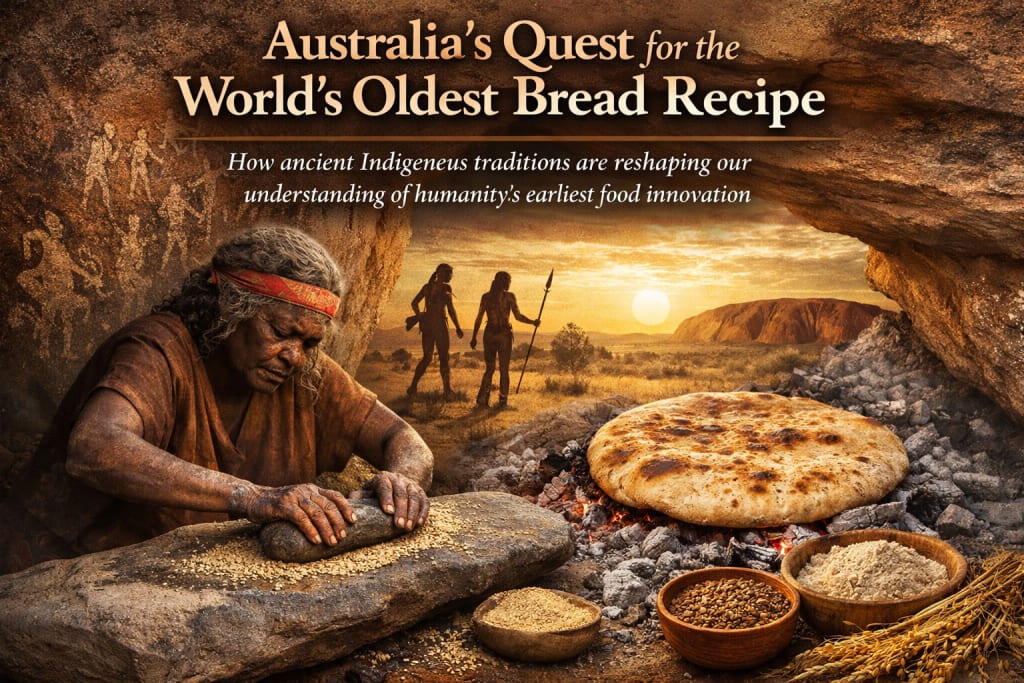
The story of bread is often told as a tale that begins with agriculture in the ancient Middle East. For decades, historians and archaeologists believed that bread emerged only after humans learned to cultivate grains. However, recent discoveries and renewed attention to Indigenous food traditions—particularly in Australia—are challenging this long-held narrative. Today, researchers are exploring whether the roots of the world’s oldest bread recipe may lie far deeper in human history than previously imagined.
Globally, the earliest confirmed evidence of bread comes from a 14,500-year-old archaeological site in Jordan, where charred crumbs of flatbread were discovered in ancient fireplaces.  These remains suggest that even hunter-gatherers, long before farming began, were grinding wild grains and baking primitive bread on hot stones or in ashes.  This discovery alone revolutionized the understanding of early human diets.
But Australia presents an even more intriguing possibility.
Archaeological and ethnographic evidence indicates that Aboriginal Australians were making a form of bread—commonly referred to as “bush bread” or seedcakes—thousands of years ago. This bread was made by grinding native seeds, mixing them with water, and cooking the dough in hot ashes.  Unlike modern wheat-based bread, these early recipes relied on local plants, roots, and seeds, showcasing a deep knowledge of the environment.
Some researchers argue that this tradition could date back tens of thousands of years. In fact, studies of ancient grinding stones in Australia have revealed starch residues that may be as old as 30,000 years, suggesting that early humans were processing plants into flour-like substances far earlier than previously believed.  While not all of this evidence points directly to bread as we know it today, it strongly supports the idea that the basic concept of bread—grinding, mixing, and cooking plant material—has extremely ancient origins.
What makes the Australian case particularly compelling is the continuity of tradition. Aboriginal communities have preserved these techniques across generations, offering a rare living link to prehistoric culinary practices. Unlike many ancient cultures where food traditions have been lost or heavily modified, Indigenous Australians maintained methods that closely resemble early human experimentation with food.
This has led some scholars to reconsider what qualifies as “bread.” If bread is defined broadly as a mixture of ground plant material and water cooked with heat, then the timeline stretches far beyond the agricultural revolution. In this context, Australian bush bread could represent one of the oldest surviving culinary traditions on Earth.
The simplicity of these early recipes is striking. There were no ovens, no refined flour, and no yeast. Instead, early bread was likely flat, dense, and unleavened—more similar to modern flatbreads than to soft loaves. It was cooked directly on hot stones or buried in ashes, a method still used in various parts of the world today.
Interestingly, this method mirrors early bread-making techniques found elsewhere. The Jordanian flatbread, for example, was also likely baked in ashes or on heated surfaces.  This parallel suggests that different human societies may have independently developed similar solutions to processing and cooking grains and plants.
However, the Australian narrative adds a unique dimension: it highlights the role of Indigenous knowledge systems in shaping human history. For many years, such contributions were overlooked or underestimated in mainstream archaeology. Now, researchers are increasingly recognizing that Aboriginal Australians were not just passive inhabitants of the land but active innovators who developed sophisticated food technologies.
Another important aspect is the diversity of ingredients. While early bread in the Middle East relied on wild cereals like barley and wheat, Australian bush bread incorporated a wide variety of native seeds and plants. This adaptability demonstrates how early humans tailored their diets to local ecosystems, using whatever resources were available.
The search for the “world’s oldest bread recipe” is therefore not just about identifying a single origin point. Instead, it reveals a broader story of human ingenuity. From the deserts of Jordan to the landscapes of Australia, early humans experimented with food in remarkably similar ways—grinding, mixing, and cooking to create something entirely new.
Today, scientists are even attempting to recreate these ancient recipes, using traditional methods and ingredients. These experiments provide valuable insights into the taste, texture, and nutritional value of early bread, offering a glimpse into the daily lives of our ancestors.
In the end, Australia’s role in this story is both profound and inspiring. It reminds us that innovation is not limited to one region or culture. The quest to understand the origins of bread is, in many ways, a journey into the shared heritage of humanity—one that continues to evolve as new discoveries come to light.
As research progresses, one thing is becoming clear: the history of bread is far older, richer, and more diverse than we ever imagined.
About the Creator
Irshad Abbasi
Ali ibn Abi Talib (RA) said 📚
“Knowledge is better than wealth, because knowledge protects you, while you have to protect wealth.
Keep reading
More stories from Irshad Abbasi and writers in Chapters and other communities.
Kashmir’s Silent Waters
For centuries, Dal Lake has been the beating heart of Kashmir—a place where shimmering waters, floating gardens, and wooden houseboats created an image of timeless beauty. Tourists once described it as paradise on earth, a peaceful retreat nestled within the majestic Himalayas. But today, many locals whisper a different story. “I have never seen Dal Lake this sad and fearful,” says a longtime resident of Srinagar, capturing a sentiment that has quietly spread across the region.
By Irshad Abbasi 3 days ago in Chapters
Life will find a way
One cocoon twitches; my screaming must have disturbed it. It’s followed by a sound like the shaking of a cobra’s tail. A dry rattle sends a shiver down my spine. The rest of the cocoons respond the same way, as if communicating with one another; the cave fills with rattling. The glow becomes stronger as they vibrate and bathes the cave floor in an eerie blue light.
By N J Delmas4 days ago in Chapters
Sacrifices For The Balance Chapter 10: Two Meetings, Two Very Different Groups
The SUV pulled up to the gate just outside the headquarters of the Double L Bar Ranch. The ranch had long stopped ranching, and had become the corporate headquarters of the company. While there were still cows on the land, it was a small herd for show purposes. The land itself was mostly a wildlife sanctuary, with some tourism; the tourism was about one-third bird field researchers, one-fourth actual tourists, and the rest were bird watchers. What little area was left was for the research area, where they were always trying out new farming techniques. Lady Astor parked and walked into the main building.
By Jamais Jochim6 days ago in Chapters
Harbinger of Despair
Who was he but just a man? To feel the weight of the world on his shoulders, he was no Atlas. Yet his bowed stance and tender neck suggested otherwise. It came to him in a dream: the absent stoking of an everlasting flame. A gnarled finger pointed towards an inevitable end, a sign that couldn't be ignorantly shaded; recurrence made sure of it. He didn't remember how long it had been going on; time didn't matter at this point. He just knew it was long enough to be petrified to fall asleep.
By James U. Rizzi5 days ago in Fiction




Comments
There are no comments for this story
Be the first to respond and start the conversation.