
Digital art and artificial intelligence: a new era of creativity
Digital Art
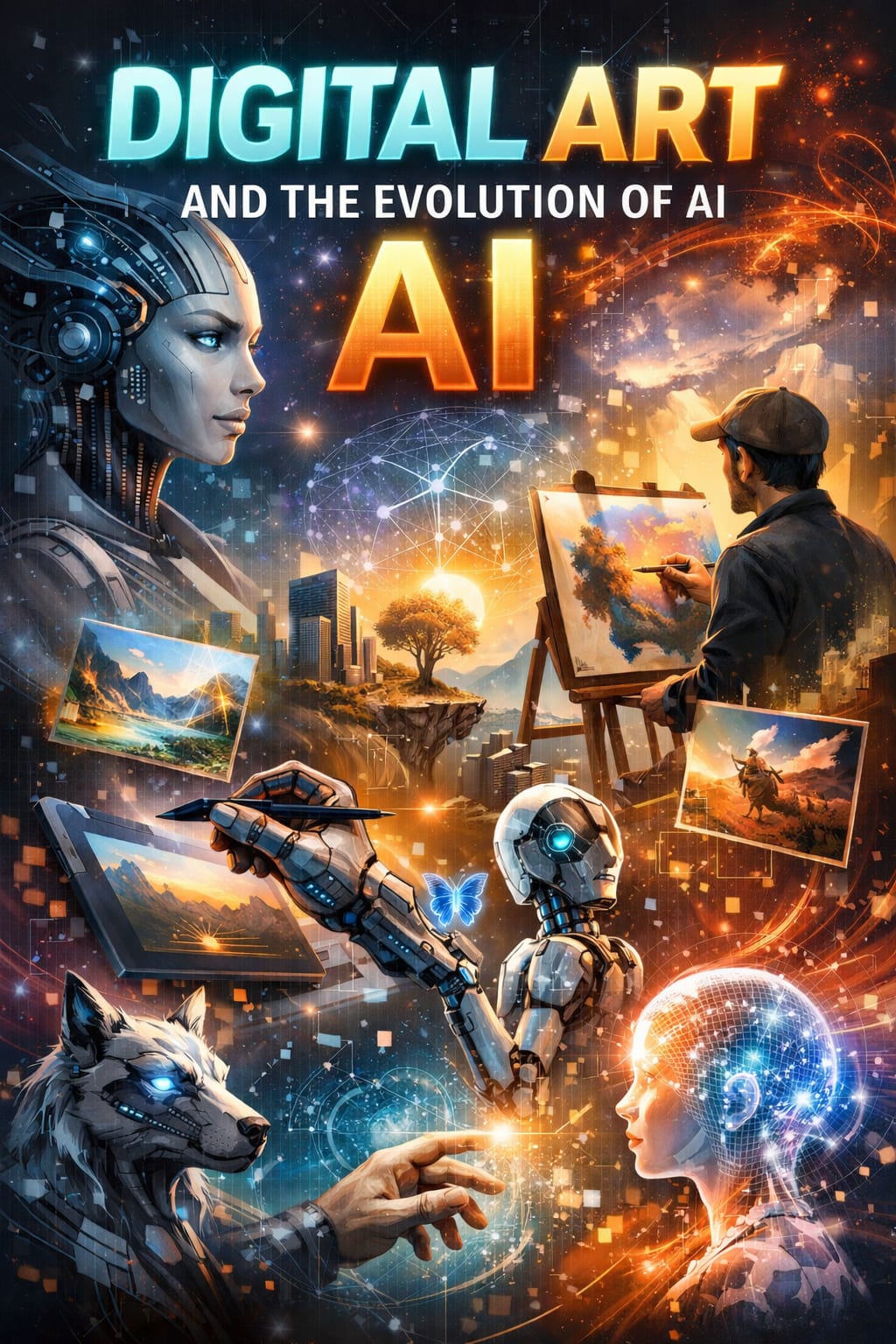
Digital art has moved far beyond its early status as a specialised practice used mainly by designers, illustrators and experimental creators. It now occupies a central place in contemporary visual culture and shapes the way images are produced, shared and understood across society. Its influence can be seen in advertising campaigns, films, fashion collections, books, architecture, video games and social media. What was once viewed as a technical niche has become a major creative force, changing not only artistic tools but also the meaning of artistic production itself.
This transformation is now entering a new phase with the rise of artificial intelligence. AI is no longer a distant concept discussed only in technological circles. It has become an active presence in creative work, affecting how artists develop ideas, test visual styles and complete projects. For some, this represents an exciting expansion of what is possible. For others, it raises difficult questions about originality, authorship and the place of the human creator. Both reactions are understandable, because the relationship between digital art and AI is not simple. It is full of promise, but also of tension. That tension is precisely what makes this moment so important.
To understand why AI is having such a powerful impact, it is useful to look at the development of digital art itself. Digital art did not suddenly appear in its current form. It emerged gradually as computers became more accessible and software became more capable. Early digital artists often worked under severe limitations. Screens were less advanced, programs were basic and computing power was weak compared with today’s standards. Even so, those artists recognised something revolutionary: the computer could be more than a machine for calculation or office work. It could become a creative partner in the making of images, forms and experiences.
As technology improved, the possibilities expanded. Graphic tablets allowed more natural drawing. Editing software gave artists greater control over colour, texture and composition. Three-dimensional modelling opened new approaches to sculpture and spatial design. Animation tools made motion more accessible. Later, smartphones and mobile applications brought creative production into everyday life. Over time, digital art ceased to be seen merely as a commercial or secondary medium. It gained recognition as an artistic language in its own right, with its own logic, aesthetics and methods.
One of the most important qualities of digital art is its flexibility. Unlike traditional media, digital work can be revised endlessly without damaging the original surface. A painting on canvas reaches a point at which changes become difficult, but a digital image remains open to editing, layering, transformation and duplication. It can be animated, made interactive or adapted for different platforms. It can exist in several versions at once. This has changed how artists think about completion, authorship and process. In the digital environment, a work is not always fixed. It may evolve over time or respond to its audience in dynamic ways.
That openness created fertile ground for the arrival of AI. Traditional digital tools usually respond directly to precise human commands. The user selects, draws, edits or adjusts. AI changes that structure because it introduces a more generative form of interaction. Instead of controlling every step manually, the artist may enter prompts, define a mood, describe a scene or guide a style, and the system produces possible outcomes. The process becomes less linear and more conversational. The artist is no longer only executing an idea but also selecting, refining and redirecting possibilities produced by the machine.
This is one of the reasons AI feels so different from previous creative technologies. It does not function only as a passive instrument. It can suggest directions, combine references, generate alternatives and produce surprising visual arrangements. That element of unpredictability has altered the rhythm of artistic work. Many creators now use AI to begin projects, create concept drafts, explore compositions, test visual atmospheres or break through creative blocks. A task that once required hours of sketching and manual experimentation may now begin with a wide range of generated options in just a short time.
The speed of this process is undeniably powerful. For professional artists, designers and studios, it can accelerate ideation and reduce the time needed for early-stage development. For beginners, it lowers technical barriers and makes visual experimentation more accessible. People who do not have advanced training in drawing or rendering can still participate in image-making and creative exploration. In this sense, AI may expand access to artistic practice and allow more people to contribute to visual culture.
Yet speed is not the same as depth, and access is not the same as mastery. An image generated quickly may be visually impressive, but that does not automatically make it meaningful. Art is not defined only by surface quality or technical polish. It gains power through intention, perspective, context and emotional resonance. A compelling work usually reflects choices that go beyond appearance. It carries traces of a point of view, a lived experience, a memory, a tension or a question. These are not things that emerge simply because a system can generate attractive forms.
This is where the human artist remains essential. AI can produce variations based on patterns learned from vast datasets, but it does not possess personal history, emotional vulnerability or cultural understanding in the way a human being does. It does not experience grief, desire, conflict, belonging or change. It does not interpret the world through memory or conscience. For that reason, many artists do not view AI as a replacement for human creativity, but as a tool that extends certain aspects of it. The artist still determines what matters, what should be kept, what should be removed and what kind of meaning a work should carry.
In many cases, the most important creative decisions happen after the generation stage. An artist may combine outputs from different prompts, alter them substantially, integrate hand-made elements, reshape the composition or place the image within a broader narrative. They may use AI-generated material as a starting point rather than a final result. What gives the work artistic value is not only the production of an image but the interpretation and transformation of that material. Curation, editing and conceptual direction become central parts of the process.
At the same time, the rise of AI in digital art has introduced serious ethical and cultural concerns. Questions about authorship and copyright are becoming more urgent. Many artists are worried about the datasets used to train image-generation systems and whether their work has been included without permission. Others are concerned about compensation, attribution and the possibility that human labour is being absorbed into automated systems without recognition. These concerns are not secondary. They are central to the debate because they affect trust, fairness and the long-term sustainability of creative professions.
There is also the question of originality. If AI systems are trained on enormous collections of existing images, what does originality mean in this context? Is a generated image a new work, a recombination of existing styles or something in between? The answer is not always clear. What is clear is that legal and cultural frameworks have not fully caught up with the speed of technological change. Artists, developers, institutions and platforms are all being forced to confront issues that will shape the future of creative production.
Another concern is that convenience may encourage superficiality. When images can be produced in large quantities with very little effort, visual culture risks becoming flooded with polished but empty material. The abundance of content may make it harder for thoughtful work to stand out. In such an environment, artistic direction becomes even more valuable. Meaning, coherence and sensitivity may become the qualities that distinguish lasting work from disposable imagery.
Looking ahead, digital art is likely to become even more interactive, immersive and hybrid. AI will probably continue to merge with animation, gaming, virtual spaces, installation art and other emerging forms. Artists may increasingly work across disciplines, combining writing, coding, sound, movement and generated visuals into complex creative systems. The role of the artist may continue to evolve from maker alone to editor, director, curator and world-builder.
Even so, one thing remains constant: tools do not replace vision. Technology can expand possibility, but it cannot decide what is worth saying. Art still begins with a human impulse, whether that impulse takes the form of a feeling, an idea, a protest, a memory or a desire to communicate. The future of digital art will not be defined by machines alone. It will be shaped by the people who use those machines with intelligence, imagination and responsibility.
The real significance of AI in art lies not in whether it can generate images, but in how artists choose to engage with it. Used carelessly, it may encourage imitation and excess. Used thoughtfully, it may open new forms of experimentation and expression. Digital art and artificial intelligence are not enemies. They are part of the same evolving story: the story of how human beings use new tools to extend the reach of their imagination.
About the Creator
Mark Senegal
Mark is a passionate blogger who writes about a wide range of topics, from lifestyle and culture to technology, travel and everyday trends.
Keep reading
More stories from Mark Senegal and writers in Art and other communities.
The Eternal Duel — Baroque vs. Renaissance
ROME — In the hushed silence of San Luigi dei Francesi church, tourists still jostle for position before three canvases that changed Western art forever. They come seeking the *Calling of Saint Matthew*, the masterpiece that Michelangelo Merisi da Caravaggio completed between 1599 and 1600. What they find is not the ethereal spirituality of the High Renaissance, but something far more disturbing: a divine intervention that looks disturbingly like a shakedown in a backroom gambling den.
By Mark Senegalabout 3 hours ago in Art
'Till Death We Do Art
There would be nothing divine in this world without art. Nature may surpass the divine to all intents and purposes, but like everything it absorbs and is absorbed by, it remains here, stuck on the surface of this world, ever-present, physically bound to the universe.
By Avocado Nunzella BSc (Psych) -- M.A.P 29 days ago in Art
Laurencia
I have attended another performance at the beautiful Tbilisi Opera and Ballet State Theater. I didn't take a picture before the performance started, but this one was taken during the break between the acts. Gives you an idea of how beautiful and grand the theater is as well.
By Lana V Lynxabout 3 hours ago in Art


Comments
There are no comments for this story
Be the first to respond and start the conversation.