
Never Explain Yourself — It Signals Weakness
The moment you open your mouth to justify a decision, you've already lost something. You may not feel it immediately — the words come out, they sound reasonable, maybe even persuasive — but somewhere in the exchange, a subtle transfer of power has occurred.

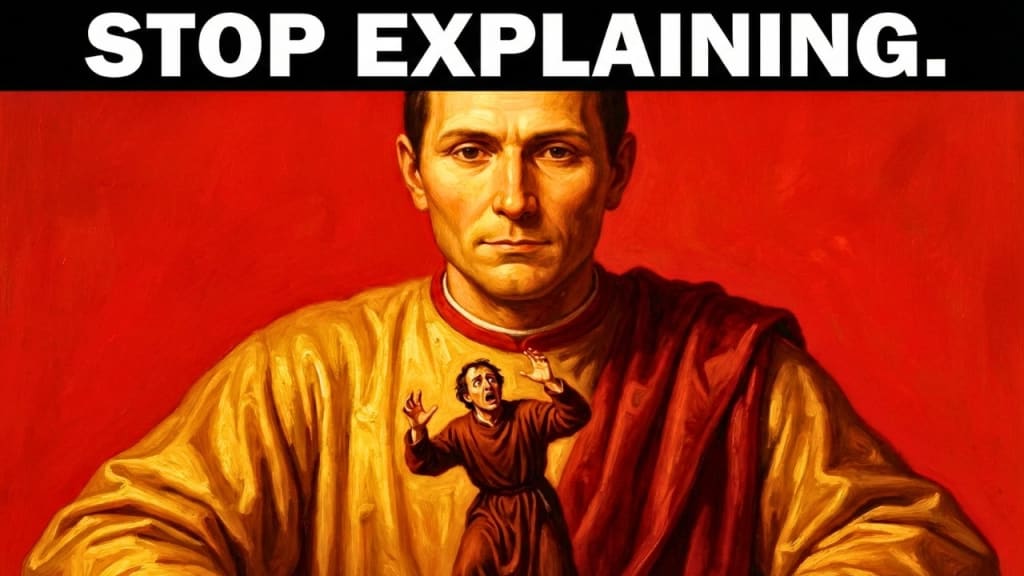
You've handed the other person the frame. You've acknowledged that your actions require their approval to make sense. And that acknowledgment is a tell.
Niccolò Machiavelli understood this before almost anyone put it into systematic thought. Writing in the early sixteenth century, surrounded by the wreckage of Italian city-states that had crumbled under weak princes and naive administrators, he was not interested in how power *should* work. He was interested in how it *does* work. And what he observed, again and again, was that the appearance of strength mattered as much as strength itself sometimes more.
In The Prince he wrote: "Men judge generally more by the eye than by the hand, because it belongs to everybody to see you, to few to come in touch with you." What he was pointing at wasn't mere vanity or political theatre. He was identifying something structural about the way humans process authority. Most people will never inspect your reasoning closely. They will never audit your motives or weigh your logic against competing evidence. They will read your posture. They will read whether you seem certain or uncertain. They will take cues from how you carry the weight of your own decisions.
When you explain yourself without being asked or when you over-explain after being challenged you are broadcasting uncertainty. You are, in effect, saying: I'm not sure this decision can stand on its own, so I'm going to prop it up with words. That's the psychology underneath it, even when the words themselves are intelligent and the reasoning is sound.
There's a particular kind of person who never seems to stop justifying themselves. They're in every organization, every family, every room. Something goes wrong and before anyone has even framed a question, they're already explaining cataloguing their intentions, listing the variables they couldn't control, constructing a verbal alibi. The explanation may be entirely accurate. That's almost beside the point. What they're communicating, underneath the facts, is anxiety. And anxiety, in any social or professional hierarchy, is contagious in exactly the wrong direction. It moves downward. It undermines.
Machiavelli's ideal prince did not operate this way. The prince Machiavelli envisioned was someone who understood the difference between being and appearing and who actively managed both. The fox who recognizes traps and the lion who frightens wolves: these were his two archetypes for political survival. Neither the fox nor the lion pauses to explain why it moves the way it moves. The fox is elusive by nature. The lion is formidable by nature. The explanation would only diminish both.
Abraham Lincoln took considerable criticism throughout his presidency that he simply absorbed without public rebuttal. His Secretary of War, Edwin Stanton, had once called him a "long-armed gorilla" and "a damned fool" before being appointed to the cabinet. When told about it, Lincoln said nothing in reply and kept Stanton in the role because Stanton was the best man for it. He didn't issue a statement. He didn't demonstrate magnanimity by announcing he had forgiven Stanton. He just acted. The silence around that decision was itself a form of power — it was total indifference to the insult combined with total confidence in his own judgment. Stanton, for his part, stood weeping at Lincoln's bedside the night he died and called him "the greatest ruler of men the world has ever seen." The silence had done what no explanation could have managed.
Napoleon Bonaparte was obsessive about the image he projected, and his famous *Bulletins de la Grande Armée* — the official dispatches he wrote after battles — were masterclasses in selective framing. When he lost, the losses were minimized or recontextualized. When he won, the victories were vivid and total. He was not explaining himself to his soldiers or his subjects; he was defining reality for them. The distinction matters. Explaining is reactive. Defining is active. Napoleon knew that if he allowed the narrative gap to open if he left space for others to frame what had happened the vacuum would fill with doubt. So he didn't leave a gap. He moved first, with certainty, and certainty is not a thing you can explain your way into. You have to project it.
The psychological mechanism here is well-established even if rarely named directly. When someone challenges you and you immediately respond with explanation, you are engaging in what amounts to an implicit concession that their challenge has standing that it deserves a response, that your position requires defense. The challenge gains weight from the fact that you took it seriously enough to answer it. This is how seemingly reasonable, intelligent people get pulled into debates they should never have entered, defending decisions that didn't need defending, justifying positions that were perfectly solid before the justification turned them fragile.
Machiavelli was not advising princes to be arrogant or stupid. He was advising them to be strategic about where they spent their credibility. Credibility is not an infinite resource. Every time you explain yourself, you are drawing on it. Sometimes that's worthwhile a key negotiation, a moment of genuine persuasion where the other person's understanding actually matters to the outcome. But most explanations are not this. Most explanations are social reflex, an anxious habit dressed up as transparency.
The prince who explained every decision invited scrutiny of every decision. Scrutiny, once invited, doesn't stay in the places you intended. It spreads. Machiavelli observed this in the trajectory of rulers who over-consulted, over-communicated, and over-justified: they trained their advisors and subjects to expect justification, and once that expectation was established, the absence of justification became its own provocation. The habit of explaining had created a dependency. That's the trap.
Deliberate ambiguity as distinct from mere silence is a different tool, and a subtler one. Elizabeth I of England was brilliant at this. When pressed on the question of marriage and succession, she refused to give a direct answer for decades, keeping her suitors and her court in a permanent state of uncertainty. Her ambiguity was not confusion; it was strategy. By never fully resolving the question, she retained the leverage that a clear answer would have dissolved. Machiavelli would have recognized the move immediately: she was keeping her options open while letting others exhaust themselves trying to read her. The explanation she never gave preserved a power that any explanation would have collapsed.
The same principle operates in far more ordinary contexts. A leader who announces every decision with a full rationale trains their team to negotiate with the rationale rather than the decision. People don't just accept the decision; they probe its logic, looking for weak points, because the leader has invited them to evaluate it. A leader who announces decisions with evident confidence and minimal commentary trains their team to engage with the decision as fact. Neither approach is inherently right for every situation. The point is that over-explaining is never neutral — it has consequences that most people haven't thought through.
There's a version of this idea that gets misunderstood as a license for arrogance or contempt, and that's not what Machiavelli was describing. He wasn't saying that a prince should be deaf to counsel or closed to information. He was extremely clear that good counsel was one of the prince's most valuable assets. The distinction was about when and where explanation serves you versus when it weakens you. Seeking good information is not the same as explaining yourself. Consulting advisors in private is not the same as justifying your choices to the crowd. The confusion between these things is where bad advice on this topic tends to come from.
What Machiavelli actually identified was the theater of power. In that theater, the audience doesn't need your script. They need to believe in your authority — and authority, unlike expertise, cannot be established through argumentation. You can argue someone into agreeing that you're right. You cannot argue someone into believing that you're powerful. Belief in power comes from the projection of certainty, from the consistent alignment between what you say you'll do and what you do, and from the visible absence of need for anyone else's approval.
Caesar's Commentarii de Bello Gallico is worth reading in this light. It's a political document as much as a military history, and its rhetorical genius is in its tone: calm, precise, third-person. Caesar doesn't explain his decisions with emotion or defensiveness. He describes them as if recording facts. His confidence is embedded in the grammar itself. He is not asking the reader to approve of what he did. He's simply reporting what happened. The implicit message is that the decisions required no justification they were obvious responses to obvious conditions, seen clearly by a man who sees clearly. The whole text is a masterclass in projecting competence without plea.
None of this means that silence is always the move. Silence in the wrong moment — when clarity is genuinely needed, when trust depends on communication, when a team is paralyzed without direction is not discipline. It's negligence. Machiavelli wasn't advocating for leaders who were cryptic to the point of uselessness. He was advocating for leaders who understood that every act of communication either builds or erodes their authority, and who made conscious choices about which they were doing.
The habit most people need to break is the reflexive one: the automatic reach for justification whenever they feel challenged or uncertain. That reflex is powered by anxiety, and anxiety to return to where this started is the thing you cannot afford to broadcast. When you feel the pull to explain yourself, the first question to ask is not *what should I say* but *why do I feel the need to say anything*. The answer to that question is almost always more useful than whatever explanation you were about to give.
Machiavelli wrote in a world where the wrong perception could get you killed, deposed, or exiled. The stakes in most contemporary situations are lower, but the mechanism is identical. People are reading you constantly, and what they're reading most closely is not your reasoning. They're reading your confidence. They're reading whether you seem to need something from them reassurance, approval, permission to be right.
Stop giving that read away. The most powerful thing in most rooms is the person who has nothing to prove and acts like it.
About the Creator
How Are Emerging Technologies Shaping the Future of Digital Finance?
The evolution of digital finance has transformed the way individuals and institutions interact with money, assets, and global markets. What once began as a niche technological experiment has grown into a rapidly expanding ecosystem filled with decentralized platforms, tokenized assets, and blockchain-powered applications.
By John Carter6 days ago in 01
Street Performers Around the World: How Busking Shapes Urban Culture
Street performers, also known as buskers, play a vital role in shaping urban culture across the world. As highlighted by Devon Alexis, street performance transforms everyday public spaces into creative hubs where music, art, and human connection come together. From busy city squares to subway platforms, busking offers travelers a unique way to experience the authentic cultural energy of a destination. For those seeking immersive travel experiences, exploring cities through their street performers reveals a deeper, more unfiltered side of urban life.
By Devon Alexisabout 19 hours ago in 01




Comments
There are no comments for this story
Be the first to respond and start the conversation.