
Does AI Use Water?
The Surprising Environmental Cost Nobody Talks About

I've spent 27 years in the tech industry watching trends emerge before the mainstream catches on. Right now, one of the most important conversations happening in AI isn't about intelligence, creativity, or jobs. It's about water.
Yes, water.
As someone who builds AI-powered tools and consults on AI strategy daily, I felt it was time to give an honest, clear answer to the question I'm seeing everywhere: does AI use water?
The short answer is yes — and the amount will genuinely surprise you.
How Does AI Use Water?
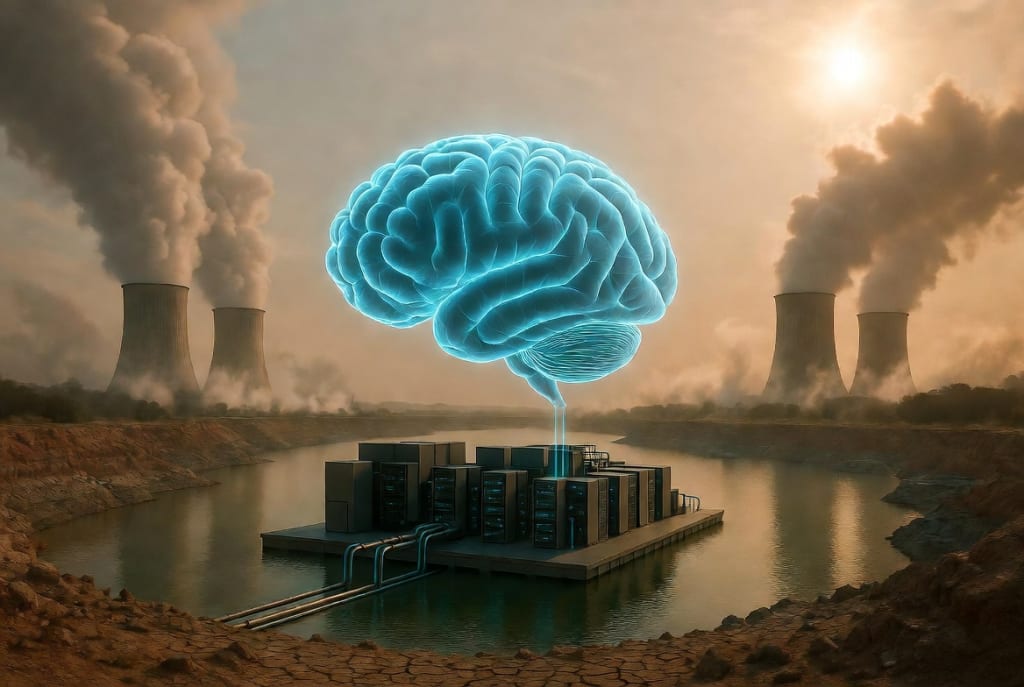
Artificial intelligence doesn't drink water the way humans do. But the data centers that power AI models — the massive warehouse-sized facilities running millions of calculations every second — generate enormous amounts of heat. That heat has to go somewhere.
The primary cooling method for most large data centers is evaporative cooling, which works essentially like a giant industrial swamp cooler. Hot air passes over water, the water evaporates, and the system cools down. Simple physics — but at an almost incomprehensible scale.
Every time you open ChatGPT, ask Google Gemini a question, generate an image, or run a search through Perplexity, you're triggering a chain of computation that produces heat, which requires cooling, which consumes water.
There's also a second, less discussed way AI uses water: the power plants generating the electricity that data centers run on. Thermoelectric power plants — coal, natural gas, and nuclear — use water for steam generation and cooling too. So AI's water footprint is actually double: once at the data center, once at the power source.
How Much Water Does AI Use?
This is where the numbers get genuinely staggering.
A single conversation with ChatGPT — back and forth, maybe 20 to 50 questions — is estimated to consume roughly 500 milliliters of water. That's a standard plastic water bottle. Per conversation.
Researchers at the University of California, Riverside studied Microsoft's water consumption and found that training GPT-3 alone consumed approximately 700,000 liters of fresh water. That's enough to produce around 370 BMW cars on a traditional manufacturing line.
Google reported that its data centers consumed over 5.6 billion gallons of water in a single recent year — a figure that has grown sharply alongside the expansion of its AI infrastructure.
Microsoft's global water consumption increased by 34% in a single year, a spike the company directly attributed to AI development.
Meta and Amazon have reported similar trends — significant increases in water usage directly tied to AI workloads.
And these are just the numbers companies are publicly reporting. Independent researchers believe actual consumption is considerably higher.
Why This Matters More Than You Think
Here's the part of the conversation that rarely gets covered.
Data centers aren't built in the middle of the ocean. They're built near communities — and they compete with those communities for local water resources. Many of the largest AI data centers in the United States are located in regions already experiencing water stress: the American Southwest, parts of the Southeast, and the Pacific Northwest during drought years.
When a hyperscale data center draws millions of gallons from a local aquifer or municipal water system, that water isn't available for agriculture, for drinking, or for local ecosystems. In drought-prone regions, this is not a hypothetical future problem. It's happening now.
There's also the temperature problem. Water used in evaporative cooling is returned to local waterways warmer than it was withdrawn. Warmer water holds less oxygen, disrupts aquatic ecosystems, and accelerates algae growth. The environmental ripple effects extend well beyond the raw volume consumed.
Is AI Bad for the Environment Because of Water?
This is a genuinely nuanced question, and I want to give you a straight answer rather than a corporate-approved hedge.
AI has enormous potential to help environmental challenges — optimizing energy grids, accelerating climate research, improving agricultural water efficiency. The technology itself is not inherently destructive.
But the current trajectory of AI development — racing to build larger models, more data centers, and faster infrastructure — is consuming natural resources at a rate that most environmental frameworks weren't designed to account for.
The honest answer is: it depends entirely on how we build and power AI going forward.
The industry is aware of the problem. Microsoft, Google, and Amazon have all made public commitments to water positivity — meaning they plan to return more water to watersheds than they consume by 2030. Renewable energy and more efficient cooling technologies are actively being developed.
But commitments and timelines are not the same as results. And the demand for AI compute is growing faster than the efficiency improvements being deployed.
What Can You Do?
As an individual user, your direct impact is small — but your voice as a consumer, investor, or business decision-maker is not.
If you're choosing between AI vendors or cloud providers for your business, water stewardship reports and sustainability commitments are now a legitimate factor to evaluate. Companies like Google, Microsoft, and Amazon publish annual sustainability reports that include water consumption data.
If you're building AI tools or products, the cloud region you deploy to matters. Some regions have more water-stressed infrastructure than others. Choosing providers committed to renewable energy and water recycling systems is a meaningful choice.
And if you're simply curious — which the 22,000+ people searching this question every month clearly are — staying informed is step one. The conversation about AI's environmental footprint is just beginning, and it's one worth paying close attention to.
The Bottom Line
Does AI use water? Absolutely — more than most people realize, and more than the industry has been transparent about.
How does AI use water? Primarily through evaporative cooling in data centers and through the power plants generating the electricity those data centers consume.
How much water does AI use? Enough that it's already a measurable strain on local water resources in multiple regions, with consumption growing year over year as AI adoption accelerates.
The technology reshaping our world has a physical footprint. Understanding that footprint — honestly, clearly, without either panic or dismissal — is how we make better decisions about how we build, deploy, and regulate AI going forward.
About the Creator
Sandy Rowley
AI SEO Expert Sandy Rowley helps businesses grow with cutting-edge search strategies, AI-driven content, technical SEO, and conversion-focused web design. 25+ years experience delivering high-ranking, revenue-generating digital solutions.
Keep reading
More stories from Sandy Rowley and writers in 01 and other communities.
The Fascination with Luxury Timepieces and the Rise of Replica Culture
Luxury watches have long represented more than just a way to tell time—they symbolize craftsmanship, prestige, and personal identity. Brands like Richard Mille and Panerai have cultivated global admiration through innovation, design, and heritage. However, alongside this admiration, a parallel market has emerged that reflects a different kind of consumer interest: the growing demand for replicas. Terms such as Richard Mille watches (理查德米勒手錶 ), high replica Richard Mille (高仿理查德米勒 ), Panerai watches(沛納海手錶), high replica Panerai (高仿沛納海), and replica Panerai (復刻沛納海 ) are increasingly searched online, highlighting a complex shift in how people engage with luxury.
By charliesamuel3 days ago in 01
A Beginner’s Guide to the Cryptocurrency Market
Cryptocurrency has become one of the most discussed topics in the financial world over the past few years. With the rise of digital assets, more people are exploring how blockchain technology is reshaping the way we think about money, investments, and online transactions. From individual investors to large institutions, the interest in crypto continues to grow steadily.
By Nimra kanwalabout an hour ago in 01




Comments
There are no comments for this story
Be the first to respond and start the conversation.