
DeFi Platform Development: How Secure Decentralized Finance Products Are Built
Find out how DeFi platforms are designed, built, and launched—from protocol logic to real-world deployment.
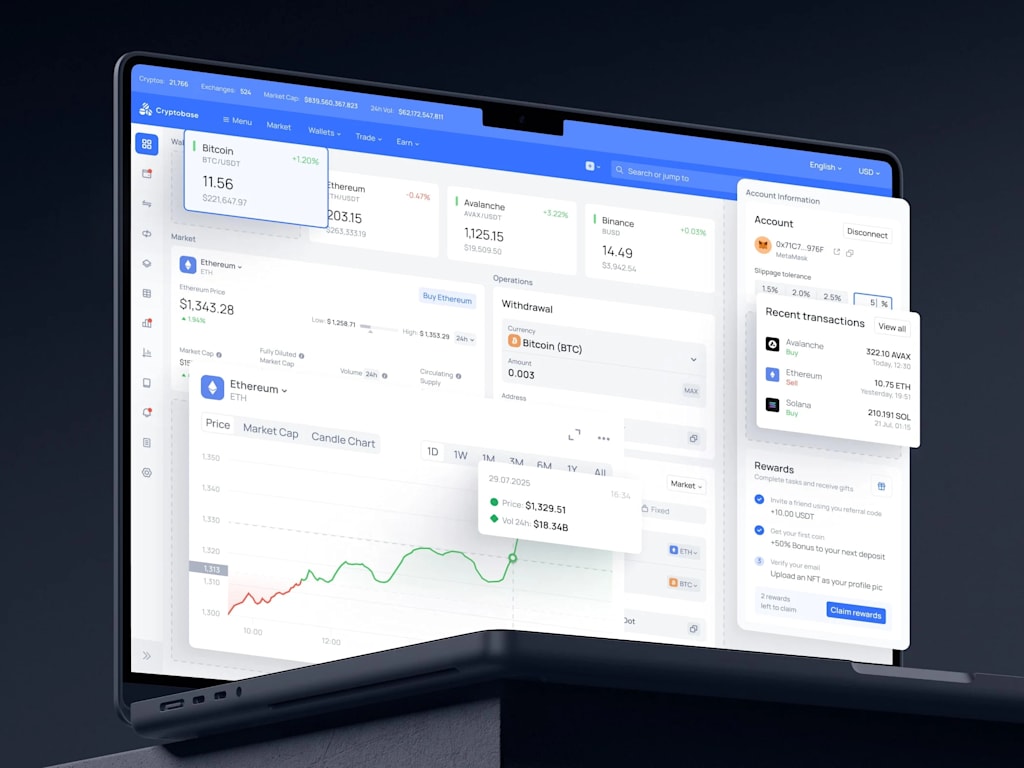
Building products in Web3 is less about chasing trends and more about designing systems that can operate without a central authority. That sounds elegant in theory. In practice, it means every important decision—asset movement, pricing, collateral, rewards, access—has to be defined in code and exposed to real users without much room for error.
A DeFi platform is not just a wallet connection and a polished dashboard. It is a financial mechanism running on smart contracts, supported by frontends, nodes, price feeds, liquidity pools, and a lot of careful engineering. If one part is weak, the product may still launch—but it will not hold up for long.
What Is a DeFi Platform?
A DeFi platform is a blockchain-based financial product where the core rules live in smart contracts rather than in a private backend controlled by a company. Users connect wallets, approve transactions, and interact with protocol logic directly.
That changes the structure of the product. In a traditional financial app, custody, execution, and records are usually controlled by one operator. In DeFi, those responsibilities are split. Users keep their assets in wallets, contracts define the rules, and the blockchain confirms execution.
Main Types of DeFi Products
Most DeFi platforms fall into a few familiar categories.
Decentralized Exchanges
DEXs allow users to swap assets directly from their wallets. The difficult part is not the interface. It is liquidity design, swap logic, slippage handling, and price behavior under uneven demand.
Lending and Borrowing Platforms
These systems let one group of users supply assets while another borrows against collateral. The platform must track deposits, interest, collateral ratios, and liquidations without manual intervention.
Staking and Yield Products
These products reward users for locking assets or providing liquidity. The logic may look straightforward on the surface, but reward calculation, lock-up conditions, and token incentives can become surprisingly complex.
Core Components of a DeFi Platform
Most platforms are built from the same technical building blocks.
Smart Contracts
Smart contracts define how funds move, how interest is calculated, how swaps are executed, and what happens when positions become unsafe. If the logic is flawed, the product is flawed.
Wallet Integrations
Wallets replace user accounts. They act as identity, approval mechanism, and transaction signer. If wallet flows are unclear or unreliable, the product quickly becomes difficult to trust.
Liquidity Infrastructure
Many DeFi products depend on liquidity pools rather than direct matching between users. That affects pricing, borrowing capacity, and transaction efficiency.
Frontend Application
The frontend does not control the protocol, but it does control how understandable the protocol feels. In DeFi, that matters more than many teams expect.
How DeFi Platform Development Usually Works
The process starts with protocol design, not visuals. First, the team defines the financial model: what the product does, how assets move, what risks exist, and which rules belong in contracts.
After that comes UX/UI design. DeFi interfaces have to explain balances, approvals, positions, fees, and risk states clearly. Otherwise users make avoidable mistakes.
Then comes smart contract development, testing, and security review. This is where most of the product’s real complexity lives. Contracts have to be tested against both normal use and edge cases, then audited before launch.
The next layer is integration: blockchain nodes, oracles, wallet providers, analytics, and sometimes cross-chain infrastructure. Only after these pieces are stable does launch become realistic.
Common Challenges in DeFi Development
The biggest problem is not that DeFi is experimental. It is that the system is unforgiving.
A small contract bug can become a public exploit. Liquidity can dry up when the product needs it most. Network fees can make normal actions feel broken. Cross-chain support adds another layer of fragility. And regulation remains inconsistent across markets.
Most failed DeFi products do not collapse because of one dramatic mistake. They weaken through a series of small structural errors.
Why Experience Matters
DeFi platforms handle real assets, real incentives, and real risk. That means teams cannot rely on the usual startup habit of polishing things after launch. By then, the most important decisions are already on-chain.
This is why experience in financial systems matters alongside blockchain expertise. Products in fintech and DeFi may use different infrastructure, but they share the same requirement: the system has to behave correctly when money is involved.
Final Thoughts
A DeFi platform is not just a blockchain app with extra terminology. It is a financial product whose logic, risks, and user flows must be designed with unusual precision.
The real job is not simply getting the product live. It is making sure the contracts, liquidity model, integrations, and interface still make sense once real users arrive. That is what separates a demo from a platform people can actually trust.
About the Creator
Keep reading
More stories from Valeriia Shulga and writers in 01 and other communities.
Building a Secure Crypto Wallet App: Architecture, Security, and Real-World Challenges
Most teams don’t start with the idea of building a wallet. They arrive there because their product suddenly needs one. A trading platform launches, a DeFi feature goes live, or a payment flow gets added — and now users need a place to hold assets. That’s usually when wallet development becomes part of broader blockchain product work, where multiple components have to interact reliably.
By Valeriia Shulga5 days ago in 01
Rooted in Principle, Ready for the Digital Age: The Story of ADNTC
Is this arrangement designed for me, or for them? In most conventional models, the honest answer tends to favour the house. Premiums come in, claims go out, and the gap between them becomes profit. The policyholder is a customer. The company is a business. The relationship is transactional.
By Mathew Davis3 days ago in 01



Comments
There are no comments for this story
Be the first to respond and start the conversation.