
AR Property Tours: Why They're Standard in 2026
How augmented reality transformed real estate marketing from a luxury novelty into an essential industry standard for modern buyers

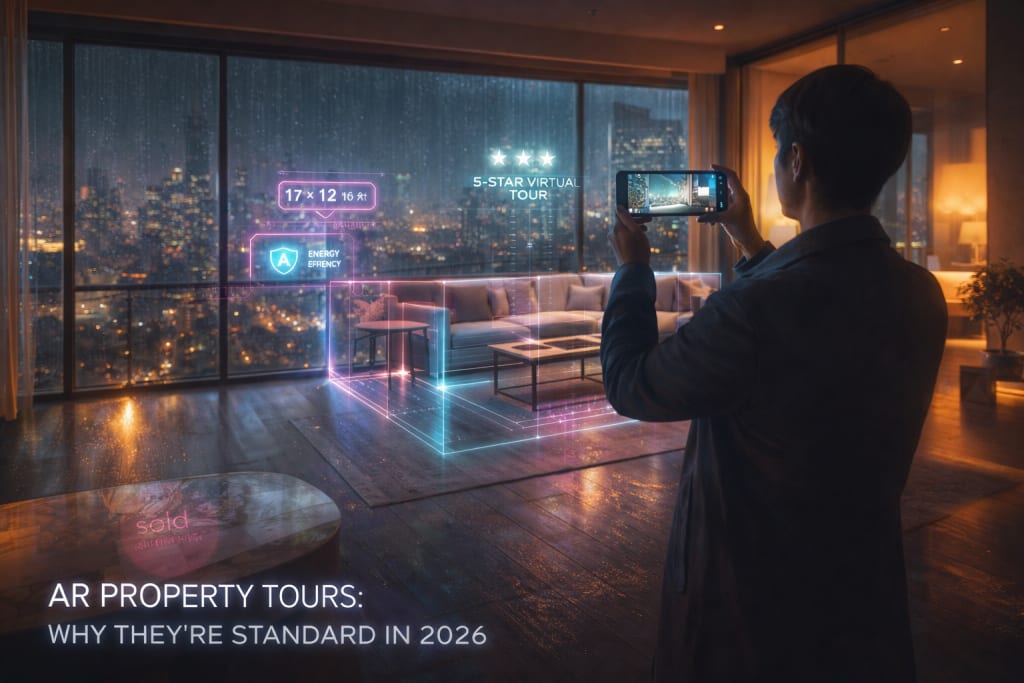
Real estate markets in 2026 follow a specific philosophy. It is "digital-first and physical-last." For today’s buyers, AR property tours are no longer a luxury. High-end boutique agencies used to offer them as perks. Now, they are the baseline expectation for every buyer. If a listing lacks an interactive layer, it fails. Modern buyers often filter out these static listings immediately. Human agents might never even receive a notification for them. This shift is a massive change in property marketing. It is as big as moving from newspapers to portals.
This evolution stems from two main factors. First, AR hardware is now very accessible to everyone. Second, buyer psychology has changed significantly. In 2026, the friction of "imagining" a space is gone. Buyers might look at an empty new construction shell. They might look at a fully furnished resale home instead. In both cases, augmented reality provides necessary visual proof. It moves the buyer from interest toward firm intent.
The 2026 Landscape: Beyond the Static Gallery
The landscape in early 2026 is very clear. Data from major real estate aggregates proves this point. Listings with AR components get 4.5 times more engagement. This is compared to traditional 2D photography alone. The era of the "fisheye lens" photo is over. These old photos often distorted the actual space.
Virtual tours in 2024 had a major problem. They were too passive for the modern user. You could look around a room easily. However, you could not interact with the environment. In 2026, AR property tours change this experience. Users can now toggle different finishings in real-time. You can swap laminate flooring for reclaimed oak instantly. The system uses spatial anchoring for better accuracy.
Buyers can drop their actual furniture into a digital twin. This allows them to check for a perfect fit. The tours also include time-of-day simulations. Users view accurate natural light patterns in the rooms. The system uses specific GPS coordinates for this task. It also accounts for the current local season.
This shift has fixed a long-standing pain point. That point is known as "Showing Fatigue." Real estate professionals reported a trend in late 2025. The number of physical walkthroughs has dropped by 60%. Buyers now use AR to "disqualify" certain properties. They remove homes that do not fit their needs. Buyers are 90% convinced when they arrive on-site.
Why AR Became the Universal Standard
AR became the standard because of two technical shifts. First, "Wearable Passthrough" devices saw widespread adoption. These devices overlay digital data onto the real world. Second, web-based AR became highly optimized. It no longer requires a separate app download.
1. The Democratization of Visualization
Physical staging used to cost thousands of dollars. In 2026, "Digital Staging 2.0" offers a better way. Agents can offer multiple "themes" for one property. An empty condo can look like a minimalist office. It can also look like a cozy nursery room. The same space can become a high-tech media room. This depends entirely on the profile of the buyer. Physical furniture could never offer this level of variety.
2. Radical Transparency in Construction
AR is a lifesaver for the pre-construction sector. It helps with both marketing and legal compliance. Builders use AR overlays on empty land lots now. They show exact views from a 15th-floor balcony. This happens before the foundation is even poured. It has reduced many post-purchase disputes. Buyers no longer complain about obstructed views. Layout misunderstandings have also decreased significantly.
3. The Integration of Localized Tech Expertise
These complex systems require very strong backend support. Firms want to scale these immersive experiences quickly. Many now partner with experts for help. They look for Mobile App Development in St. Louis. These developers ensure that AR layers remain lag-free. High-fidelity visuals must work on every user device. Smooth performance is key to maintaining buyer trust.
Real-World Application: Resale vs. New Construction
AR utility changes based on the asset class. However, the total value remains very consistent.
In Resale: Buyers use AR to "strip away" clutter. They can hide a current owner's ugly wallpaper. It allows them to see the "bones" of the house. NAR conducted a survey in 2025. It showed that 72% of buyers felt more confident. They made more offers on "fixer-upper" homes. They used AR overlays to see the renovated version.
In New Construction: Sales centers have ditched model homes. Physical models are expensive to build and maintain. They use "Ghost Suites" instead. These are empty rooms where AR glasses work. The tech populates every detail of the home. It shows everything from crown molding to appliances.
AI Tools and Resources
Matterport Axis — A motorized mount and capture system
- Best for: High-fidelity digital twin creation for residential listings
- Why it matters: Automates spatial mapping for accurate AR overlays
- Who should skip it: Low-budget, short-term rental listings with 2D needs
- 2026 status: Now features "Live-Link" for remote guided AR tours
Planner 5D AR Pro — Professional-grade interior visualization tool
- Best for: Agents providing renovation potential tours to buyers
- Why it matters: Allows for instant wall-removal and structural changes
- Who should skip it: Luxury listings that are already professionally staged
- 2026 status: Fully integrated with major MLS platforms for viewing
Google Geospatial Creator — World-scale AR content placement
- Best for: Commercial real estate and neighborhood context visualization
- Why it matters: Shows where future developments like parks will be
- Who should skip it: Single-family homes in established, static neighborhoods
- 2026 status: Active with updated 2026 urban planning data layers
Risks, Trade-offs, and Limitations
AR has revolutionized the industry in many ways. However, it is not a perfect solution for everyone. Misuse of the technology can cause legal friction.
When AR Visualization Fails: The "Beauty Filter" Trap
A common failure occurs in 2026 quite often. Agents use AR to hide major material defects. They should use it to show potential instead.
- Warning signs: The AR overlay is mandatory for viewing. The digital version may alter the perceived scale. It might use "thin" furniture to look larger.
- Why it happens: Agents over-optimize for higher click-through rates. This leads to a "Catfishing" effect for the buyer. The physical reality then becomes a major disappointment.
- Alternative approach: Use "Split-View" AR for better transparency. The digital overlay only occupies half the screen. Users can toggle it on or off instantly. This keeps a clear distinction between the current state and the potential future state.
Hardware Fragmentation is another critical limitation. Most mid-range phones in 2026 handle AR well. However, users on older devices may experience "drift." Digital furniture might appear to float in the air. It might slide across the floor unexpectedly. This breaks the immersion for the potential buyer. It creates a sense of instability in their mind. This feeling can transfer to the property’s quality.
Key Takeaways for 2026
- Expectation is Reality: Buyers no longer see AR as optional. They must visualize their life in the home digitally. Otherwise, they will move to the next listing.
- Reduced Friction: AR property tours act as a filter. They ensure physical showings go to serious leads. These leads are already pre-qualified and interested.
- Accuracy Over Aesthetics: Successful AR prioritizes spatial accuracy. True-to-life lighting is better than glossy renders. Buyers trust realistic visuals over artistic ones.
- Infrastructure Matters: Success depends on the quality of the app. The AR environment must be stable at all times. Working with specialized developers is essential for firms. It helps maintain brand authority in a tech market.
About the Creator
Keep reading
More stories from Devin Rosario and writers in 01 and other communities.
Mindfulness App Development: Converting Wellness Seekers
The 2026 Wellness Shift: Beyond the "Breathe" Prompt Mindfulness app development has undergone a radical transformation. As of early 2026, the market has changed. It moved past the "content library" phase. This phase was dominated by pioneers like Calm and Headspace.
By Devin Rosario9 days ago in 01
Asset Tokenization Platform Development: Democratizing Wealth Creation in 2026
In 2026, financial systems are going through a structural shift as digital ownership models gain wider acceptance. One of the most significant developments in this space is asset tokenization, which is gradually changing how individuals and institutions access, trade, and manage assets. The concept is simple in principle but far-reaching in its impact. Physical and financial assets are converted into digital tokens on a blockchain network, allowing fractional ownership, easier transfer, and wider participation.
By Ethan hunt2 days ago in 01



Comments
There are no comments for this story
Be the first to respond and start the conversation.